
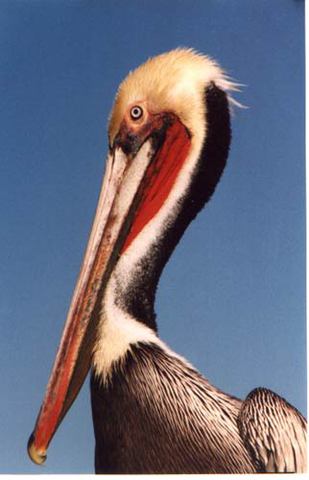
How to identify the Brown Pelican
Pelecanus occidentalis
Spotted a bird? Identify it instantly with the Birdby app
Open the appTo correctly identify the Brown Pelican (Pelecanus occidentalis), check each of these features. Birds can be tricky: habit, habitat, and call often confirm a sighting that a single photo cannot.
Size at a glance
- Length
- 106-137 cm (42-54 in)
- Wingspan
- 1.83-2.5 m (6-8.2 ft)
- Weight
- 2.7-5.0 kg (6-11 lbs)
Physical features to check
- 1
Plumage
Overall feather coloration and pattern.
Adults have a dark gray-brown body, a white neck, and a pale yellow wash on the head. The back of the neck is dark chestnut-brown during breeding season. Non-breeding adults have a white neck and head with a yellowish wash. Juveniles are duller, with a grayish-brown head and neck and a pale belly.
- 2
Beak shape
Shape and color of the bill: a key field mark.
Long, flattened, and straight bill with a large, distensible gular pouch underneath. The bill is grayish-pink to yellowish in non-breeding adults, becoming brighter yellow and reddish-orange at the tip during breeding.
- 3
Eye color
Iris color and any distinctive eye markings.
Pale yellow to white
- 4
Leg color
Leg and foot color.
Dark gray to blackish
- 5
Distinguishing features
Standout features that separate this species.
Large size, distinctive plunge-diving behavior, prominent gular pouch, and the unique head and neck coloration patterns that vary with age and season.
- 6
Juvenile appearance
How young birds differ from adults.
Juveniles are uniformly dull grayish-brown on the head, neck, and upperparts, with a pale, often whitish, belly. They lack the distinct white neck and yellow head of adults.
- 7
Seasonal changes
Plumage variation between breeding and non-breeding seasons.
During the breeding season, adults develop a rich chestnut-brown hindneck and a brighter yellow wash on the crown. The gular pouch and bill also become more intensely colored with yellow, orange, and reddish hues. Outside of breeding, the hindneck is white, and the head is mostly white with a pale yellow wash.
- 8
Sexual dimorphism
How males and females differ.
Males are generally slightly larger than females, but plumage is identical.
Key field marks
- Plunge-diving behavior. The most distinctive identification feature. No other pelican species or large coastal bird regularly dives headfirst into the water from significant heights to catch fish.
- Overall coloration. Dark brown body, contrasting with a white neck and yellowish head (adults). Juveniles are uniformly dull brown.
- Bill and Pouch. The very long bill with a large, expandable gular pouch is unmistakable. Note the color changes with age and season.
- Flight profile. Flies with slow, deep wingbeats, often in V-formations or single lines, frequently gliding low over the water. The long neck is typically tucked back in an S-curve during flight, unlike herons which fly with their necks extended.
Explore the Brown Pelican
Identify birds anywhere
Free on iOS, Android, and Web. Photo & sound identification, full species database, and your personal life list.