
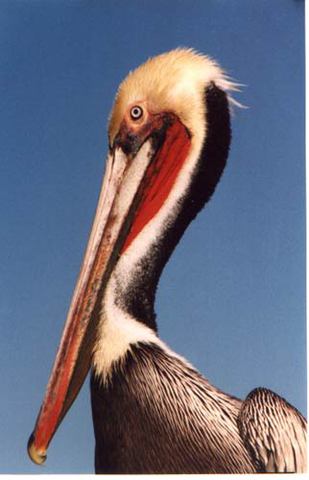
Where does the Brown Pelican live?
Pelecanus occidentalis
Spotted a bird? Identify it instantly with the Birdby app
Open the appThe Brown Pelican lives in specific habitats and regions. Knowing where, and when, to look improves your chances of a successful sighting.
Biomes
Coastal marine environments, estuaries, lagoons, and large bays.
Geographic range
Coastal areas of North, Central, and South America. From Nova Scotia (rarely) and Maryland south along the Atlantic and Gulf Coasts of the U.S., throughout the Caribbean, and south to the Amazon River in Brazil. On the Pacific Coast, from British Columbia (rarely) and Washington south through California, Mexico, Central America, and down to Chile.
Preferred environments
Shallow coastal waters, sandy beaches, rocky shores, mangrove swamps, and offshore islands for nesting and roosting. They require calm, fish-rich waters for feeding.
Elevation range
Primarily sea level, rarely found inland.
Where to look
Coastal beaches and jetties
Often seen perched on pilings, jetties, or along sandy beaches, especially where fishing boats are active.
Estuaries and bays
Look for them fishing in shallow, protected coastal waters, particularly where schooling fish are present.
Offshore islands and mangrove swamps
These are preferred nesting and roosting sites, though access may be restricted during breeding season.
Field tips
- Watch for feeding activity. Their spectacular plunge-diving is a key indicator of their presence. Look for birds circling high above the water before diving.
- Scan coastal structures. They frequently perch on man-made structures like piers, docks, and channel markers, offering excellent viewing opportunities.
- Observe flocks. Brown Pelicans are social; where you see one, you're likely to see more, often flying in characteristic lines or V-formations.
Migration
Northern populations (e.g., those breeding in the Carolinas) are migratory, moving south for the winter. Southern populations are largely resident or undertake short-distance dispersal movements. Juveniles often disperse widely after fledging.
Explore the Brown Pelican
Identify birds anywhere
Free on iOS, Android, and Web. Photo & sound identification, full species database, and your personal life list.