
Spotted a bird? Identify it instantly with the Birdby app
Open the appAbout
The Common Pheasant is a large, long-tailed game bird native to Asia and parts of Europe, widely introduced across the globe for hunting and ornamental purposes. Males are strikingly colorful with iridescent plumage, while females are camouflaged in duller brown tones. They are primarily ground-dwelling birds, known for their distinctive crowing call and powerful, albeit short, flight.
Size & lifespan
- Length
- Male: 60-89 cm (including tail of 35-50 cm); Female: 50-63 cm (including tail of 20-25 cm)
- Wingspan
- 70-90 cm
- Weight
- Male: 0.9-1.5 kg; Female: 0.7-1.1 kg
- Lifespan
- 1-3 years in the wild, up to 7 years in captivity
- Diet
- Omnivore
Physical characteristics
- Plumage
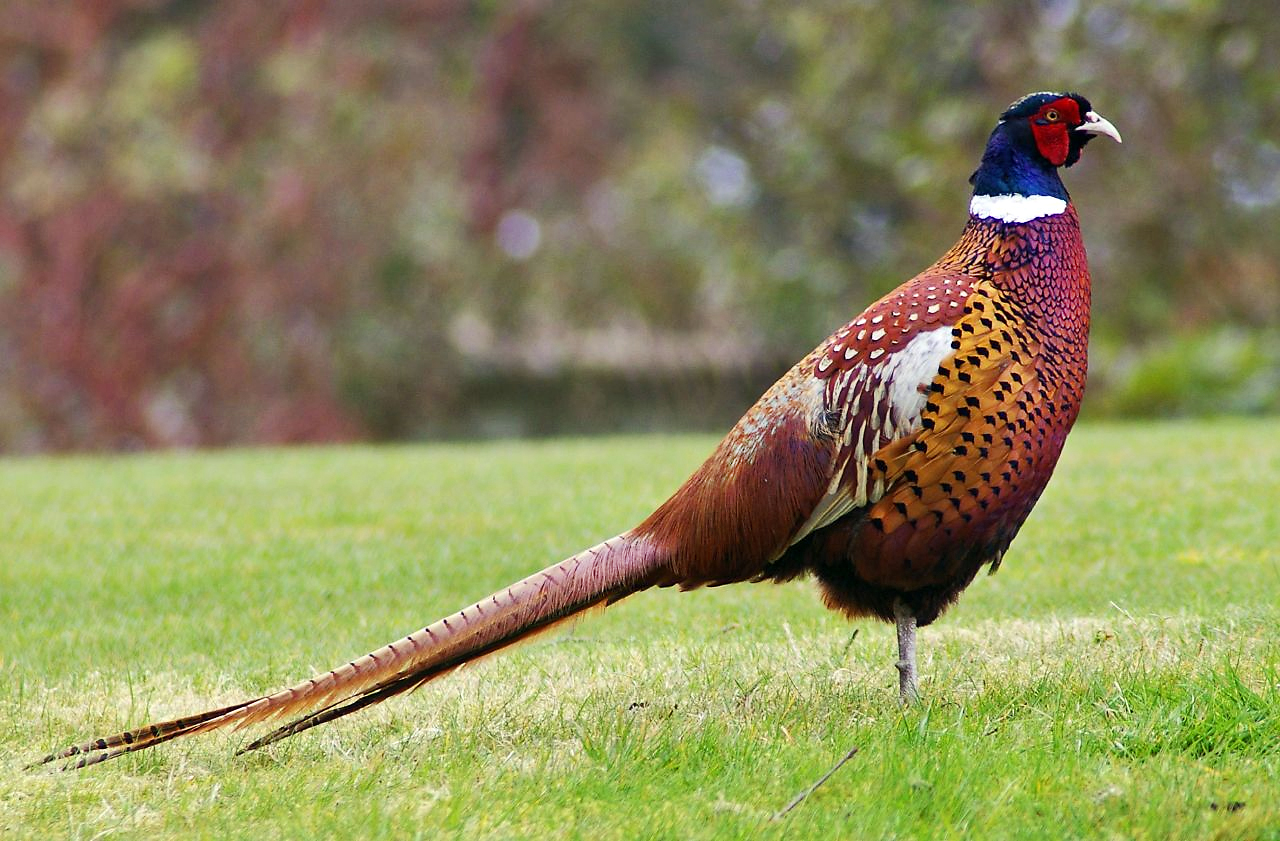
- Males (cocks) are highly variable due to extensive hybridization and subspecies, but typically feature a glossy green head, red wattles around the eyes, and often a white neck ring. The body plumage is a rich coppery-brown with iridescent purple, green, and gold flecks, barred with black. The long, pointed tail is barred brown and black. Females (hens) are cryptically colored, predominantly mottled brown and black with a shorter tail, providing camouflage.
- Beak shape
- Short, stout, conical, and horn-colored to yellowish-brown.
- Eye color
- Brown to dark brown.
- Leg color
- Greyish-brown to dark grey, with males possessing a spur on the tarsus.
- Distinguishing features
- Males are unmistakable with their vibrant plumage, long tail, and red facial wattles. The white neck ring is a common, but not universal, feature. Females are distinguished from other game birds by their relatively long, pointed tail and mottled brown plumage.
- Juvenile appearance
- Juveniles resemble adult females but are generally smaller and have shorter tails. Young males gradually acquire their adult male plumage over their first year, starting with hints of color and developing wattles.
- Seasonal changes
- No significant seasonal plumage changes in adults. Plumage remains consistent year-round, though males' wattles may appear more vibrant during the breeding season.
- Sexual dimorphism
- Pronounced sexual dimorphism. Males are significantly larger, much more colorful, and possess a very long tail and facial wattles. Females are smaller, duller, and have a shorter tail.
How to identify
- 1
Male Plumage
Look for the iridescent green head, red facial wattles, and coppery-brown body with black barring. The presence or absence of a white neck ring can vary but is a common feature in introduced populations.
- 2
Female Plumage
Observe the mottled brown and black plumage, which provides excellent camouflage. Note the relatively long, pointed tail compared to other ground-dwelling birds.
- 3
Tail Length
Both sexes have long, pointed tails, but the male's tail is significantly longer and more prominent, often accounting for more than half of its total body length.
- 4
Call
Listen for the male's distinctive, harsh 'kok-kok!' or 'ko-ORRK!' call, often accompanied by wing-whirring, especially during spring.
- 5
Behavior
Watch for their ground-dwelling habits, foraging by scratching the soil. When startled, they typically run into cover or take off with a sudden, noisy burst of flight.
Habitat & range
- Biomes
- Grasslands, agricultural fields, open woodlands, scrubland, hedgerows, marshes, and forest edges.
- Geographic range
- Native to Asia (from the Caucasus and Black Sea to China, Korea, and Japan) and parts of Europe. Widely introduced and naturalized across Europe, North America, Australia, and New Zealand.
- Elevation range
- Typically found from sea level up to 3,000 meters, depending on the region and availability of suitable habitat.
- Preferred environments
- Prefers mosaic landscapes with a mix of dense cover (for roosting and nesting), open areas (for foraging), and water sources. Often found near agricultural land, hedgerows, and woodland fringes.
Behavior
- Activity time
- Diurnal, most active during early morning and late afternoon, often roosting in dense cover during midday.
- Feeding habits
- Forages primarily on the ground, scratching and pecking for food. Diet includes seeds, grains, berries, roots, leaves, insects, worms, and small reptiles. They are opportunistic feeders, adapting their diet to seasonal availability.
- Social behavior
- Generally solitary or found in small groups outside the breeding season. During the breeding season, males are territorial and polygynous, attracting a harem of females. Females are solitary during nesting and chick-rearing.
- Flight pattern
- Strong, rapid, and noisy flight, characterized by fast wing beats, especially during take-off. Flight is typically low and direct over short distances. They prefer to run or hide rather than fly when disturbed.
- Migration pattern
- Resident; non-migratory throughout its range. Local movements may occur in response to food availability or hunting pressure.
- Territoriality
- Males are highly territorial during the breeding season, defending an area against rival males with aggressive displays and fights. They establish territories that encompass foraging areas and suitable nesting sites for their harem.
Song & calls
- Song
- The male's primary vocalization is a loud, harsh, two-syllable 'kok-kok!' or 'ko-ORRK!' often followed by a rapid wing-whirring display. This call serves as a territorial advertisement and attracts females.
- Call
- Females have a softer, clucking call, especially when with chicks. Both sexes may emit alarm calls, a sharp 'kek-kek-kek' when startled.
- When they vocalize
- Males call most frequently during the breeding season (spring and early summer), particularly at dawn and dusk. Alarm calls can be heard year-round when birds are disturbed.
Breeding & reproduction
- Breeding season
- Typically April to June, varying by geographic location.
- Nesting habits
- Nests are shallow scrapes on the ground, often concealed in dense vegetation, tall grass, hedgerows, or at the base of shrubs. The nest is lined with grass, leaves, and feathers.
- Clutch size
- 8-15 eggs, though larger clutches can occur, sometimes due to 'dump nesting' by multiple females.
- Egg description
- Eggs are olive-brown to pale blue-green, unspotted, and oval-shaped. Approximately 45 x 36 mm.
- Incubation period
- 23-26 days, primarily by the female.
- Fledging period
- Chicks are precocial and leave the nest shortly after hatching. They can fly short distances at 10-12 days old and are independent at 10-12 weeks.
- Parental care
- Only the female cares for the eggs and raises the young. Males play no role in parental care after mating.
Where to find
Agricultural Areas
Often found in fields of corn, wheat, and other crops, especially near field edges and hedgerows that provide cover.
Open Woodlands and Forest Edges
They utilize the transition zones between forests and open areas, where they can find both cover and foraging opportunities.
Scrubland and Hedgerows
Dense shrubbery and hedgerows offer crucial protection from predators and harsh weather, as well as roosting sites.
Marshes and Wetlands
Some populations inhabit marshy areas with tall reeds and grasses, particularly in regions where such habitats are abundant.
Field tips
- Listen for Calls. The male's loud crowing call is often the first indication of a pheasant's presence, especially at dawn and dusk during the breeding season.
- Look for Movement in Cover. Pheasants are masters of camouflage. Scan dense vegetation, tall grass, and hedgerows for subtle movements or the distinctive shape of a pheasant's head or tail.
- Check Field Edges. They frequently forage along the edges of agricultural fields, where they can quickly retreat into cover if disturbed.
- Early Morning/Late Afternoon. These are their most active foraging times, increasing your chances of spotting them out in the open.
- Roadsides. In some areas, pheasants can be seen foraging along roadsides, particularly in rural settings.
Similar species
Green Pheasant
Phasianus versicolor
Native to Japan. Males have a predominantly dark green plumage on the breast and mantle, lacking the coppery-red tones of the Common Pheasant. They also typically lack a white neck ring. Females are very similar and difficult to distinguish in the field.
Reeves's Pheasant
Syrmaticus reevesii
Males are much larger with an exceptionally long, barred tail (up to 1.5 meters). They have a distinctive white head with a black mask and a golden-scaled body plumage. Females are also larger than Common Pheasant hens and have a more distinctly patterned plumage.
Ring-necked Pheasant (subspecies group)
Phasianus colchicus colchicus group
Many introduced populations of Common Pheasant are often referred to as 'Ring-necked Pheasants' due to the prominent white neck ring. This is not a separate species but a common characteristic of several subspecies (e.g., P. c. torquatus, P. c. karpowi) that have been widely introduced. The distinction is primarily based on the presence or absence of this ring and subtle plumage variations among the numerous subspecies.
Quick facts
- Native Range:
- Asia and parts of Europe
- Introduced Range:
- Globally, including North America, Europe, Australia, New Zealand
- Diet Type:
- Omnivorous
- Flight Style:
- Short, rapid, noisy bursts
- Social Structure:
- Polygynous during breeding, otherwise solitary or small groups
- Nest Type:
- Ground scrape
- Conservation Status:
- Least Concern (due to widespread introduction and management)
Fun facts
- The Common Pheasant is one of the world's most widely introduced game birds, primarily for hunting.
- There are over 30 recognized subspecies of Common Pheasant, leading to significant variation in male plumage across its native and introduced ranges.
- Despite their strong flight, pheasants prefer to run and hide from danger, only taking to the air as a last resort.
- The scientific name 'colchicus' refers to Colchis, an ancient region in modern-day Georgia, from where pheasants were historically introduced to Europe.
- Male pheasants perform a 'crow and wing-whir' display to attract females and assert dominance.
Scientific classification
- Kingdom
- Animalia
- Phylum
- Chordata
- Class
- Aves
- Order
- Galliformes
- Family
- Phasianidae
- Genus
- Phasianus
- Species
- Phasianus colchicus
Explore the Common Pheasant
Identify birds anywhere
Free on iOS, Android, and Web. Photo & sound identification, full species database, and your personal life list.