
Spotted a bird? Identify it instantly with the Birdby app
Open the appAbout
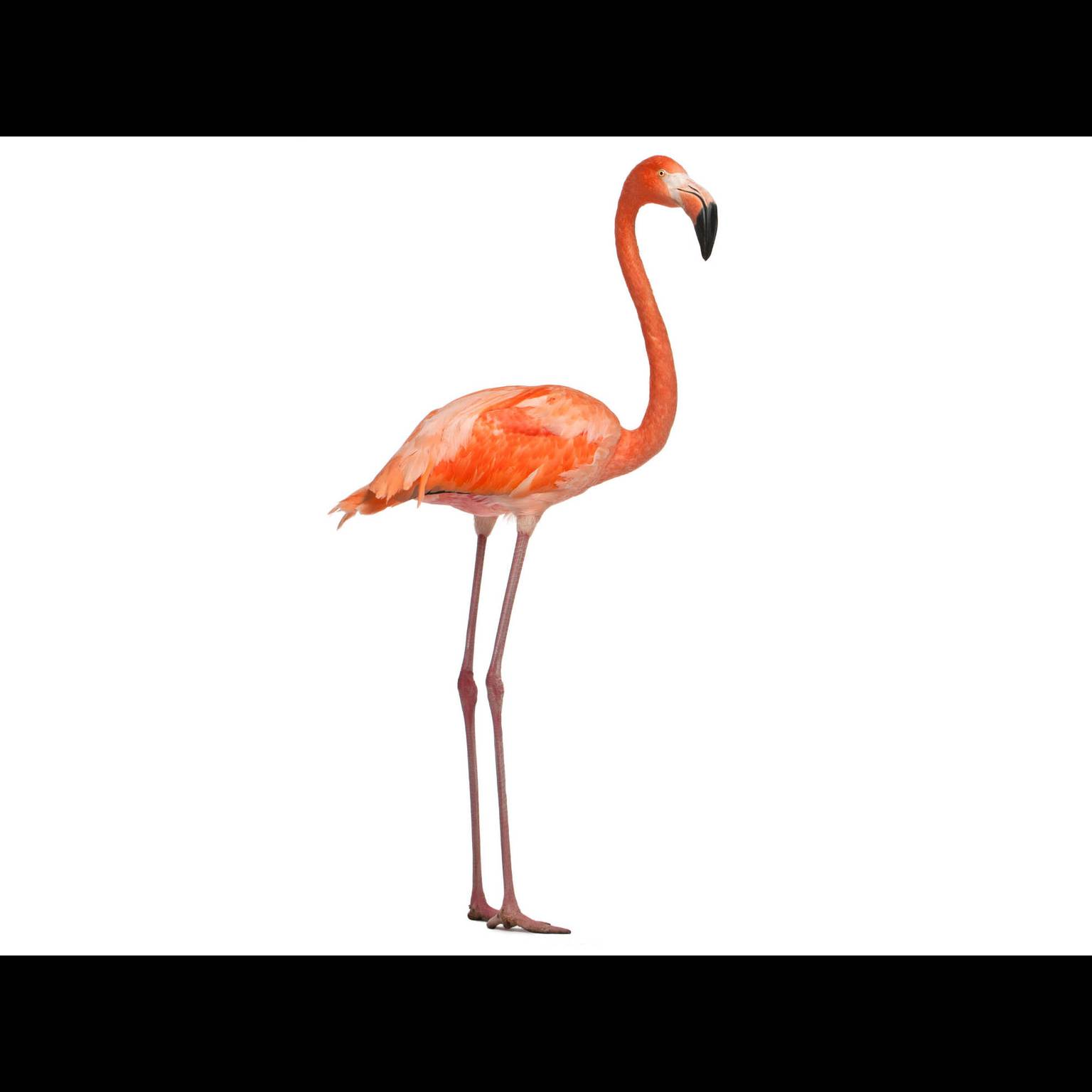
The American Flamingo, also known as the Caribbean Flamingo, is a large species of flamingo resident in the Neotropics. It is the only flamingo species that naturally inhabits North America. Characterized by its brilliant pink to reddish-orange plumage, long stilt-like legs, a long flexible neck, and a distinctively downward-bending bill. These social birds are typically found in large colonies in shallow coastal and inland aquatic habitats.
Size & lifespan
- Length
- 120-145 cm (47-57 in)
- Wingspan
- 140-165 cm (55-65 in)
- Weight
- 2.2-2.8 kg (4.9-6.2 lbs)
- Lifespan
- Up to 40-50 years in the wild, longer in captivity
- Diet
- Primarily filter-feeders, consuming small invertebrates (brine shrimp, insect larvae), algae, diatoms, and small fish from shallow waters.
Physical characteristics
- Plumage
- Adult plumage ranges from pale pink to brilliant reddish-orange, with primary and secondary flight feathers being black, visible during flight. The intensity of color is due to carotenoid pigments in their diet.
- Beak shape
- Large, heavy, and distinctively bent downwards in the middle, pinkish-white at the base, becoming black towards the tip. The unique shape is adapted for filter-feeding.
- Eye color
- Small, yellow eyes with a dark pupil.
- Leg color
- Long, thin, stilt-like legs are entirely pink.
- Distinguishing features
- Its vibrant coloration, large size, exceptionally long pink legs and neck, and the uniquely angled bill are all highly distinctive. Black flight feathers are prominent against the pink body in flight.
- Juvenile appearance
- Juveniles are dull grey or whitish with some brown streaking, especially on the back and wings. Their legs are greyish-pink, and their bill is dark grey. They gradually acquire adult plumage over 2-3 years.
- Seasonal changes
- Plumage color can vary slightly based on diet and breeding condition, becoming more intense during breeding season due to higher carotenoid intake and hormonal influences, but no distinct breeding/non-breeding plumage exists.
- Sexual dimorphism
- Males are generally slightly larger and heavier than females, but plumage coloration is identical. Sex determination based solely on visual observation is often difficult.
How to identify
- 1
Plumage Color
Look for the intense, uniform reddish-pink to orange-red body plumage, which is a key characteristic separating it from other flamingo species in its range (where they might rarely overlap, like vagrant Greater Flamingos).
- 2
Bill Structure and Color
Observe the distinctive downward-curved bill: it's pinkish-white at the base, becoming broadly black towards the tip. This pattern helps distinguish it from other flamingos.
- 3
Leg Color
Note the entirely pink legs. This differs from other species like the Chilean Flamingo, which has grey legs with pink joints.
- 4
Flight Pattern
In flight, the vibrant pink body contrasting sharply with the extensive black primary and secondary flight feathers is unmistakable. They fly with outstretched neck and legs.
- 5
Vocalizations
Listen for their characteristic goose-like honks and grunts, especially in colonial settings. These calls are quite distinct and can be heard from a distance.
Habitat & range
- Biomes
- Coastal wetlands, estuaries, saline lagoons, hypersaline lakes, and other shallow brackish or saline aquatic environments.
- Geographic range
- Predominantly found in the Caribbean islands (e.g., Bahamas, Cuba, Hispaniola, Bonaire), the Yucatán Peninsula of Mexico, and coastal northern South America (e.g., Colombia, Venezuela, Suriname). Small populations historically occurred in Florida, with reintroductions and occasional vagrants observed.
- Elevation range
- Typically found at sea level to relatively low elevations, always associated with shallow water bodies.
- Preferred environments
- Large expanses of shallow, warm, brackish or saline water with mudflats, where they can easily wade and feed. They require areas protected from predators for nesting.
Behavior
- Activity time
- Primarily diurnal, with peak feeding activity often occurring during early morning and late afternoon. May feed nocturnally under certain conditions or during full moons.
- Feeding habits
- Gathers food by wading in shallow water, holding its head upside down and filtering water through its specialized bill lamellae. It pumps water with its tongue to strain out small food particles.
- Social behavior
- Highly gregarious, forming massive colonies that can number in the tens of thousands during breeding and non-breeding periods. They communicate extensively within colonies.
- Flight pattern
- Flies with its long neck and legs fully extended, often in large V-formations or long lines. Flight is powerful and direct, with regular, deep wing beats. Black flight feathers are very noticeable.
- Migration pattern
- Generally non-migratory, but local movements occur in response to changes in water levels, food availability, or disturbance. Younger birds may disperse further, and vagrants can appear outside typical ranges.
- Territoriality
- Not territorial over feeding grounds, but nests are built in close proximity within large colonies, with some defense of immediate nest site.
Song & calls
- Song
- American Flamingos do not have a complex song. Their vocalizations are generally described as honking or goose-like.
- Call
- A variety of honking, grunting, and nasal calls, resembling geese. Common calls include a deep 'ka-hunk' or 'ga-ga-ga' sounds. Chicks produce softer peeping calls.
- When they vocalize
- Vocalizes frequently, especially within colonies for communication, during feeding, and when disturbed or in flight.
Breeding & reproduction
- Breeding season
- Varies geographically, typically between April and August, but can be influenced by rainfall and food availability. In some regions, breeding can occur year-round.
- Nesting habits
- Nests in dense colonies on mudflats, small islands, or elevated mud mounds. Both parents participate in building a cone-shaped nest out of mud, sometimes incorporating small stones or feathers, typically 30-60 cm (12-24 in) tall.
- Clutch size
- 1 egg, rarely 2.
- Egg description
- Usually a single, chalky white egg, sometimes two. The egg is elliptical and has a rough texture.
- Incubation period
- 28-32 days. Both parents share incubation duties.
- Fledging period
- Chicks leave the nest after a few days but remain in crèches (large groups of young birds) guarded by a few adults. They are capable of flight at 70-75 days old, becoming independent shortly thereafter.
- Parental care
- Both parents incubate the egg and feed the chick 'crop milk' (a nutrient-rich secretion from the upper digestive tract) for the first few weeks, supplemented by filtered food as they mature.
Where to find
Caribbean Islands
Large, easily accessible populations exist in places like the Bahamas (e.g., Great Inagua), Cuba, Bonaire, and the Cayman Islands, often in designated wildlife sanctuaries.
Yucatán Peninsula, Mexico
Major breeding and feeding grounds, particularly in the Ría Lagartos Biosphere Reserve, where thousands can be seen.
Coastal South America
Venezuela and Colombia harbor significant populations along their Caribbean coasts, for instance in Los Roques Archipelago or La Guajira Peninsula.
Florida, USA
While historically extirpated, a small, growing wild population exists in South Florida (e.g., Everglades, Florida Bay), and vagrants are occasionally sighted across the state, especially after strong winds from the Caribbean.
Field tips
- Visit during the dry season. Lower water levels in many areas concentrate flamingos in fewer, more accessible feeding grounds, making them easier to spot.
- Seek out large, shallow wetlands. Flamingos prefer extensive, open, shallow saline or brackish water bodies with muddy bottoms. Look for these specific habitat types.
- Use a spotting scope or binoculars. Flamingos are often observed at a distance, and their delicate filter-feeding behavior and bill details are best appreciated with optics.
- Observe colonial behavior. Listen for their characteristic calls and watch for large groups. Their social nature often means if you find one, you'll find many.
- Consider guided tours. In established flamingo viewing locations, local guides can provide access to prime viewing spots and interpret their behavior and ecology.
Similar species
Greater Flamingo
Phoenicopterus roseus
The American Flamingo is generally more brightly colored (reddish-pink) than the Greater Flamingo, which is typically paler pink to almost white. The Greater Flamingo's bill has a black tip, but a more extensive pink base, whereas the American Flamingo's bill has more black on the outer half and a distinct pinkish-white base. Geographic range is also a key differentiator; Greater Flamingos are found in Africa, Asia, and southern Europe.
Chilean Flamingo
Phoenicopterus chilensis
The Chilean Flamingo is generally paler pink than the American Flamingo and has greyish legs with pink joints (knees and ankles). Its bill is about half black and half pale pink, with less extensive black than the American Flamingo. Found in temperate South America.
Quick facts
- Average Lifespan:
- 40 years
- Conservation Status:
- Least Concern
- Diet:
- Brine shrimp, algae, diatoms
- Social Structure:
- Highly colonial
- Nesting Habitat:
- Mud mounds in shallow water
Fun facts
- The vibrant pink color of American Flamingos comes from beta-carotene pigments obtained from their diet of brine shrimp and algae. Without these pigments, their feathers would be white or pale pink.
- Flamingos feed with their heads upside down, using their powerful tongues to pump water through their unique filter-feeding bills.
- A group of flamingos is known as a 'flamboyance,' a 'stand,' or a 'colony.'
- Flamingo chicks are born with white downy feathers and a straight bill; the bill gradually develops its characteristic downward curve as they mature.
- American Flamingos can tolerate extremely salty and alkaline conditions that are inhospitable to most other animal life, allowing them to exploit abundant food sources without much competition.
Scientific classification
- Kingdom
- Animalia
- Phylum
- Chordata
- Class
- Aves
- Order
- Phoenicopteriformes
- Family
- Phoenicopteridae
- Genus
- Phoenicopterus
- Species
- P. ruber
Explore the American Flamingo
Identify birds anywhere
Free on iOS, Android, and Web. Photo & sound identification, full species database, and your personal life list.