
Spotted a bird? Identify it instantly with the Birdby app
Open the appAbout
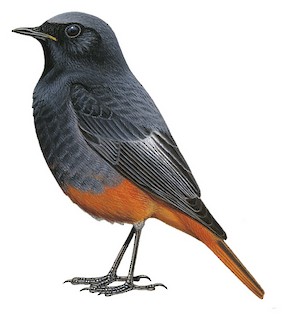
The Black Redstart is a small passerine bird that belongs to the Old World flycatcher family. It is known for its distinctive plumage, particularly the sooty black coloration of the male and its striking rusty-orange tail, which is constantly quivering. These birds are highly adaptable, having transitioned from rocky mountain and cliff habitats to urban environments, often nesting on buildings and industrial structures. They are insectivorous, feeding on a wide variety of invertebrates, especially during the breeding season.
Size & lifespan
- Length
- 13-14.5 cm
- Wingspan
- 23-26 cm
- Weight
- 11-20 g
- Lifespan
- Typically 2-5 years in the wild, with a maximum recorded of over 10 years.
- Diet
- Primarily insects (flies, beetles, ants, caterpillars, spiders, grasshoppers, crickets). Also feeds on berries and small fruits, especially outside the breeding season or when insects are scarce.
Physical characteristics
- Plumage
- Adult male: Sooty black head, mantle, back, and underparts, with a prominent white wing-patch (usually visible only in flight or at rest) and a rufous-orange rump and tail. Throat is often deep black. Adult female:整體 upperparts are greyish-brown, with paler underparts, a pale greyish-white belly, and a duller rufous-orange rump and tail. The tail is always rusty-orange. First-year male: Resembles a duller adult male, often with less intense black and a smaller or absent white wing-patch. Juvenile: Spotted brown plumage resembling a juvenile Robin, but with the characteristic rusty-orange tail.
- Beak shape
- Slender, pointed, dark (blackish) bill, adapted for catching insects.
- Eye color
- Dark brown.
- Leg color
- Dark grey to blackish.
- Distinguishing features
- The quivering rusty-orange tail is a key identification feature for both sexes and all ages. Males are characterized by their sooty black plumage and white wing-patch. Females are distinctly grey-brown with the same orange tail.
- Juvenile appearance
- Juveniles are heavily mottled brown on the upperparts and breast, giving them a spotted appearance. Their underparts are paler. The rusty-orange tail is already present, which helps differentiate them from juvenile European Robins.
- Seasonal changes
- Plumage does not undergo significant seasonal changes; the breeding and non-breeding plumages are generally similar. Some wear can make colors appear duller towards the end of the breeding season.
- Sexual dimorphism
- Strongly sexually dimorphic, with males being primarily blackish-grey and females being brownish-grey. Both sexes share the rufous-orange tail.
How to identify
- 1
Tail Color and Movement
Crucial for identification at all ages and sexes: the tail is always rusty-orange/rufous and is habitually quivered or shivered, even when perched. This provides an almost constant flash of orange.
- 2
Male Plumage
Look for the sooty dark grey to black overall coloration. The white patch on the wing is a key feature, especially conspicuous while in flight or when the bird stretches its wing. Note the darker throat. Contrast with the rusty tail is stark.
- 3
Female Plumage
Females are duller, greyish-brown all over, but still retain the distinctive rusty-orange tail. They lack the white wing-patch of the male. Look for their overall drabness contrasting with the tail.
- 4
Juvenile Plumage
Young birds are mottled brown, but the key is the rusty-orange tail, which is present from the earliest stages of development and is constantly quivering.
- 5
Habitat and Behavior
Often found in urban areas (city centers, industrial sites) or rocky, open landscapes. They perch prominently on rooftops, wires, or rock outcrops, making short flights to catch insects or drop to the ground. Their upright posture is also characteristic.
- 6
Song and Calls
Learn the distinctive 'creaky' or 'squeaky gate' song, which includes a dry rattling or crackling note. The common 'tic' or 'tsip' call is also very useful for detection.
Habitat & range
- Biomes
- Temperate forests, shrublands, grasslands, urban and industrial areas, rocky mountainous regions.
- Geographic range
- Breeds across much of Europe, North Africa, and Asia, from Western Europe eastward to Central Asia and China. Winters in Southern Europe, North Africa, and the Middle East.
- Elevation range
- From sea level up to 3,000 meters in mountainous regions, particularly in its original cliff and gorge habitats.
- Preferred environments
- Originally a bird of rocky gorges, cliffs, scree slopes, and sparsely vegetated mountainsides. It has successfully adapted to urban and industrial environments, thriving in cities, towns, industrial estates, derelict buildings, rubble, and even power stations. Requires open areas for foraging and vertical structures for nesting and perching.
Behavior
- Activity time
- Diurnal, most active during the early morning and late afternoon.
- Feeding habits
- Primarily an insectivore, it forages by making short sallies from a perch to catch insects in flight (flycatching), or by picking them from the ground or vegetation. It often hops agilely on the ground. Also consumes berries, especially in autumn and winter. Known to be quite tame in urban settings.
- Social behavior
- Generally solitary or found in pairs during the breeding season. Can form small loose flocks during migration or in wintering grounds, especially at abundant food sources.
- Flight pattern
- Undulating flight pattern with rapid wing beats, often punctuated by short glides. Quick and agile in flight for catching insects.
- Migration pattern
- Partial or short-distance migrant. Western European populations are largely resident or undertake short dispersive movements. Northern and eastern populations are migratory, moving south to winter in the Mediterranean basin, North Africa, and the Middle East.
- Territoriality
- Males are highly territorial during the breeding season, defending their nesting areas with song and displays. Territories are established around suitable nesting sites.
Song & calls
- Song
- The song is distinctive and rather scratchy or 'creaky', often described as 'squeaky gate' or 'crushing gravel'. It includes a mix of short, wheezy, and scratching notes, often interspersed with musical whistles and sometimes mimicking other birds. The most characteristic part is a short, dry, crackling or rattling phrase, sometimes described as 'tectec-twee-tee-techecheche'.
- Call
- The most common call is a sharp, often repeated 'tic' or 'tack', sometimes drawn out into a 'tsip'. When alarmed, it gives a sharper, more urgent 'chitt-itt-itt' or 'tuck-itt-itt'.
- When they vocalize
- Males sing from prominent perches in their territory, usually from early morning to late evening, and particularly intensified during the breeding season (March to July). Calls are given year-round.
Breeding & reproduction
- Breeding season
- Typically April to August, with two broods common.
- Nesting habits
- Nests are typically placed in crevices, hollows, or ledges on cliffs, rock faces, old buildings, walls, or industrial structures. The female builds a cup-shaped nest from moss, grass, roots, and fibrous material, lined with hair or feathers. Often nests close to human habitation.
- Clutch size
- Typically 4-6 eggs per clutch.
- Egg description
- 4-6 eggs, pure white, sometimes with a very faint bluish tint, unspotted. Glossy.
- Incubation period
- 12-14 days, primarily by the female.
- Fledging period
- 12-19 days after hatching, both parents feed the young.
- Parental care
- Both parents feed the chicks, although the female does most of the incubation. After fledging, the young are cared for by the parents for a further period before becoming independent.
Where to find
Urban Areas:
Look on rooftops, balconies, industrial buildings, derelict sites, power stations, and areas with exposed concrete or rubble. Often found in city centers and suburban areas.
Rocky Habitats:
In natural settings, search rocky gorges, cliffs, scree slopes, and mountainous areas with sparse vegetation.
Gardens and Parks:
While less common than in more 'rugged' urban environments, they can visit gardens, especially those with tall buildings or walls nearby, particularly during migration.
Field tips
- Scan Prominent Perches. Black Redstarts often perch conspicuously on the highest points of buildings, rock outcrops, or power lines. They are not shy and often allow close approach in urban settings.
- Look for Tail Quivering. Always watch for the characteristic quivering or shivering of the rusty-orange tail. This is a constant behavior and a very reliable identification cue.
- Listen for the Song. Familiarize yourself with the unique, scratchy, and rattling song. It's often delivered from a high perch and announces the bird's presence even if not immediately visible.
- Check Disturbed Ground. They often forage on open, disturbed ground, running and hopping to pick up insects. Construction sites or areas with exposed earth can be good spots.
- Watch for Flycatching. Observe for short, darting flights from a perch to catch insects in mid-air, a common foraging strategy.
Similar species
Common Redstart
Phoenicurus phoenicurus
The male Common Redstart has a bright orange breast, black face, and grey crown and back, contrasting significantly with the male Black Redstart's sooty black plumage. Females are browner overall than female Black Redstarts, and have a more prominent buffy wash on the underparts, though both share the rusty-orange tail. Common Redstarts typically prefer woodland and parkland habitats, unlike the Black Redstart's more open or urban preference.
Robin (European Robin)
Erithacus rubecula
Juvenile Black Redstarts can sometimes be confused with juvenile Robins due to spotted plumage. However, juvenile Black Redstarts always show a clear rusty-orange tail, which Robins lack. Adult Robins are easily identified by their bright orange-red breast and face.
Rufous-tailed Rock Thrush
Monticola saxatilis
While also having an orange tail, the Rufous-tailed Rock Thrush is a larger, stockier bird, with distinct plumage patterns. Males have a blue-grey head, orange underparts, and a scaly back. Females are drabber but still larger and differently patterned from any Black Redstart.
Quick facts
- Favorite Habitat Shift:
- Successfully colonized urban environments from natural rocky habitats.
- Tail Feature:
- Rusty-orange tail, constantly quivered.
- Male Markings:
- Sooty black with a white wing-patch.
- Diet:
- Insectivorous, supplementing with berries.
- Migration:
- Partial migrant; northern and eastern populations move south.
Fun facts
- During World War II, Black Redstarts were among the first birds to recolonize bombed-out cities, finding the rubble and exposed structures ideal substitutes for their natural cliff habitats.
- The Black Redstart's urbanization is one of the most striking examples of a bird species adapting to anthropogenic landscapes in recent history.
- Its 'creaky' or 'squeaky gate' song is highly distinctive and often helps birdwatchers locate it even before seeing the bird.
- In many parts of its range, it is one of the most common birds found breeding directly on human structures within city centers.
Scientific classification
- Kingdom
- Animalia
- Phylum
- Chordata
- Class
- Aves
- Order
- Passeriformes
- Family
- Muscicapidae
- Genus
- Phoenicurus
- Species
- Phoenicurus ochruros
Explore the Black Redstart
Identify birds anywhere
Free on iOS, Android, and Web. Photo & sound identification, full species database, and your personal life list.