
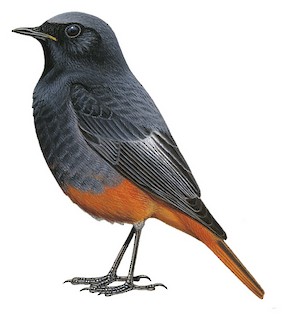
How to identify the Black Redstart
Phoenicurus ochruros
Spotted a bird? Identify it instantly with the Birdby app
Open the appTo correctly identify the Black Redstart (Phoenicurus ochruros), check each of these features. Birds can be tricky: habit, habitat, and call often confirm a sighting that a single photo cannot.
Size at a glance
- Length
- 13-14.5 cm
- Wingspan
- 23-26 cm
- Weight
- 11-20 g
Physical features to check
- 1
Plumage
Overall feather coloration and pattern.
Adult male: Sooty black head, mantle, back, and underparts, with a prominent white wing-patch (usually visible only in flight or at rest) and a rufous-orange rump and tail. Throat is often deep black. Adult female:整體 upperparts are greyish-brown, with paler underparts, a pale greyish-white belly, and a duller rufous-orange rump and tail. The tail is always rusty-orange. First-year male: Resembles a duller adult male, often with less intense black and a smaller or absent white wing-patch. Juvenile: Spotted brown plumage resembling a juvenile Robin, but with the characteristic rusty-orange tail.
- 2
Beak shape
Shape and color of the bill: a key field mark.
Slender, pointed, dark (blackish) bill, adapted for catching insects.
- 3
Eye color
Iris color and any distinctive eye markings.
Dark brown.
- 4
Leg color
Leg and foot color.
Dark grey to blackish.
- 5
Distinguishing features
Standout features that separate this species.
The quivering rusty-orange tail is a key identification feature for both sexes and all ages. Males are characterized by their sooty black plumage and white wing-patch. Females are distinctly grey-brown with the same orange tail.
- 6
Juvenile appearance
How young birds differ from adults.
Juveniles are heavily mottled brown on the upperparts and breast, giving them a spotted appearance. Their underparts are paler. The rusty-orange tail is already present, which helps differentiate them from juvenile European Robins.
- 7
Seasonal changes
Plumage variation between breeding and non-breeding seasons.
Plumage does not undergo significant seasonal changes; the breeding and non-breeding plumages are generally similar. Some wear can make colors appear duller towards the end of the breeding season.
- 8
Sexual dimorphism
How males and females differ.
Strongly sexually dimorphic, with males being primarily blackish-grey and females being brownish-grey. Both sexes share the rufous-orange tail.
Key field marks
- Tail Color and Movement. Crucial for identification at all ages and sexes: the tail is always rusty-orange/rufous and is habitually quivered or shivered, even when perched. This provides an almost constant flash of orange.
- Male Plumage. Look for the sooty dark grey to black overall coloration. The white patch on the wing is a key feature, especially conspicuous while in flight or when the bird stretches its wing. Note the darker throat. Contrast with the rusty tail is stark.
- Female Plumage. Females are duller, greyish-brown all over, but still retain the distinctive rusty-orange tail. They lack the white wing-patch of the male. Look for their overall drabness contrasting with the tail.
- Juvenile Plumage. Young birds are mottled brown, but the key is the rusty-orange tail, which is present from the earliest stages of development and is constantly quivering.
- Habitat and Behavior. Often found in urban areas (city centers, industrial sites) or rocky, open landscapes. They perch prominently on rooftops, wires, or rock outcrops, making short flights to catch insects or drop to the ground. Their upright posture is also characteristic.
- Song and Calls. Learn the distinctive 'creaky' or 'squeaky gate' song, which includes a dry rattling or crackling note. The common 'tic' or 'tsip' call is also very useful for detection.
Explore the Black Redstart
Identify birds anywhere
Free on iOS, Android, and Web. Photo & sound identification, full species database, and your personal life list.