
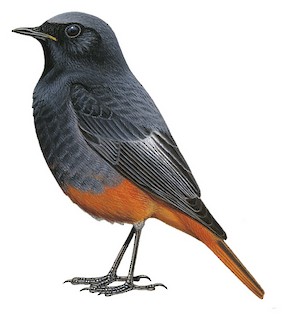
Where does the Black Redstart live?
Phoenicurus ochruros
Spotted a bird? Identify it instantly with the Birdby app
Open the appThe Black Redstart lives in specific habitats and regions. Knowing where, and when, to look improves your chances of a successful sighting.
Biomes
Temperate forests, shrublands, grasslands, urban and industrial areas, rocky mountainous regions.
Geographic range
Breeds across much of Europe, North Africa, and Asia, from Western Europe eastward to Central Asia and China. Winters in Southern Europe, North Africa, and the Middle East.
Preferred environments
Originally a bird of rocky gorges, cliffs, scree slopes, and sparsely vegetated mountainsides. It has successfully adapted to urban and industrial environments, thriving in cities, towns, industrial estates, derelict buildings, rubble, and even power stations. Requires open areas for foraging and vertical structures for nesting and perching.
Elevation range
From sea level up to 3,000 meters in mountainous regions, particularly in its original cliff and gorge habitats.
Where to look
Urban Areas:
Look on rooftops, balconies, industrial buildings, derelict sites, power stations, and areas with exposed concrete or rubble. Often found in city centers and suburban areas.
Rocky Habitats:
In natural settings, search rocky gorges, cliffs, scree slopes, and mountainous areas with sparse vegetation.
Gardens and Parks:
While less common than in more 'rugged' urban environments, they can visit gardens, especially those with tall buildings or walls nearby, particularly during migration.
Field tips
- Scan Prominent Perches. Black Redstarts often perch conspicuously on the highest points of buildings, rock outcrops, or power lines. They are not shy and often allow close approach in urban settings.
- Look for Tail Quivering. Always watch for the characteristic quivering or shivering of the rusty-orange tail. This is a constant behavior and a very reliable identification cue.
- Listen for the Song. Familiarize yourself with the unique, scratchy, and rattling song. It's often delivered from a high perch and announces the bird's presence even if not immediately visible.
- Check Disturbed Ground. They often forage on open, disturbed ground, running and hopping to pick up insects. Construction sites or areas with exposed earth can be good spots.
- Watch for Flycatching. Observe for short, darting flights from a perch to catch insects in mid-air, a common foraging strategy.
Migration
Partial or short-distance migrant. Western European populations are largely resident or undertake short dispersive movements. Northern and eastern populations are migratory, moving south to winter in the Mediterranean basin, North Africa, and the Middle East.
Explore the Black Redstart
Identify birds anywhere
Free on iOS, Android, and Web. Photo & sound identification, full species database, and your personal life list.