
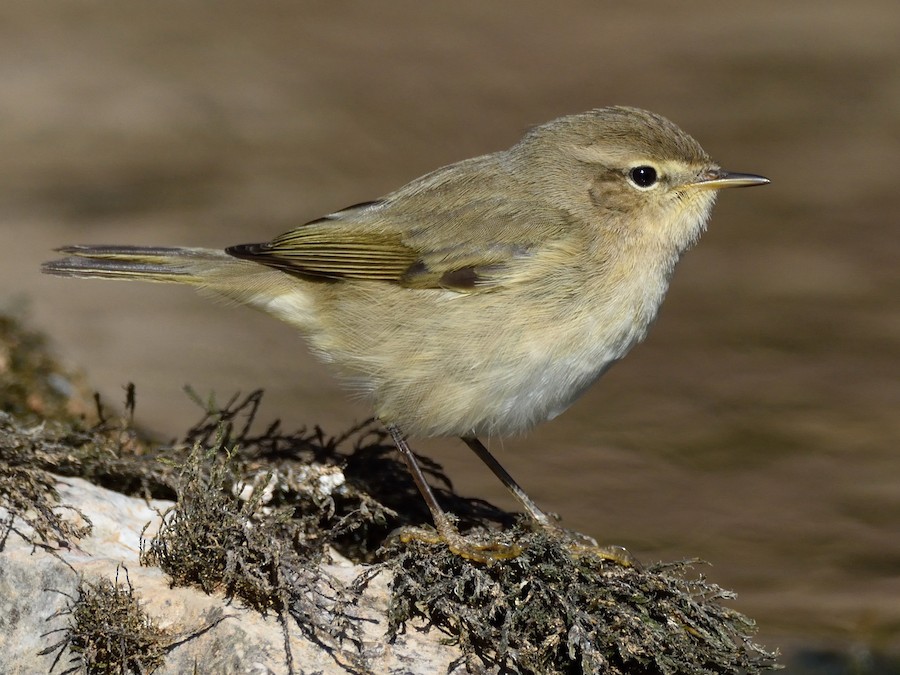
How to identify the Common Chiffchaff
Phylloscopus collybita
Spotted a bird? Identify it instantly with the Birdby app
Open the appTo correctly identify the Common Chiffchaff (Phylloscopus collybita), check each of these features. Birds can be tricky: habit, habitat, and call often confirm a sighting that a single photo cannot.
Size at a glance
- Length
- 10-12 cm
- Wingspan
- 15-21 cm
- Weight
- 6-10 g
Physical features to check
- 1
Plumage
Overall feather coloration and pattern.
Overall dull greenish-brown upperparts, off-white to yellowish-white underparts. The flanks often have a yellowish wash. The supercilium (eyebrow stripe) is usually short and indistinct, yellowish or buffish. Dark eye-stripe. Rump and uppertail coverts are slightly brighter green. Primaries are dark with pale edges. No wing bars.
- 2
Beak shape
Shape and color of the bill: a key field mark.
Small, slender, pointed bill, dark brown to blackish on the upper mandible, paler (often yellowish or orange-brown) on the lower mandible.
- 3
Eye color
Iris color and any distinctive eye markings.
Dark brown
- 4
Leg color
Leg and foot color.
Legs are typically dark (blackish-brown), but can vary to pale brown or even yellowish-orange, especially in some subspecies or individuals.
- 5
Distinguishing features
Standout features that separate this species.
Small size, active foraging, often drooping wings and flicking tail. The most reliable feature is its distinctive song. The leg color can be a helpful, though variable, clue.
- 6
Juvenile appearance
How young birds differ from adults.
Juveniles are similar to adults but often have a slightly browner wash on the upperparts and a more yellowish tinge to the underparts, especially on the flanks and vent. Their plumage is generally softer and less worn.
- 7
Seasonal changes
Plumage variation between breeding and non-breeding seasons.
No significant seasonal plumage changes. Plumage may appear slightly fresher and brighter after the post-breeding molt in late summer/autumn, and more worn and duller by late spring.
- 8
Sexual dimorphism
How males and females differ.
None; males and females are identical in plumage.
Key field marks
- Song. The most definitive identification feature. Listen for the repetitive 'chiff-chaff' song. If you hear this, it's almost certainly a Chiffchaff.
- Plumage. Look for dull greenish-brown upperparts and off-white to yellowish-white underparts. Note the lack of prominent wing bars and a generally indistinct supercilium.
- Leg Color. While variable, many Chiffchaffs have dark (blackish) legs, which can help distinguish them from Willow Warblers (often pale legs). However, some Chiffchaffs can have pale legs, so this is not a foolproof method.
- Behavior. Observe its active foraging style, constantly flitting and gleaning insects from foliage. It often flicks its tail downwards and then slowly raises it, a characteristic 'tail-wagging' motion.
- Overall Impression. A small, rather plain, active warbler. If in doubt, wait for it to sing.
Explore the Common Chiffchaff
Identify birds anywhere
Free on iOS, Android, and Web. Photo & sound identification, full species database, and your personal life list.