
Spotted a bird? Identify it instantly with the Birdby app
Open the appAbout
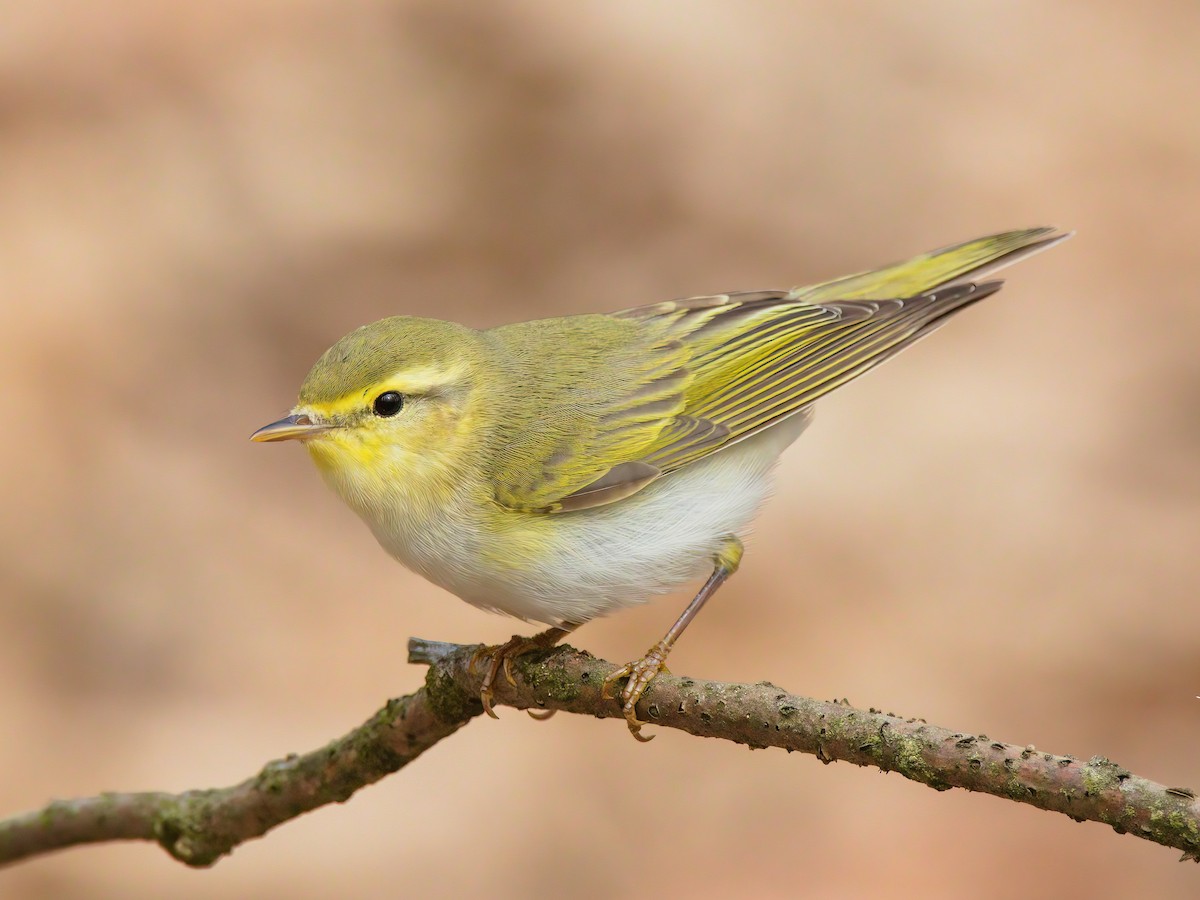
The Wood Warbler is a small, migratory passerine bird, known for its distinctive vibrant yellow-green upperparts, pure white underparts, and a prominent yellow throat and breast. It is a long-distance migrant, breeding across much of temperate Europe and wintering in sub-Saharan Africa. Its characteristic 'shivering' song is a key identification feature.
Size & lifespan
- Length
- 11-12.5 cm
- Wingspan
- 19-24 cm
- Weight
- 8-13 g
- Lifespan
- Typically 2-3 years in the wild, with records up to 8 years.
- Diet
- Insectivore
Physical characteristics
- Plumage
- Adults have bright yellow-green upperparts, including the crown, nape, mantle, and back. The rump and uppertail coverts are slightly brighter green. The underparts are pure white, contrasting sharply with a bright yellow throat and breast. A distinct yellow supercilium (eyebrow stripe) extends from the bill to just behind the eye. The lores are dark, and the ear coverts are yellowish-green. The wings and tail are dark brown with greenish-yellow edgings to the flight feathers. The underwing coverts are yellow.
- Beak shape
- Small, slender, pointed, and dark brown to blackish, with a paler base to the lower mandible.
- Eye color
- Dark brown.
- Leg color
- Pale yellowish-brown to pale orange-brown.
- Distinguishing features
- Key features include the bright yellow-green upperparts, pure white belly, bright yellow throat/breast, prominent yellow supercilium, and pale legs. Its relatively long primary projection (wingtip beyond tertials) is also a useful field mark.
- Juvenile appearance
- Juveniles resemble adults but are generally duller, with less intense yellow on the throat and breast, and the upperparts may be a slightly duller green. The plumage is often looser and fluffier.
- Seasonal changes
- There are no significant seasonal plumage changes. The breeding and non-breeding plumages are essentially the same, though fresh autumn plumage may appear slightly brighter and less worn than late breeding season plumage.
- Sexual dimorphism
- Males and females are virtually identical in plumage. Males tend to be slightly larger on average, but this is not discernible in the field.
How to identify
- 1
Plumage Coloration
Look for the striking contrast between bright yellow-green upperparts and pure white underparts, with a distinct yellow throat and breast. This combination is unique among European Phylloscopus warblers.
- 2
Supercilium
Note the prominent, bright yellow supercilium (eyebrow stripe) that stands out against the darker lores.
- 3
Leg Color
Observe the pale yellowish-brown to pale orange-brown legs, which can help distinguish it from some other warblers with dark legs.
- 4
Primary Projection
If visible, the relatively long primary projection (the length of the wingtip beyond the tertials) is a good structural clue, indicating its long-distance migratory nature.
- 5
Song
Listen for the unmistakable 'shivering' song: an accelerating 'pit-pit-pit' followed by a rapid, descending trill 'sisisisisisisisi'. This is often the easiest way to detect and identify the species.
- 6
Call
Learn its plaintive 'hoo-eet' or 'pee-oo' call, which is often given when foraging or moving through the canopy.
- 7
Behavior
Watch for its active foraging style, gleaning insects from leaves and twigs, and making short aerial sallies. It often sings from a prominent perch high in the canopy.
Habitat & range
- Biomes
- Temperate broadleaf and mixed forests, boreal forests, woodlands.
- Geographic range
- Breeds across most of temperate Europe, from Great Britain and France eastward through Scandinavia, Central and Eastern Europe, and into western Siberia. Winters in sub-Saharan Africa, primarily in the tropical rainforest belt from West Africa to East Africa.
- Elevation range
- Typically breeds from sea level up to 1,500 meters, occasionally higher in some mountainous regions.
- Preferred environments
- Prefers mature deciduous or mixed woodlands with an open understory, often with a good canopy cover and sparse ground vegetation. Beech and oak woodlands are particularly favored. Also found in conifer plantations, especially those with a broadleaf component. Requires open ground for foraging and singing perches.
Behavior
- Activity time
- Diurnal.
- Feeding habits
- Primarily insectivorous, feeding on a wide variety of small insects and their larvae, including flies, beetles, moths, caterpillars, and spiders. It forages actively in the canopy and mid-story of trees, gleaning insects from leaves and twigs. It also performs short, agile sallies to catch flying insects in mid-air. Occasionally, it may take small berries outside the breeding season.
- Social behavior
- Solitary and territorial during the breeding season. Outside of the breeding season and during migration, it can be found singly or in loose mixed-species foraging flocks.
- Flight pattern
- Flight is typically undulating and agile, especially when foraging or performing aerial sallies. During migration, it undertakes long-distance, direct flights.
- Migration pattern
- A long-distance migratory species. Breeds in Europe and migrates south to winter in sub-Saharan Africa. Autumn migration typically occurs from late July to October, and spring migration from March to May. It is one of the earliest warblers to arrive on its breeding grounds in spring.
- Territoriality
- Highly territorial during the breeding season. Males establish and defend territories through song and displays. They are known to be polygynous, with males often having multiple females nesting within their territory.
Song & calls
- Song
- The song is highly distinctive and consists of two main parts. It starts with a series of soft, high-pitched, accelerating 'pit-pit-pit-pit-pit' notes that build in intensity, followed by a rapid, shivering, trilling 'sisisisisisisisisi' that descends slightly in pitch and fades away. Often described as sounding like a coin spinning on a metal plate or a sewing machine. The two parts can be given separately or together.
- Call
- The most common call is a soft, plaintive 'hoo-eet' or 'pee-oo', often given as a contact call or alarm. It can also give a sharp 'chip' or 'tchip' when agitated.
- When they vocalize
- Males sing frequently from arrival on breeding grounds in spring (late April/early May) through to late June or early July. They are most vocal in the mornings and evenings, and throughout the day when establishing territories or attracting mates. Calls are given year-round, but more frequently during migration and when disturbed.
Breeding & reproduction
- Breeding season
- May to July.
- Nesting habits
- The female builds a dome-shaped nest, often referred to as a 'domed nest' or 'oven-shaped' nest, on or very close to the ground, typically concealed amongst vegetation such as grass, moss, or low shrubs. It is constructed from grass, moss, leaves, and lined with finer materials like hair or rootlets. The entrance is usually on the side.
- Clutch size
- 5-7 eggs, occasionally 4 or 8.
- Egg description
- Typically 5-7 eggs, white with fine reddish-brown or purplish-brown speckles, often concentrated at the broader end. Eggs measure approximately 15 x 12 mm.
- Incubation period
- 12-14 days, primarily by the female.
- Fledging period
- 12-13 days after hatching. Young are fed by both parents.
- Parental care
- Both parents feed the nestlings, though the female does most of the incubation. After fledging, the young remain dependent on the parents for a short period before becoming independent.
Where to find
Mature Deciduous Woodlands
Especially beech and oak forests with an open understory. These provide the ideal combination of canopy cover for foraging and open ground for nesting.
Mixed Woodlands
Forests containing a mix of broadleaf and coniferous trees, particularly those with mature broadleaf components.
Forest Edges and Clearings
While preferring dense canopy, they can be found at the edges of woodlands or in clearings where suitable nesting and foraging conditions exist.
Field tips
- Listen for the Song. The Wood Warbler's song is highly distinctive and carries well. Learning to recognize it is the most effective way to locate this species, as it often sings from high in the canopy and can be difficult to spot visually.
- Visit Early in the Breeding Season. Males are most vocal upon arrival in spring (late April to May) as they establish territories and attract mates. This is the best time to hear and potentially see them.
- Scan the Canopy. Wood Warblers typically forage and sing high in the tree canopy. Use binoculars to scan the upper branches of mature trees, especially where you hear singing.
- Look for Movement. They are active foragers. Look for small, quick movements among the leaves as they glean insects or make short aerial sallies.
- Be Patient and Quiet. Like many warblers, they can be elusive. Patience and quiet observation will increase your chances of a good sighting.
Similar species
Chiffchaff
Phylloscopus collybita
The Chiffchaff is smaller and duller, with olive-brown upperparts and buffish-white underparts, lacking the bright yellow throat and breast of the Wood Warbler. Its legs are typically dark (though can be pale), and its primary projection is shorter. The song is a repetitive 'chiff-chaff, chiff-chaff'.
Willow Warbler
Phylloscopus trochilus
The Willow Warbler is also smaller and duller than the Wood Warbler, with olive-green upperparts and yellowish-white underparts. It has a less prominent supercilium and typically pale legs, similar to the Wood Warbler. However, its primary projection is shorter, and its song is a distinctive, fluid, descending cascade of notes.
Greenish Warbler
Phylloscopus trochiloides
The Greenish Warbler has a single pale wing-bar (sometimes faint or absent), which the Wood Warbler lacks. It is generally duller green above and whiter below, without the strong yellow on the throat and breast. Its call is a sharp 'chup' and its song is a rapid, rattling trill.
Quick facts
- Migration:
- Long-distance migrant to sub-Saharan Africa
- Nest Type:
- Dome-shaped, on or near the ground
- Key ID Feature:
- Shivering song and bright yellow-green/white plumage
- Diet:
- Exclusively insects
- Habitat Preference:
- Mature deciduous woodlands with open understory
Fun facts
- The Wood Warbler's scientific name 'sibilatrix' comes from Latin and means 'whistler' or 'hisser', referring to its distinctive song.
- It is one of the earliest warblers to arrive on its European breeding grounds in spring, often appearing before the leaves are fully out on the trees.
- Males are often polygynous, meaning a single male may mate with multiple females within his territory, sometimes having two or three nests simultaneously.
- Despite its bright plumage, its preference for high canopy and dense foliage can make it surprisingly difficult to spot, making its song crucial for identification.
- The Wood Warbler has experienced significant population declines in parts of its range, particularly in Western Europe, making its conservation status a concern in some regions, despite its overall 'Least Concern' IUCN status.
Scientific classification
- Kingdom
- Animalia
- Phylum
- Chordata
- Class
- Aves
- Order
- Passeriformes
- Family
- Phylloscopidae
- Genus
- Phylloscopus
- Species
- Phylloscopus sibilatrix
Explore the Wood Warbler
Identify birds anywhere
Free on iOS, Android, and Web. Photo & sound identification, full species database, and your personal life list.