
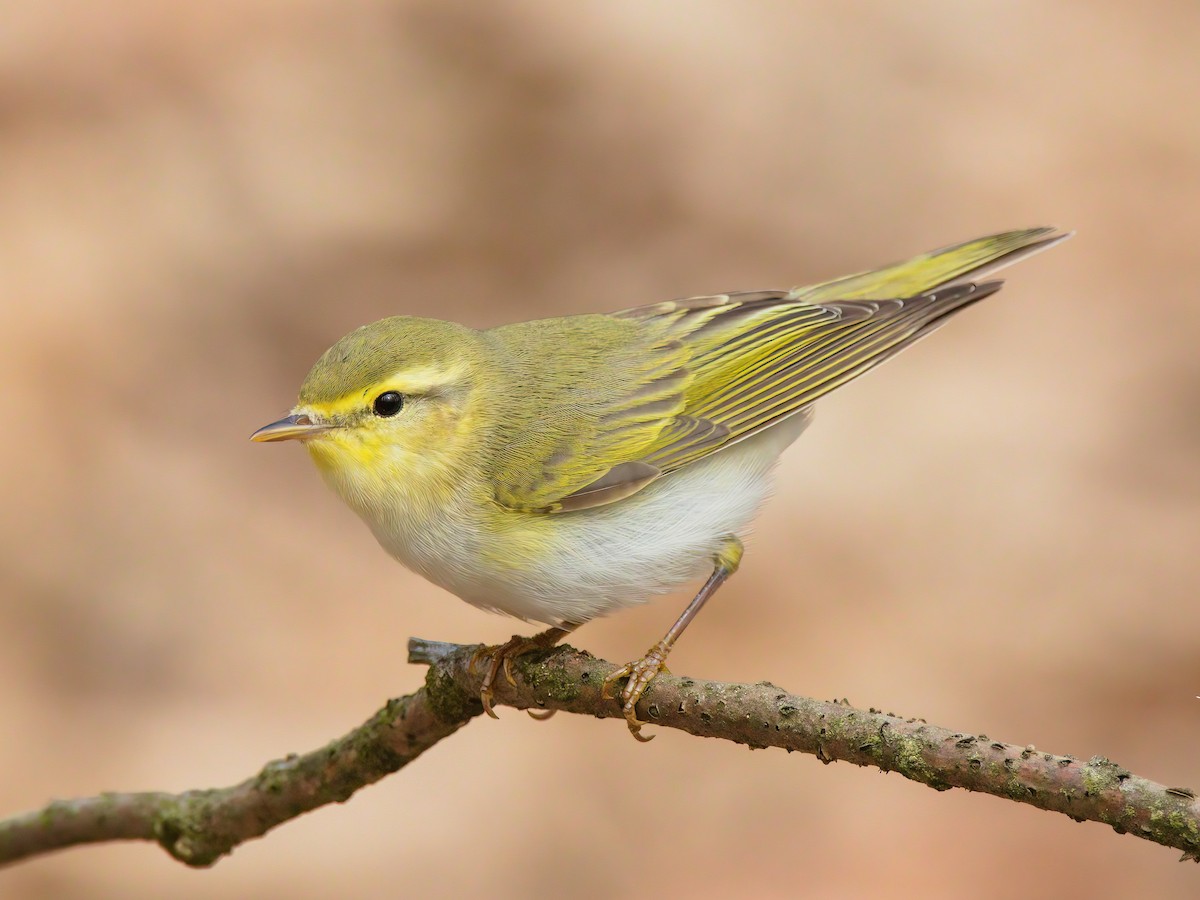
How to identify the Wood Warbler
Phylloscopus sibilatrix
Spotted a bird? Identify it instantly with the Birdby app
Open the appTo correctly identify the Wood Warbler (Phylloscopus sibilatrix), check each of these features. Birds can be tricky: habit, habitat, and call often confirm a sighting that a single photo cannot.
Size at a glance
- Length
- 11-12.5 cm
- Wingspan
- 19-24 cm
- Weight
- 8-13 g
Physical features to check
- 1
Plumage
Overall feather coloration and pattern.
Adults have bright yellow-green upperparts, including the crown, nape, mantle, and back. The rump and uppertail coverts are slightly brighter green. The underparts are pure white, contrasting sharply with a bright yellow throat and breast. A distinct yellow supercilium (eyebrow stripe) extends from the bill to just behind the eye. The lores are dark, and the ear coverts are yellowish-green. The wings and tail are dark brown with greenish-yellow edgings to the flight feathers. The underwing coverts are yellow.
- 2
Beak shape
Shape and color of the bill: a key field mark.
Small, slender, pointed, and dark brown to blackish, with a paler base to the lower mandible.
- 3
Eye color
Iris color and any distinctive eye markings.
Dark brown.
- 4
Leg color
Leg and foot color.
Pale yellowish-brown to pale orange-brown.
- 5
Distinguishing features
Standout features that separate this species.
Key features include the bright yellow-green upperparts, pure white belly, bright yellow throat/breast, prominent yellow supercilium, and pale legs. Its relatively long primary projection (wingtip beyond tertials) is also a useful field mark.
- 6
Juvenile appearance
How young birds differ from adults.
Juveniles resemble adults but are generally duller, with less intense yellow on the throat and breast, and the upperparts may be a slightly duller green. The plumage is often looser and fluffier.
- 7
Seasonal changes
Plumage variation between breeding and non-breeding seasons.
There are no significant seasonal plumage changes. The breeding and non-breeding plumages are essentially the same, though fresh autumn plumage may appear slightly brighter and less worn than late breeding season plumage.
- 8
Sexual dimorphism
How males and females differ.
Males and females are virtually identical in plumage. Males tend to be slightly larger on average, but this is not discernible in the field.
Key field marks
- Plumage Coloration. Look for the striking contrast between bright yellow-green upperparts and pure white underparts, with a distinct yellow throat and breast. This combination is unique among European Phylloscopus warblers.
- Supercilium. Note the prominent, bright yellow supercilium (eyebrow stripe) that stands out against the darker lores.
- Leg Color. Observe the pale yellowish-brown to pale orange-brown legs, which can help distinguish it from some other warblers with dark legs.
- Primary Projection. If visible, the relatively long primary projection (the length of the wingtip beyond the tertials) is a good structural clue, indicating its long-distance migratory nature.
- Song. Listen for the unmistakable 'shivering' song: an accelerating 'pit-pit-pit' followed by a rapid, descending trill 'sisisisisisisisi'. This is often the easiest way to detect and identify the species.
- Call. Learn its plaintive 'hoo-eet' or 'pee-oo' call, which is often given when foraging or moving through the canopy.
- Behavior. Watch for its active foraging style, gleaning insects from leaves and twigs, and making short aerial sallies. It often sings from a prominent perch high in the canopy.
Explore the Wood Warbler
Identify birds anywhere
Free on iOS, Android, and Web. Photo & sound identification, full species database, and your personal life list.