
Spotted a bird? Identify it instantly with the Birdby app
Open the appAbout
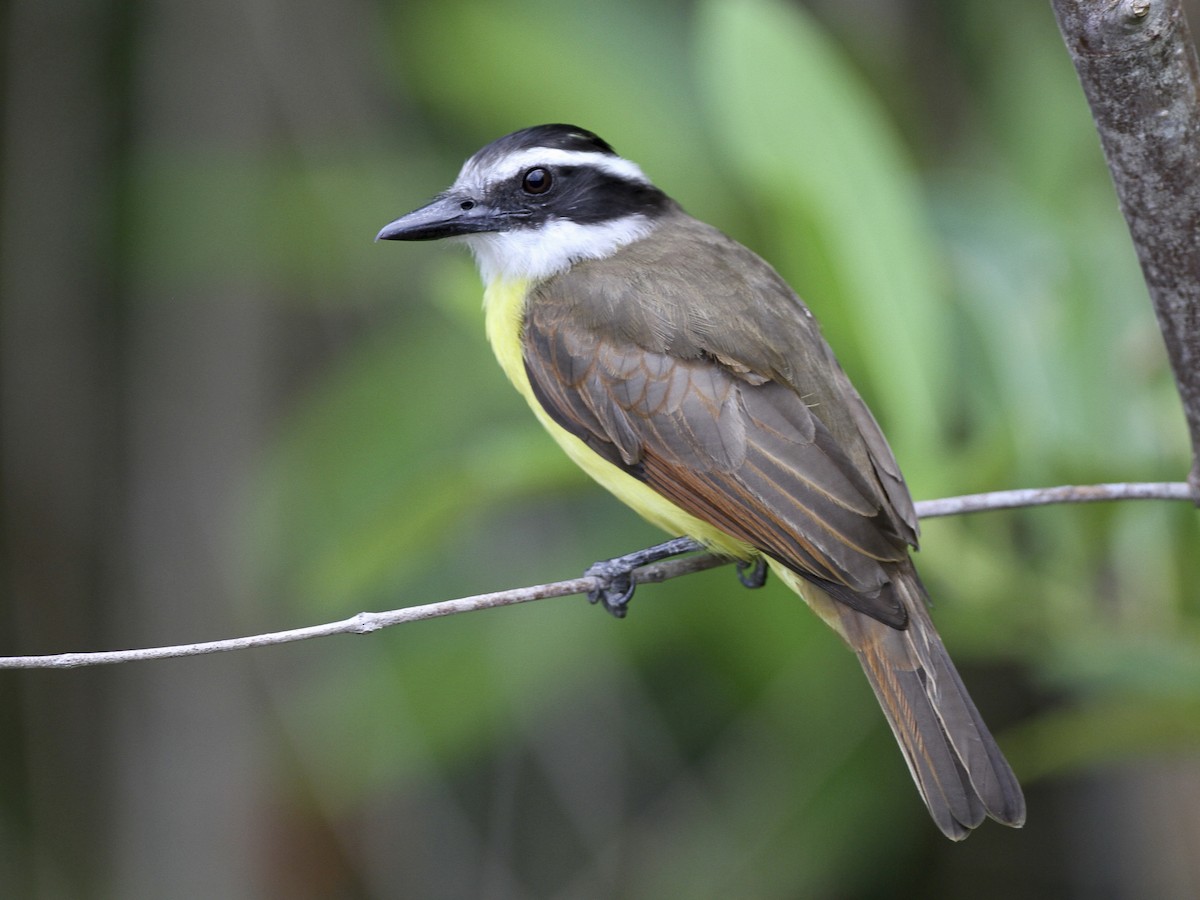
The Great Kiskadee is a large, strikingly colored tyrant flycatcher known for its bold yellow underparts, rufous wings and tail, and a distinctive black and white head pattern with a concealed yellow crown patch. It is an opportunistic and adaptable species, often found near water, and recognized by its loud, emphatic call. Highly vocal and active, it is a conspicuous bird across its wide range.
Size & lifespan
- Length
- 20-25 cm (7.9-9.8 in)
- Wingspan
- 35-44 cm (13.8-17.3 in)
- Weight
- 50-80 g (1.8-2.8 oz)
- Lifespan
- Typically 5-8 years in the wild, up to 10 years observed.
- Diet
- Omnivorous, primarily insectivorous, but also consumes fish, frogs, lizards, small snakes, rodents, and a significant amount of fruit, often seen hawking insects or diving for fish.
Physical characteristics
- Plumage
- Adults have bright yellow underparts from the throat to the undertail coverts. The back and upperwing coverts are olive-brown. The head is boldly patterned with a black crown, lore, and eye-stripes contrasted by a prominent white supercilium. A concealed bright yellow/orange-yellow crown patch is usually only visible when the bird is agitated or displaying. Flight feathers and tail are rufous, especially noticeable in flight. The chin and throat are white.
- Beak shape
- Sturdy, relatively broad, and slightly hooked black bill, adapted for catching insects and small vertebrates.
- Eye color
- Dark brown.
- Leg color
- Dark gray to black.
- Distinguishing features
- Combination of bright yellow underparts, rufous wings and tail, bold black-and-white head pattern, and often a visible yellow crown patch sets it apart. Its large size for a flycatcher is also a key feature.
- Juvenile appearance
- Juveniles resemble adults but typically have duller, less vibrant plumage, especially the yellow underparts. The rufous on the wings and tail may be less intense, and the head pattern might be slightly smudged or less sharply defined. The yellow crown patch may be absent or very small and dull.
- Seasonal changes
- No significant seasonal plumage changes. Plumage remains consistent year-round.
- Sexual dimorphism
- Males and females are monomorphic, appearing identical in plumage and size. The yellow crown patch may be slightly more prominent in males but is not a reliable field mark for sexing.
How to identify
- 1
Plumage
Look for the unmistakable combination of a bright yellow belly, olive-brown back, rufous wings and tail, and a bold black-and-white striped head with a white throat.
- 2
Head Pattern
The strong black eye-stripe, black crown, and bright white supercilium are highly diagnostic. Note the sometimes visible yellow crown patch.
- 3
Vocalization
Listen for its loud, unmistakable "kis-ka-DEE!" call, which is often the first clue to its presence, especially in dense vegetation.
- 4
Behavior
Observe its active feeding strategies: sallying for insects, diving for fish, and frequently perching prominently on bare branches or wires.
- 5
Size
It is a relatively large flycatcher, larger than typical passerines, which helps distinguish it from smaller, similarly colored species.
Habitat & range
- Biomes
- Tropical and subtropical forests, savannas, grasslands, wetlands, and urban areas.
- Geographic range
- Extensive range from southern Texas and Mexico, south through Central America, and across much of South America, eastward to southern Argentina, and on Trinidad and Tobago. Introduced to Bermuda.
- Elevation range
- Sea level up to approximately 2,500 meters (8,200 ft), though more common at lower elevations.
- Preferred environments
- Highly adaptable, prefers open woodlands, forest edges, riparian corridors, mangroves, savannas with scattered trees, parks, gardens, and often near water sources such as rivers, lakes, and ponds.
Behavior
- Activity time
- Diurnal, most active during the morning and late afternoon.
- Feeding habits
- Highly opportunistic and versatile. Perches conspicuously and sally-hawks for flying insects. Also dives into water to catch small fish and tadpoles. Gleams insects from foliage. Plucks fruits (berries, figs, papayas) and nectar. Will also opportunistically take small reptiles, frogs, nestling birds, and rodents. Often seen robbing nests of other birds.
- Social behavior
- Usually seen singly or in pairs. Can be aggressive towards other birds, especially when defending feeding territories or nesting sites. Not typically found in large flocks.
- Flight pattern
- Typically strong, direct, and slightly undulating flight. Capable of acrobatic maneuvers when hawking insects. Often makes short, quick flights between perches.
- Migration pattern
- Largely resident throughout its range. Northern populations (e.g., southern Texas) may undertake short-distance dispersal or altitudinal movements, but long-distance migration is not characteristic.
- Territoriality
- Highly territorial, especially during the breeding season. Males will aggressively defend nesting areas and preferred feeding zones against conspecifics and other bird species.
Song & calls
- Song
- The characteristic call is a loud, emphatic, and somewhat harsh "kis-ka-DEE!" or "kis-ka-dee-dee!". It is often delivered from a prominent perch and can be heard over considerable distances. The call is the source of its common name.
- Call
- In addition to the primary song, it produces a variety of other calls including harsh chattering, scolding notes, and a rapid, rising "cherr-cherr-cherr" when agitated or mobbing a predator.
- When they vocalize
- Highly vocal throughout the day, especially active during early morning and late afternoon. Calls are frequent during the breeding season and often in response to perceived threats.
Breeding & reproduction
- Breeding season
- Varies geographically; typically occurs during the rainy season in tropical areas, e.g., March to June in Central America, October to December in parts of South America, and April to August in Texas.
- Nesting habits
- Nests are large, messy, dome-shaped structures with a side entrance, often built in trees or shrubs, commonly near water. Made from twigs, grasses, roots, and sometimes artificial materials like plastic or cloth. Both parents participate in nest building.
- Clutch size
- Usually 2-5 eggs, most commonly 3-4.
- Egg description
- 2-5 eggs, typically 3-4. Eggs are whitish or cream-colored, heavily marked with brown, purplish-brown, or reddish-brown spots and blotches, especially at the larger end.
- Incubation period
- Approximately 14-16 days, primarily by the female.
- Fledging period
- Nestlings fledge around 17-20 days after hatching. Both parents feed the young.
- Parental care
- Both parents are involved in incubating, brooding, and feeding the young. They also vigorously defend the nest from predators, including much larger birds.
Where to find
Riparian areas
Look near rivers, streams, lakes, ponds, and wetlands. They are frequently found along water bodies due to their diet preferences.
Open woodlands and forest edges
Scan the edges of forests, clearings, and open woodlands where there are scattered trees and shrubs for perching and nesting.
Urban/Suburban areas
Check parks, gardens, orchards, and cultivated lands, especially those with mature trees and access to water. They are well-adapted to human-modified landscapes.
Mangroves
In coastal regions, they are common inhabitants of mangrove forests.
Field tips
- Listen for the call. Their loud 'kis-ka-DEE!' call is highly distinctive and often leads you to the bird before you see it. They vocalize frequently.
- Scan prominent perches. Great Kiskadees often perch conspicuously on high, exposed branches, utility wires, or television antennas, especially over water, providing good viewing opportunities.
- Observe feeding behavior. Watch for their characteristic sallying after insects or sudden dives into water. This behavior is very common and can draw attention to them.
- Check fruit trees. They consume a lot of fruit, so checking fruiting trees can be productive, especially during the non-breeding season.
- Be aware of local aggression. They can be quite vocal and aggressive when defending territories or nests, sometimes mobbing larger birds, which can make them easy to spot.
Similar species
Lesser Kiskadee
Pitangus lictor
The Lesser Kiskadee is noticeably smaller, has a more slender bill, and its rufous coloring on the wings and tail is less extensive and duller than the Great Kiskadee. Its call is also distinct, being less harsh and often described as 'chip-chip-chip'.
Boat-billed Flycatcher
Megarynchus pitangua
The Boat-billed Flycatcher is similar in overall pattern (yellow belly, black and white head), but has a significantly larger, broader, and more flattened bill, which is its namesake. Its call is also different, a more burry 'ra-check' or 'chup'.
Sulphury Flycatcher
Myiodynastes luteiventris
The Sulphury Flycatcher has a more heavily streaked breast and flanks, a longer and more pointed bill, and yellow fringing on the flight feathers. Its head pattern is less bold, with less extensive black. Often migrates, unlike the resident Great Kiskadee.
Quick facts
- Etymology:
- The common name 'Kiskadee' is onomatopoeic, derived from its characteristic call.
- Diet Versatility:
- One of the most omnivorous flycatchers, eating insects, fish, small vertebrates, and a wide variety of fruits.
- Nest Roosting:
- Pairs often roost in their old nests outside of the breeding season.
- Ecological Role:
- Acts as both an insect predator and a seed disperser through its varied diet.
- Introduced Population:
- An established population exists in Bermuda, originating from a single introduction in 1957 to control Lizard Anoles.
Fun facts
- The Great Kiskadee is one of the few passerine birds known to regularly dive into water to catch fish and tadpoles, a behavior more commonly associated with kingfishers.
- Its loud and distinctive 'kis-ka-DEE!' call is so emphatic that it's often impossible to confuse with any other bird in its range, serving as a natural identifier.
- Despite being a flycatcher, it exhibits very un-flycatcher-like dietary habits, including eating small mammals, showcasing its opportunistic nature.
- Great Kiskadees are known to be quite bold and fearless, often approaching human settlements and even stealing food from outdoor tables if given the chance.
- They are formidable defenders of their nests, known to chase away much larger birds of prey and even small mammals that venture too close.
Scientific classification
- Kingdom
- Animalia
- Phylum
- Chordata
- Class
- Aves
- Order
- Passeriformes
- Family
- Tyrannidae
- Genus
- Pitangus
- Species
- sulphuratus
Explore the Great Kiskadee
Identify birds anywhere
Free on iOS, Android, and Web. Photo & sound identification, full species database, and your personal life list.