
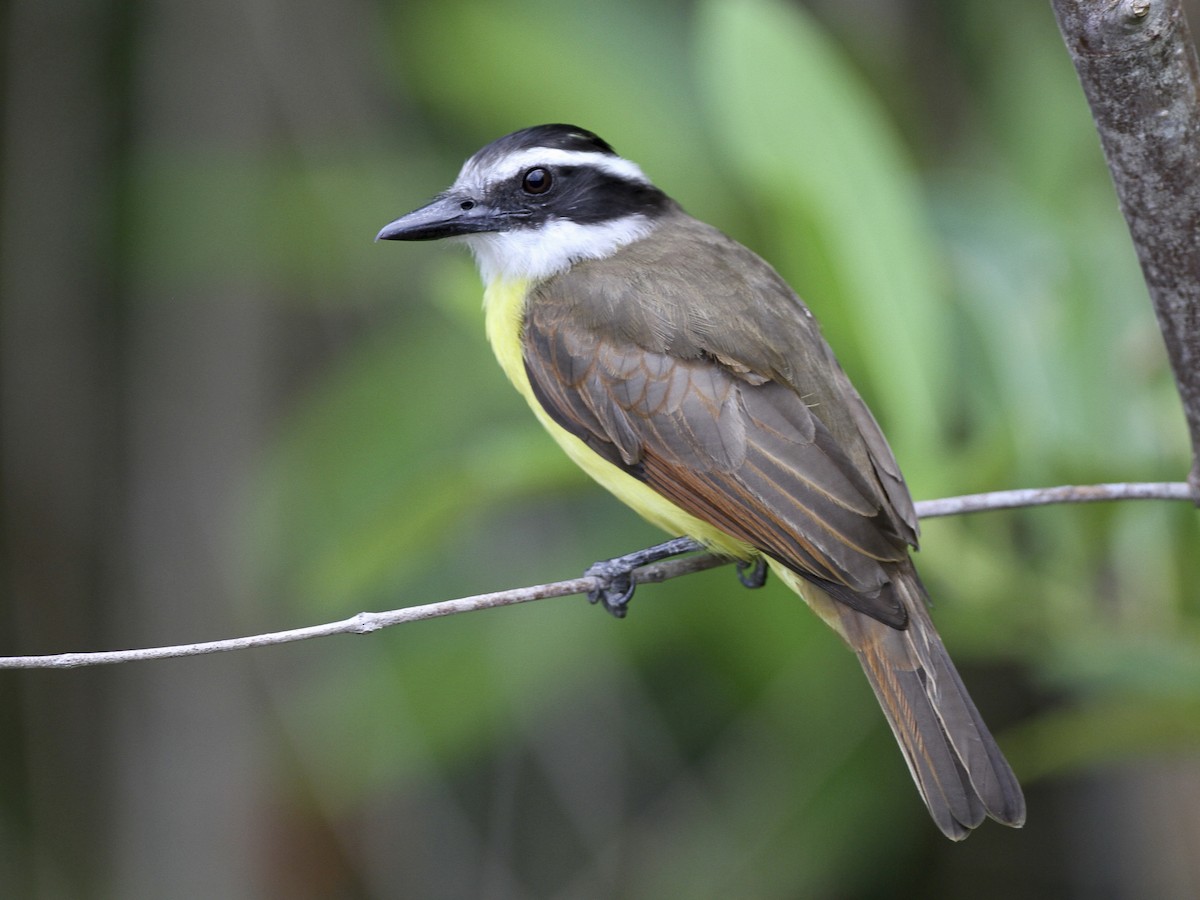
How to identify the Great Kiskadee
Pitangus sulphuratus
Spotted a bird? Identify it instantly with the Birdby app
Open the appTo correctly identify the Great Kiskadee (Pitangus sulphuratus), check each of these features. Birds can be tricky: habit, habitat, and call often confirm a sighting that a single photo cannot.
Size at a glance
- Length
- 20-25 cm (7.9-9.8 in)
- Wingspan
- 35-44 cm (13.8-17.3 in)
- Weight
- 50-80 g (1.8-2.8 oz)
Physical features to check
- 1
Plumage
Overall feather coloration and pattern.
Adults have bright yellow underparts from the throat to the undertail coverts. The back and upperwing coverts are olive-brown. The head is boldly patterned with a black crown, lore, and eye-stripes contrasted by a prominent white supercilium. A concealed bright yellow/orange-yellow crown patch is usually only visible when the bird is agitated or displaying. Flight feathers and tail are rufous, especially noticeable in flight. The chin and throat are white.
- 2
Beak shape
Shape and color of the bill: a key field mark.
Sturdy, relatively broad, and slightly hooked black bill, adapted for catching insects and small vertebrates.
- 3
Eye color
Iris color and any distinctive eye markings.
Dark brown.
- 4
Leg color
Leg and foot color.
Dark gray to black.
- 5
Distinguishing features
Standout features that separate this species.
Combination of bright yellow underparts, rufous wings and tail, bold black-and-white head pattern, and often a visible yellow crown patch sets it apart. Its large size for a flycatcher is also a key feature.
- 6
Juvenile appearance
How young birds differ from adults.
Juveniles resemble adults but typically have duller, less vibrant plumage, especially the yellow underparts. The rufous on the wings and tail may be less intense, and the head pattern might be slightly smudged or less sharply defined. The yellow crown patch may be absent or very small and dull.
- 7
Seasonal changes
Plumage variation between breeding and non-breeding seasons.
No significant seasonal plumage changes. Plumage remains consistent year-round.
- 8
Sexual dimorphism
How males and females differ.
Males and females are monomorphic, appearing identical in plumage and size. The yellow crown patch may be slightly more prominent in males but is not a reliable field mark for sexing.
Key field marks
- Plumage. Look for the unmistakable combination of a bright yellow belly, olive-brown back, rufous wings and tail, and a bold black-and-white striped head with a white throat.
- Head Pattern. The strong black eye-stripe, black crown, and bright white supercilium are highly diagnostic. Note the sometimes visible yellow crown patch.
- Vocalization. Listen for its loud, unmistakable "kis-ka-DEE!" call, which is often the first clue to its presence, especially in dense vegetation.
- Behavior. Observe its active feeding strategies: sallying for insects, diving for fish, and frequently perching prominently on bare branches or wires.
- Size. It is a relatively large flycatcher, larger than typical passerines, which helps distinguish it from smaller, similarly colored species.
Explore the Great Kiskadee
Identify birds anywhere
Free on iOS, Android, and Web. Photo & sound identification, full species database, and your personal life list.