
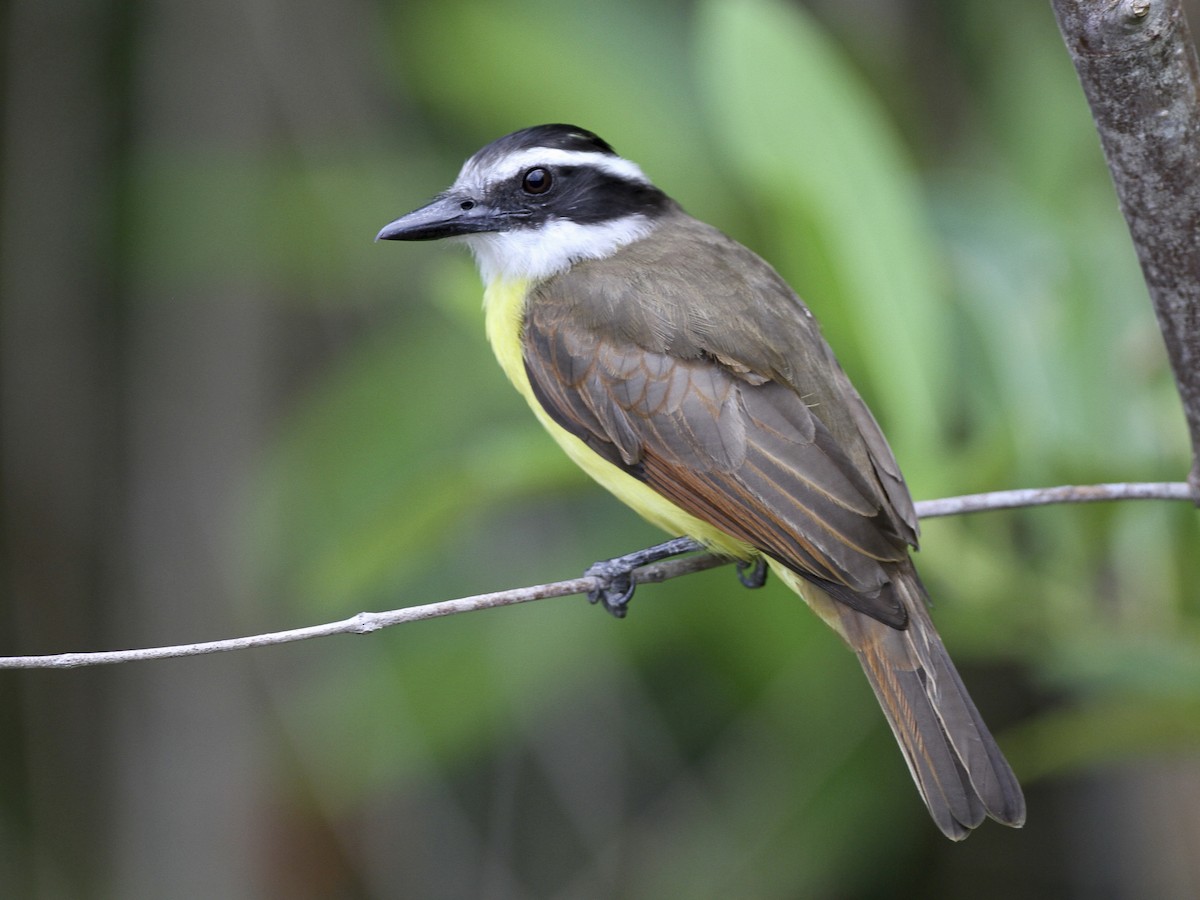
Where does the Great Kiskadee live?
Pitangus sulphuratus
Spotted a bird? Identify it instantly with the Birdby app
Open the appThe Great Kiskadee lives in specific habitats and regions. Knowing where, and when, to look improves your chances of a successful sighting.
Biomes
Tropical and subtropical forests, savannas, grasslands, wetlands, and urban areas.
Geographic range
Extensive range from southern Texas and Mexico, south through Central America, and across much of South America, eastward to southern Argentina, and on Trinidad and Tobago. Introduced to Bermuda.
Preferred environments
Highly adaptable, prefers open woodlands, forest edges, riparian corridors, mangroves, savannas with scattered trees, parks, gardens, and often near water sources such as rivers, lakes, and ponds.
Elevation range
Sea level up to approximately 2,500 meters (8,200 ft), though more common at lower elevations.
Where to look
Riparian areas
Look near rivers, streams, lakes, ponds, and wetlands. They are frequently found along water bodies due to their diet preferences.
Open woodlands and forest edges
Scan the edges of forests, clearings, and open woodlands where there are scattered trees and shrubs for perching and nesting.
Urban/Suburban areas
Check parks, gardens, orchards, and cultivated lands, especially those with mature trees and access to water. They are well-adapted to human-modified landscapes.
Mangroves
In coastal regions, they are common inhabitants of mangrove forests.
Field tips
- Listen for the call. Their loud 'kis-ka-DEE!' call is highly distinctive and often leads you to the bird before you see it. They vocalize frequently.
- Scan prominent perches. Great Kiskadees often perch conspicuously on high, exposed branches, utility wires, or television antennas, especially over water, providing good viewing opportunities.
- Observe feeding behavior. Watch for their characteristic sallying after insects or sudden dives into water. This behavior is very common and can draw attention to them.
- Check fruit trees. They consume a lot of fruit, so checking fruiting trees can be productive, especially during the non-breeding season.
- Be aware of local aggression. They can be quite vocal and aggressive when defending territories or nests, sometimes mobbing larger birds, which can make them easy to spot.
Migration
Largely resident throughout its range. Northern populations (e.g., southern Texas) may undertake short-distance dispersal or altitudinal movements, but long-distance migration is not characteristic.
Explore the Great Kiskadee
Identify birds anywhere
Free on iOS, Android, and Web. Photo & sound identification, full species database, and your personal life list.