
Spotted a bird? Identify it instantly with the Birdby app
Open the appAbout
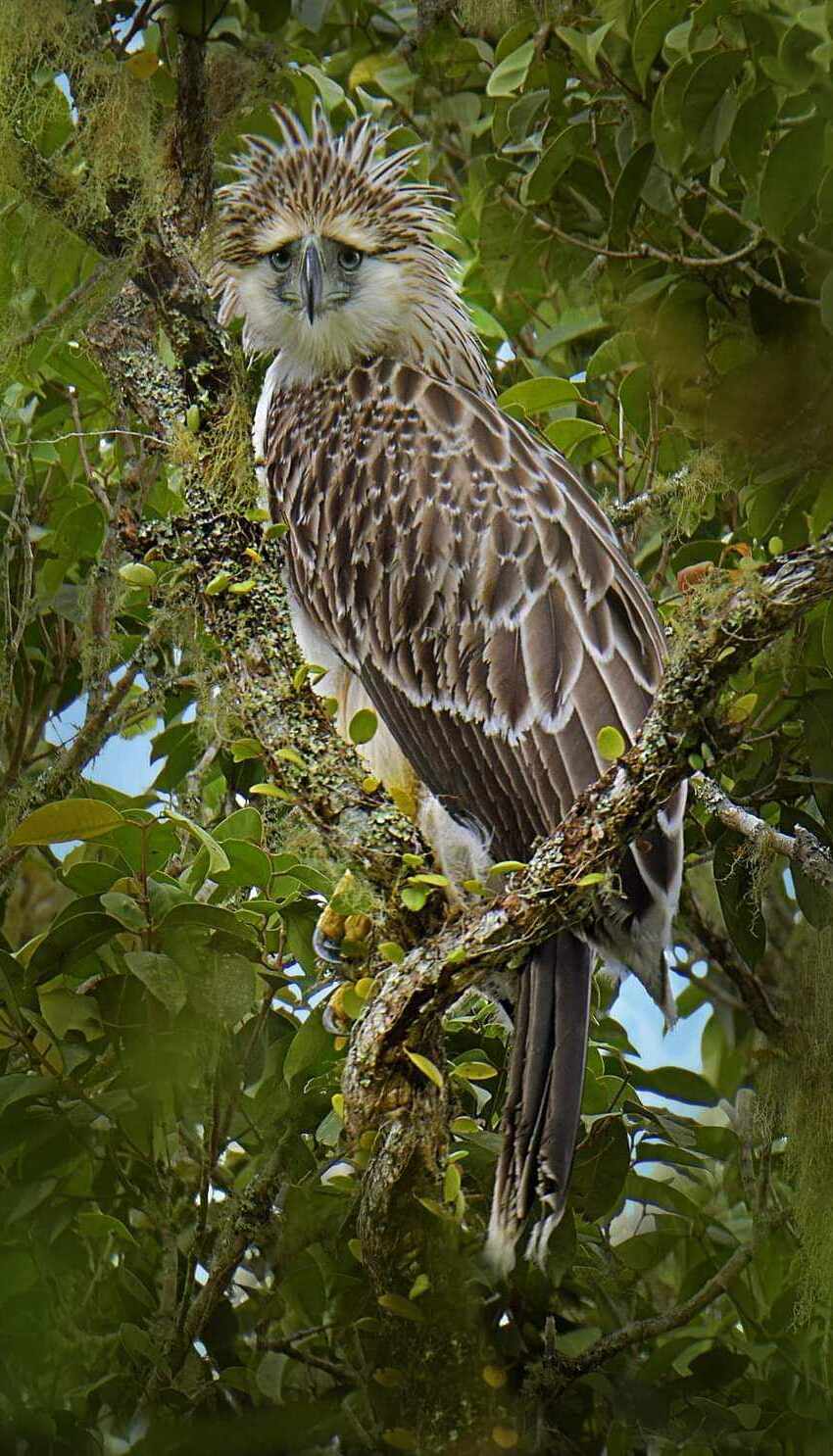
The Philippine Eagle, also known as the Monkey-eating Eagle, is one of the largest and most powerful eagles in the world. It is endemic to the Philippines and is critically endangered. It is characterized by its shaggy crest, large hooked beak, and powerful talons, adapted for hunting arboreal prey.
Size & lifespan
- Length
- 86-102 cm (34-40 in)
- Wingspan
- 184-220 cm (6 ft 0 in - 7 ft 3 in)
- Weight
- 4.7-8.0 kg (10.4-17.6 lb), with females generally larger than males
- Lifespan
- Up to 30-60 years in captivity; less in the wild, likely 15-25 years.
- Diet
- Primarily arboreal and ground mammals (e.g., flying lemurs, civets, monkeys, bats, squirrels) and large birds (e.g., hornbills). Snakes and monitor lizards are also taken.
Physical characteristics
- Plumage
- Adults have a dark brown back and wings, with a creamy-white belly and underwing coverts. The most distinctive feature is a shaggy, long crest of narrow brown feathers on the head and nape, giving the head a lion-like or bushy appearance. The crown feathers are lighter brown with darker shaft streaks. The underparts are white to creamy. Juveniles are similar but with more mottled brown on the back and a less developed crest.
- Beak shape
- Large, deep, and prominently hooked, dark grey to black.
- Eye color
- Grey-blue in juveniles, changing to pale blue-grey in adults.
- Leg color
- Bright yellow, with powerful black talons.
- Distinguishing features
- Massive size, shaggy crest, dark brown upperparts contrasting with creamy-white underparts, and powerful yellow legs with enormous talons.
- Juvenile appearance
- Juveniles have a similar overall pattern but are generally lighter brown on the upperparts with pale feather edgings, appearing more scaled. The head crest is shorter and less developed, and the underparts may have some buffy wash. Their eyes are grey-blue, transitioning to adult coloration.
- Seasonal changes
- No significant seasonal changes in plumage.
- Sexual dimorphism
- Females are typically 10-20% larger than males in weight and wing-length, though plumage is similar. This size difference is less pronounced in overall length than in some other raptor species.
How to identify
- 1
Size
Its immense size, making it one of the largest eagles in the world, is often the first clue. It appears truly massive, even at a distance.
- 2
Head and Crest
The prominent, shaggy crest of long, narrow brown feathers on its head and nape is unique among raptors in its range.
- 3
Plumage Contrast
The stark contrast between its dark brown upperparts and creamy-white underparts is a key field mark.
- 4
Beak and Talons
Its enormous, deep, dark hooked beak and powerful yellow legs with huge black talons are indicative of its predatory power and further distinguish it.
- 5
Flight Profile
In flight, its massive broad wings, slightly rounded tail, and often prominent head and crest can be discerned.
- 6
Vocalization
Its loud, high-pitched whistling calls, though generally heard infrequently, are distinctive.
Habitat & range
- Biomes
- Tropical and subtropical moist broadleaf forests.
- Geographic range
- Endemic to the Philippines, primarily found on four major islands: Luzon, Samar, Leyte, and Mindanao. The largest remaining populations are on Mindanao and Luzon.
- Elevation range
- Typically found from lowlands up to 1,800 meters (5,900 feet) in undisturbed primary and old-growth forests.
- Preferred environments
- Dense, old-growth rainforests with tall emergent trees for nesting and perching. Requires extensive forest cover and a continuous canopy for hunting.
Behavior
- Activity time
- Diurnal, active during daylight hours.
- Feeding habits
- A highly specialized predator, often hunting from a high perch, swooping down to snatch prey from trees or the forest floor. They are also known to hunt in pairs, with one bird distracting prey while the other attacks. They are known for their powerful grip and sharp talons, capable of killing relatively large prey.
- Social behavior
- Generally solitary or in breeding pairs. Very territorial, with pairs maintaining large home ranges. Interactions outside of breeding pairs are rare.
- Flight pattern
- Powerful and agile in flight despite its size. Exhibits soaring flight high above the forest canopy on broad wings, but also capable of maneuvering through dense forest. Often seen perching prominently on tall snag trees.
- Migration pattern
- Sedentary; non-migratory.
- Territoriality
- Highly territorial. Breeding pairs defend large territories, sometimes up to 100 square kilometers, which are crucial for finding sufficient prey to support their long breeding cycle.
Song & calls
- Song
- Does not have a complex song. Vocalizations are primarily calls.
- Call
- The primary call is a series of loud, high-pitched whistles that rise and fall in cadence, often described as 'whii-wheeuu' or 'kiii-kiiyee'. These calls are used for communication between mates, territorial defense, and alarm. Juveniles may utter begging calls.
- When they vocalize
- Most vocal during the breeding season, especially around the nest site, and during territorial displays.
Breeding & reproduction
- Breeding season
- Breeding can occur year-round, but peaks from July to February, varying slightly by island. The breeding cycle is one of the longest among raptors.
- Nesting habits
- Builds massive nests, up to 1.5 meters (5 feet) across and 30 meters (100 feet) deep, usually in the fork of a tall, emergent forest tree (often a 'Toog' tree, Koompassia excelsa). Nests are reused across multiple breeding seasons.
- Clutch size
- One egg, rarely two.
- Egg description
- Typically a single, dull white egg.
- Incubation period
- Approximately 58-62 days, primarily by the female, though the male assists in foraging and occasionally incubating.
- Fledging period
- The chick fledges at around 130-150 days (4-5 months) after hatching. Post-fledging parental care continues for an extended period, often up to 18-20 months, making the breeding cycle often two years long.
- Parental care
- Both parents are involved in raising the single chick. The male provides most of the food during incubation and early chick rearing, while the female guards the nest. Parental care is prolonged, with juveniles staying with parents for a lengthy period, learning hunting skills.
Where to find
National Parks and Reserves
Key locations include Mount Apo Natural Park, Mount Kitanglad Range Natural Park, and the Southern Sierra Madre mountains in Luzon. These areas offer protected habitats.
Philippine Eagle Center
While not a wild setting, the Philippine Eagle Center in Davao City, Mindanao, offers guaranteed viewing of several eagles, including breeding pairs, and is crucial for conservation efforts. It provides an opportunity to observe their morphology and behavior up close before attempting to see them in the wild.
Remote Forests
Requires venturing into very remote, well-preserved primary and old-growth dipterocarp forests on the four main islands where they are found. This often involves multi-day treks with experienced local guides.
Field tips
- Hire Local Guides. Engage experienced local bird guides who are familiar with the eagle's territory and habits. Their knowledge is invaluable for locating these elusive birds.
- Patience and Persistence. Spotting a Philippine Eagle in the wild requires significant patience. Be prepared for long periods of waiting and multiple attempts. Success is not guaranteed due to their rarity and preferred dense habitat.
- Look for Soaring Birds. Scan the skies above suitable forest habitats, especially during mid-morning to early afternoon, when they may be soaring on thermals.
- Listen for Calls. Be attentive to their distinctive calls, which can sometimes lead you to their general vicinity, particularly during morning or late afternoon.
- Look for Perches. They often perch on prominent, tall emergent trees that rise above the forest canopy. Focus your search on such potential perching sites.
- Support Conservation. Consider visiting and supporting the Philippine Eagle Center and other conservation initiatives, as their work is vital for the species' survival.
Similar species
Rufous-bellied Eagle
Lophotriorchis kienerii
Significantly smaller, with a rufous belly, darker head without a prominent crest, and different flight profile. The Philippine Eagle's massive size and shaggy crest are unmistakable.
Changeable Hawk-Eagle
Nisaetus cirrhatus
Smaller than the Philippine Eagle, with a more upright crest (if present, as some morphs are crestless) or no crest, and usually paler underparts with barring. Lacks the shaggy, lion-like crest and the sheer bulk of the Philippine Eagle.
Quick facts
- National Bird:
- It is the national bird of the Philippines.
- Monogamous:
- Breeding pairs are monogamous and mate for life.
- Largest Forest Raptor:
- Considered the largest extant forest raptor in terms of length and wing surface area.
- Iconic Species:
- A symbol of Philippine biodiversity and conservation efforts.
- Long Breeding Cycle:
- Has one of the longest breeding cycles of any bird of prey, often taking two years to fledge a single chick to independence.
Fun facts
- Its former common name 'Monkey-eating Eagle' was somewhat misleading, as monkeys make up only a small part of its diet. Flying lemurs (colugos) are a much more significant prey item.
- The scientific name 'Pithecophaga jefferyi' means 'monkey-eating' (Pithecophaga) and honors the father of the discoverer, W.R.B. Jeffery, who sent the specimen to England.
- A substantial fine and up to 12 years in prison is the penalty for killing a Philippine Eagle in the Philippines.
- It requires vast tracts of untouched primary forest, which illustrates its role as an umbrella species for the conservation of Philippine rainforests.
Scientific classification
- Kingdom
- Animalia
- Phylum
- Chordata
- Class
- Aves
- Order
- Accipitriformes
- Family
- Accipitridae
- Genus
- Pithecophaga
- Species
- jefferyi
Explore the Philippine Eagle
Identify birds anywhere
Free on iOS, Android, and Web. Photo & sound identification, full species database, and your personal life list.