
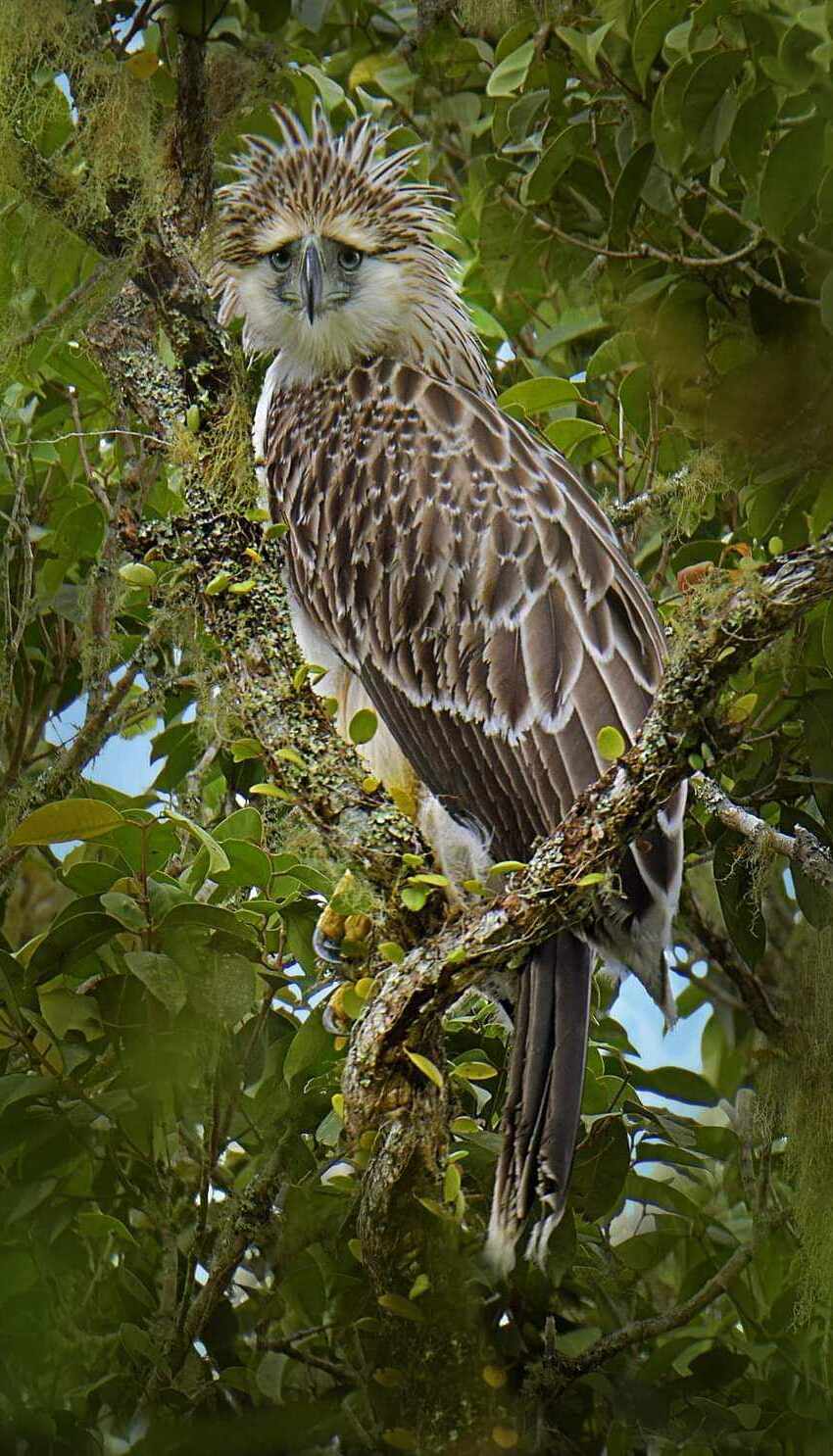
How to identify the Philippine Eagle
Pithecophaga jefferyi
Spotted a bird? Identify it instantly with the Birdby app
Open the appTo correctly identify the Philippine Eagle (Pithecophaga jefferyi), check each of these features. Birds can be tricky: habit, habitat, and call often confirm a sighting that a single photo cannot.
Size at a glance
- Length
- 86-102 cm (34-40 in)
- Wingspan
- 184-220 cm (6 ft 0 in - 7 ft 3 in)
- Weight
- 4.7-8.0 kg (10.4-17.6 lb), with females generally larger than males
Physical features to check
- 1
Plumage
Overall feather coloration and pattern.
Adults have a dark brown back and wings, with a creamy-white belly and underwing coverts. The most distinctive feature is a shaggy, long crest of narrow brown feathers on the head and nape, giving the head a lion-like or bushy appearance. The crown feathers are lighter brown with darker shaft streaks. The underparts are white to creamy. Juveniles are similar but with more mottled brown on the back and a less developed crest.
- 2
Beak shape
Shape and color of the bill: a key field mark.
Large, deep, and prominently hooked, dark grey to black.
- 3
Eye color
Iris color and any distinctive eye markings.
Grey-blue in juveniles, changing to pale blue-grey in adults.
- 4
Leg color
Leg and foot color.
Bright yellow, with powerful black talons.
- 5
Distinguishing features
Standout features that separate this species.
Massive size, shaggy crest, dark brown upperparts contrasting with creamy-white underparts, and powerful yellow legs with enormous talons.
- 6
Juvenile appearance
How young birds differ from adults.
Juveniles have a similar overall pattern but are generally lighter brown on the upperparts with pale feather edgings, appearing more scaled. The head crest is shorter and less developed, and the underparts may have some buffy wash. Their eyes are grey-blue, transitioning to adult coloration.
- 7
Seasonal changes
Plumage variation between breeding and non-breeding seasons.
No significant seasonal changes in plumage.
- 8
Sexual dimorphism
How males and females differ.
Females are typically 10-20% larger than males in weight and wing-length, though plumage is similar. This size difference is less pronounced in overall length than in some other raptor species.
Key field marks
- Size. Its immense size, making it one of the largest eagles in the world, is often the first clue. It appears truly massive, even at a distance.
- Head and Crest. The prominent, shaggy crest of long, narrow brown feathers on its head and nape is unique among raptors in its range.
- Plumage Contrast. The stark contrast between its dark brown upperparts and creamy-white underparts is a key field mark.
- Beak and Talons. Its enormous, deep, dark hooked beak and powerful yellow legs with huge black talons are indicative of its predatory power and further distinguish it.
- Flight Profile. In flight, its massive broad wings, slightly rounded tail, and often prominent head and crest can be discerned.
- Vocalization. Its loud, high-pitched whistling calls, though generally heard infrequently, are distinctive.
Explore the Philippine Eagle
Identify birds anywhere
Free on iOS, Android, and Web. Photo & sound identification, full species database, and your personal life list.