
Spotted a bird? Identify it instantly with the Birdby app
Open the appAbout
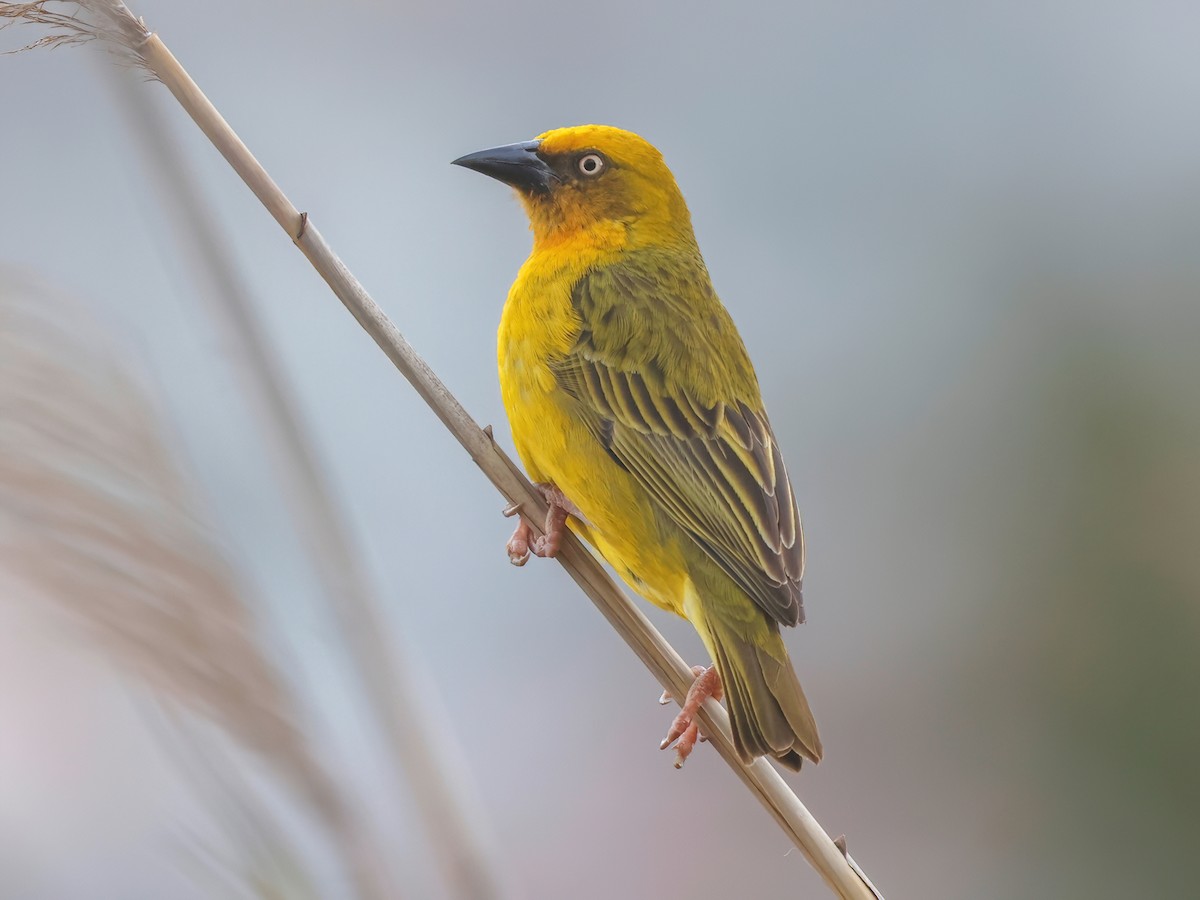
The Cape Weaver is a common and distinctive passerine bird endemic to southern Africa. Males are notably vibrant, featuring bright yellow plumage and chestnut coloration, especially during the breeding season. Females are duller. They are well-known for their elaborate woven nests, a characteristic trait of the weaver family.
Size & lifespan
- Length
- 17-18 cm (6.7-7.1 inches)
- Wingspan
- 25-28 cm (9.8-11 inches)
- Weight
- 36-50 g (1.3-1.8 oz)
- Lifespan
- Approximately 5-8 years in the wild
- Diet
- Primarily granivorous, feeding on seeds of grasses and cultivated crops, supplemented with insects (e.g., caterpillars, beetles, termites) during breeding season to feed young. They also consume nectar from flowers.
Physical characteristics
- Plumage
- Adult breeding males are brilliant golden-yellow with a chestnut wash on the face, throat, and breast, and a strong chestnut tinge on the nape and hindneck. The upperparts are olive-yellow, streaked finely with dusky lines. Non-breeding males are duller, resembling females but retaining some yellow. Females and non-breeding males are olive-brown above, with diffuse darker streaking, and pale yellowish-white underparts, often with a faint yellow wash on the flanks and undertail coverts. They show a yellow wash over the supercilium.
- Beak shape
- Conical, stout, and strong, adapted for cracking seeds, and pointed for weaving.
- Eye color
- Reddish-brown.
- Leg color
- Pale brownish-pink to flesh-colored.
- Distinguishing features
- Breeding male's strong golden-yellow plumage with chestnut face mask. Both sexes have a heavy, conical bill. Unique woven nests are a strong identification feature when nesting.
- Juvenile appearance
- Juveniles resemble females but are duller, often with more streaking on the breast and fainter yellow tones.
- Seasonal changes
- Males undergo a distinct molt into their bright breeding plumage from late winter to early spring, losing their chestnut and vibrant yellow tones in the non-breeding season to resemble females. Females show less significant seasonal plumage variation.
- Sexual dimorphism
- Pronounced sexual dimorphism. Breeding males are strikingly yellow with a chestnut face and throat; females are olive-brown and duller yellow on the underparts. Non-breeding males are intermediate.
How to identify
- 1
Plumage (Breeding Male)
Look for the intense golden-yellow body plumage combined with a characteristic chestnut wash on the face, throat, and breast, and a relatively duller olive-yellow back.
- 2
Nesting Behavior
Observe for their colonial nesting in reeds or trees near water, and the male's vigorous nest-building and display. The distinct woven, spherical nests with a side entrance are unmistakable.
- 3
Size and Shape
Note their medium-large size for a weaver (17-18 cm) and robust, conical bill, which is thicker than many other weaver species.
- 4
Calls and Song
Listen for the male's energetic, chattering, and sibilant song during the breeding season. Alarm calls are typically harsh 'chuck' notes.
Habitat & range
- Biomes
- Grasslands, fynbos, shrublands, cultivated lands, urban and suburban gardens, parks, and riparian zones.
- Geographic range
- Endemic to southern Africa, primarily found in South Africa, extending west into Namibia and east into parts of Lesotho and Eswatini. Its distribution closely follows the Cape Floristic Region and adjoining areas.
- Elevation range
- Sea level up to approximately 2000 meters (6500 feet).
- Preferred environments
- Prefers areas with scattered trees or reeds near water, as well as human-modified landscapes with suitable nesting sites and foraging opportunities.
Behavior
- Activity time
- Diurnal, active from dawn to dusk.
- Feeding habits
- Forages mainly on the ground in open areas, often in flocks. They glean seeds from grasses and agricultural fields, and also hawk flying insects or gather them from foliage. Also known to feed on nectar by probing flowers.
- Social behavior
- Highly gregarious, especially outside the breeding season, forming large flocks that can number in the hundreds or thousands, often associating with other granivorous birds. Breeds in colonies.
- Flight pattern
- Strong, direct, and slightly undulating flight. Often flies in loose flocks to and from feeding or roosting sites.
- Migration pattern
- Generally sedentary, with local movements driven by food availability. No large-scale migration.
- Territoriality
- Breeding males are territorial around their chosen nest sites within a colony, aggressively defending them from rivals. Colonial nesting means individual territories are small and focused on the immediate nest vicinity.
Song & calls
- Song
- The male's song is a lively, rambling series of chattering, chirping, and squeaking notes, often described as 'chissik-tschwisk-swizzle-swizzle'. It's often delivered with flicking wings and a vigorous display near the nest.
- Call
- Common calls include a harsh 'chuck' or 'chissik', often given in alarm or while foraging. A high-pitched 'tseee' note is also heard.
- When they vocalize
- Most vocal during the breeding season when males are establishing territories and attracting females. Calls are heard year-round, especially in social contexts.
Breeding & reproduction
- Breeding season
- August to February, peaking from September to January, correlating with the rainy season and increased food availability.
- Nesting habits
- Colonial nesters. Males construct elaborate, roughly spherical, woven nests from strips of grass, reeds, and palm fronds. The nest has a side entrance, often with a short tunnel or porch. Nests are typically suspended from branches over water or amid reeds, or in gardens.
- Clutch size
- 2-5 eggs, most commonly 3-4.
- Egg description
- Eggs are typically pale blue or greenish-blue, often speckled or blotched with brown, grey, or reddish markings, sometimes forming a ring at the broader end.
- Incubation period
- Approximately 12-14 days, primarily by the female.
- Fledging period
- Chicks fledge around 16-18 days after hatching.
- Parental care
- Both parents feed the nestlings, though the female does most of the incubation. Males may build multiple nests to attract different females within a colony (polygynous tendency).
Where to find
Wetlands and Riparian Areas
Look in reeds, rushes, and trees bordering rivers, dams, and vleis (seasonal wetlands), which are preferred nesting sites.
Gardens and Parks
Common in suburban and urban areas, especially if there are large trees or water features, as they readily adapt to human-modified landscapes.
Agricultural Lands
Can be found foraging in cultivated fields, especially grain crops, and often nesting in trees bordering these areas.
Bushveld and Fynbos
Present in various open and semi-open habitats throughout their range, particularly where suitable nesting trees or tall vegetation are present.
Field tips
- Visit during breeding season. The best time to observe males in their vibrant breeding plumage and witness their remarkable nest-building activities is from August to February.
- Look near water bodies. Cape Weavers often choose nesting sites over water or very close to it, so focus your search around dams, rivers, and wet areas.
- Listen for their song. The male's characteristic chattering song is a strong indicator of their presence, especially during breeding displays.
- Observe flocks. Outside the breeding season, look for large, noisy flocks foraging in grasslands or agricultural areas.
Similar species
Southern Masked Weaver
Ploceus velatus
The Southern Masked Weaver male has a distinct black mask extending to the forehead and often a red eye; its yellow is less intense. Cape Weavers have a chestnut face mask (not black) and a red-brown eye.
Village Weaver
Ploceus cucullatus
The Village Weaver male has a black head and often a chestnut nape, separated from the yellow body. Its overall size is larger, and distribution only marginally overlaps in some areas. Cape Weaver has a chestnut face, not black.
Lesser Masked Weaver
Ploceus intermedius
Lesser Masked Weaver is smaller and has a distinct black mask that covers the lores and ear-coverts, but not the crown, and less extensive yellow plumage.
Quick facts
- Status:
- Endemic to Southern Africa
- Nesting Style:
- Colonial, elaborate woven nests
- Diet:
- Omnivorous (seeds, insects, nectar)
- Sociality:
- Highly gregarious
- Key Identification Mark (male):
- Golden-yellow with chestnut face mask
Fun facts
- The male Cape Weaver is a prolific nest builder, often constructing multiple nests in a single breeding season to attract females. Females inspect nests before selecting a mate.
- Their strong, conical bill is perfectly adapted not only for cracking seeds but also for meticulously weaving strips of vegetation into their intricate nests.
- Cape Weavers can often be seen 'robbing' nectar from flowers by piercing the base of the corolla, rather than entering through the normal opening, a behavior known as 'nectar robbing'.
Scientific classification
- Kingdom
- Animalia
- Phylum
- Chordata
- Class
- Aves
- Order
- Passeriformes
- Family
- Ploceidae
- Genus
- Ploceus
- Species
- Ploceus capensis
Explore the Cape Weaver
Identify birds anywhere
Free on iOS, Android, and Web. Photo & sound identification, full species database, and your personal life list.