
Spotted a bird? Identify it instantly with the Birdby app
Open the appAbout
The Grey Plover, also known as the Black-bellied Plover in North America, is a medium-sized shorebird with a circumpolar breeding distribution in the Arctic tundra. It is known for its striking black breeding plumage and its distinctive 'plee-oo-ee' call. It undertakes long-distance migrations to coastal areas across much of the world.
Size & lifespan
- Length
- 27-31 cm
- Wingspan
- 71-83 cm
- Weight
- 170-320 g
- Lifespan
- Up to 20 years in the wild
- Diet
- Carnivore (invertebrates)
Physical characteristics
- Plumage
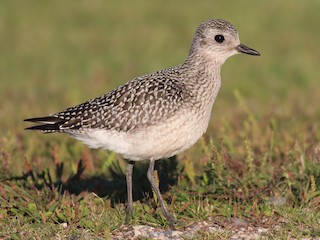
- Non-breeding plumage: Upperparts are mottled grey-brown with fine white speckles, underparts are white with streaky grey on the breast and flanks. Breeding plumage: Upperparts are black with white speckles, face and underparts are entirely black, sharply demarcated from the white forehead, supercilium, and flanks. A prominent white band extends from the forehead over the eye and down the sides of the neck and breast.
- Beak shape
- Short, stout, and straight, black in color.
- Eye color
- Dark brown.
- Leg color
- Dark grey to black.
- Distinguishing features
- In all plumages, the presence of a prominent black 'armpit' (axillary feathers) visible in flight is a key diagnostic feature. It also has a distinctive white wing bar and a white rump contrasting with a dark tail in flight.
- Juvenile appearance
- Juveniles resemble non-breeding adults but have more yellowish-buff mottling on the upperparts and breast, giving them a scaly appearance. The underparts are whiter, and the black axillaries are present.
- Seasonal changes
- Undergoes a dramatic plumage change between non-breeding (grey-brown and white) and breeding (black and white) plumages. The transition occurs during spring migration, with full breeding plumage typically attained on the breeding grounds.
- Sexual dimorphism
- Males and females are generally similar in appearance, though males in breeding plumage tend to have more extensive and intense black on the underparts. Females may be slightly duller.
How to identify
- 1
Size and Shape
Medium-sized, stocky shorebird with a relatively large head and short, stout bill.
- 2
Plumage (Breeding)
Look for the striking black face and underparts, sharply contrasting with white forehead, supercilium, and flanks. Upperparts are black with white speckles.
- 3
Plumage (Non-breeding)
Overall grey-brown upperparts with fine white speckles, white underparts with streaky grey on the breast. Less distinctive but still identifiable.
- 4
In-flight Markings
The most reliable field mark in all plumages is the prominent black 'armpit' (axillary feathers) visible against the white underwing. Also note the white wing bar and white rump contrasting with a dark tail.
- 5
Call
Listen for its distinctive, mournful, three-note whistle 'plee-oo-ee' or 'tlee-oo-ee'.
- 6
Behavior
Observe its characteristic 'run-stop-scan' foraging method on mudflats.
Habitat & range
- Biomes
- Tundra (breeding), coastal wetlands, estuaries, mudflats, sandy beaches, rocky shores (non-breeding).
- Geographic range
- Circumpolar Arctic for breeding (northern Canada, Alaska, Siberia). Non-breeding range is extensive, covering coastal areas of all continents except Antarctica, including Europe, Africa, Asia, Australasia, and North and South America.
- Elevation range
- Primarily low-lying coastal areas during non-breeding season; tundra plains during breeding season.
- Preferred environments
- During migration and winter, they prefer intertidal zones with soft substrates for foraging, such as mudflats and sandflats. Breeding habitat is typically dry, elevated tundra ridges and hummocks near wetlands.
Behavior
- Activity time
- Diurnal, but also forages at night during low tide, especially on moonlit nights.
- Feeding habits
- Forages by sight, running short distances and then stopping abruptly to scan for prey. It uses its short bill to probe shallowly into mud or sand for marine worms, small crustaceans (crabs, shrimp), mollusks, and insects. Occasionally takes small fish.
- Social behavior
- Highly social outside the breeding season, forming large flocks, sometimes mixed with other shorebird species. During breeding, they are territorial and typically solitary or in loose pairs.
- Flight pattern
- Strong, direct flight with rapid wingbeats. Often flies in tight flocks during migration. The black axillaries are very conspicuous in flight.
- Migration pattern
- Long-distance migratory. Breeds in the Arctic and migrates south to temperate and tropical coastal regions for the non-breeding season. Migration routes are broad, often following coastlines.
- Territoriality
- Highly territorial during the breeding season, defending a nesting area. Less territorial during migration and winter, where feeding grounds are shared.
Song & calls
- Song
- The breeding song is a mournful, whistled 'plee-oo-ee' or 'tlee-oo-ee', often repeated, given during display flights over the tundra.
- Call
- The most common call is a clear, three-note whistle, 'tlee-oo-ee' or 'pee-oo-ee', often heard in flight or when disturbed. Also gives a sharp 'chip' or 'kew' call.
- When they vocalize
- Calls are given year-round, especially during migration and on the breeding grounds. Song is primarily heard during the breeding season.
Breeding & reproduction
- Breeding season
- Late May to early July in the Arctic tundra.
- Nesting habits
- Nests are shallow scrapes on dry, elevated tundra ridges or hummocks, often lined with lichens, moss, and leaves. Both parents participate in nest site selection and construction.
- Clutch size
- Usually 4 eggs.
- Egg description
- Typically 4 eggs, pear-shaped, pale olive to buff with dark brown or black blotches and spots, concentrated at the larger end.
- Incubation period
- 26-27 days, shared by both parents.
- Fledging period
- Chicks are precocial and leave the nest shortly after hatching. They fledge in approximately 28-35 days.
- Parental care
- Both parents incubate eggs and care for the young. Females often depart before the young fledge, leaving the male to complete parental duties.
Where to find
Coastal Mudflats and Estuaries
During migration and winter, these are prime locations to find large flocks of Grey Plovers, often mixed with other shorebirds.
Sandy Beaches and Rocky Shores
Can also be found foraging on these habitats, especially during high tide when mudflats are covered.
Arctic Tundra
For breeding, they are found on dry, elevated ridges and hummocks in the high Arctic. This requires specialized expeditions.
Field tips
- Tide Watching. Grey Plovers are highly dependent on tidal cycles for feeding. Plan your visit to coastal areas around low tide when mudflats are exposed.
- Scan Flocks. They often associate with other large shorebirds like godwits and curlews. Carefully scan mixed flocks for their distinctive features.
- Listen for Calls. Their distinctive whistle is often heard before the bird is seen, especially during migration or in foggy conditions.
- Observe Flight. If a flock takes flight, look for the diagnostic black axillaries and white wing bar.
Similar species
European Golden Plover
Pluvialis apricaria
The Grey Plover lacks the golden spangling on the back of the Golden Plover. In breeding plumage, the Golden Plover has a white flank stripe that does not extend over the eye, and its underparts are black but often with a white border. In flight, Golden Plovers lack the prominent black axillaries and white wing bar of the Grey Plover.
American Golden Plover
Pluvialis dominica
Similar to European Golden Plover, the American Golden Plover also lacks the black axillaries and white wing bar of the Grey Plover. Its breeding plumage is also black below, but with golden spangling on the back and a white flank stripe that does not extend over the eye. Non-breeding plumages are also browner than Grey Plover.
Pacific Golden Plover
Pluvialis fulva
Like other golden plovers, the Pacific Golden Plover lacks the black axillaries and white wing bar. Its breeding plumage is black below with golden spangling above, and a white flank stripe. It is generally smaller and more slender than the Grey Plover.
Quick facts
- Global Distribution:
- Circumpolar Arctic breeder, widespread coastal non-breeder.
- Key ID Feature:
- Black 'armpit' (axillary feathers) in flight.
- Breeding Plumage:
- Black face and underparts, white supercilium, speckled black back.
- Non-breeding Plumage:
- Grey-brown upperparts, white underparts.
- Diet:
- Marine invertebrates (worms, crustaceans, mollusks).
Fun facts
- The Grey Plover is one of the most widespread shorebirds globally, undertaking epic migrations from the Arctic to nearly every continent.
- Its North American common name, 'Black-bellied Plover', refers to its striking breeding plumage, which is a key identification feature.
- The black axillary feathers are unique among plovers and are a reliable way to identify the species in any plumage, even at a distance in flight.
- During the non-breeding season, Grey Plovers can be found in large, sometimes mixed-species, flocks, demonstrating their social nature outside of the breeding period.
Scientific classification
- Kingdom
- Animalia
- Phylum
- Chordata
- Class
- Aves
- Order
- Charadriiformes
- Family
- Charadriidae
- Genus
- Pluvialis
- Species
- Pluvialis squatarola
Explore the Grey Plover
Identify birds anywhere
Free on iOS, Android, and Web. Photo & sound identification, full species database, and your personal life list.