
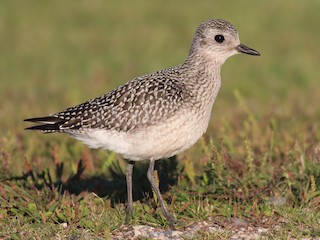
How to identify the Grey Plover
Pluvialis squatarola
Spotted a bird? Identify it instantly with the Birdby app
Open the appTo correctly identify the Grey Plover (Pluvialis squatarola), check each of these features. Birds can be tricky: habit, habitat, and call often confirm a sighting that a single photo cannot.
Size at a glance
- Length
- 27-31 cm
- Wingspan
- 71-83 cm
- Weight
- 170-320 g
Physical features to check
- 1
Plumage
Overall feather coloration and pattern.
Non-breeding plumage: Upperparts are mottled grey-brown with fine white speckles, underparts are white with streaky grey on the breast and flanks. Breeding plumage: Upperparts are black with white speckles, face and underparts are entirely black, sharply demarcated from the white forehead, supercilium, and flanks. A prominent white band extends from the forehead over the eye and down the sides of the neck and breast.
- 2
Beak shape
Shape and color of the bill: a key field mark.
Short, stout, and straight, black in color.
- 3
Eye color
Iris color and any distinctive eye markings.
Dark brown.
- 4
Leg color
Leg and foot color.
Dark grey to black.
- 5
Distinguishing features
Standout features that separate this species.
In all plumages, the presence of a prominent black 'armpit' (axillary feathers) visible in flight is a key diagnostic feature. It also has a distinctive white wing bar and a white rump contrasting with a dark tail in flight.
- 6
Juvenile appearance
How young birds differ from adults.
Juveniles resemble non-breeding adults but have more yellowish-buff mottling on the upperparts and breast, giving them a scaly appearance. The underparts are whiter, and the black axillaries are present.
- 7
Seasonal changes
Plumage variation between breeding and non-breeding seasons.
Undergoes a dramatic plumage change between non-breeding (grey-brown and white) and breeding (black and white) plumages. The transition occurs during spring migration, with full breeding plumage typically attained on the breeding grounds.
- 8
Sexual dimorphism
How males and females differ.
Males and females are generally similar in appearance, though males in breeding plumage tend to have more extensive and intense black on the underparts. Females may be slightly duller.
Key field marks
- Size and Shape. Medium-sized, stocky shorebird with a relatively large head and short, stout bill.
- Plumage (Breeding). Look for the striking black face and underparts, sharply contrasting with white forehead, supercilium, and flanks. Upperparts are black with white speckles.
- Plumage (Non-breeding). Overall grey-brown upperparts with fine white speckles, white underparts with streaky grey on the breast. Less distinctive but still identifiable.
- In-flight Markings. The most reliable field mark in all plumages is the prominent black 'armpit' (axillary feathers) visible against the white underwing. Also note the white wing bar and white rump contrasting with a dark tail.
- Call. Listen for its distinctive, mournful, three-note whistle 'plee-oo-ee' or 'tlee-oo-ee'.
- Behavior. Observe its characteristic 'run-stop-scan' foraging method on mudflats.
Explore the Grey Plover
Identify birds anywhere
Free on iOS, Android, and Web. Photo & sound identification, full species database, and your personal life list.