
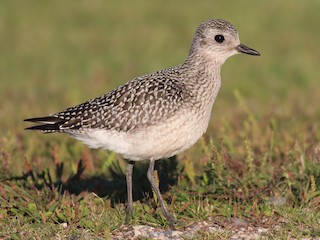
Where does the Grey Plover live?
Pluvialis squatarola
Spotted a bird? Identify it instantly with the Birdby app
Open the appThe Grey Plover lives in specific habitats and regions. Knowing where, and when, to look improves your chances of a successful sighting.
Biomes
Tundra (breeding), coastal wetlands, estuaries, mudflats, sandy beaches, rocky shores (non-breeding).
Geographic range
Circumpolar Arctic for breeding (northern Canada, Alaska, Siberia). Non-breeding range is extensive, covering coastal areas of all continents except Antarctica, including Europe, Africa, Asia, Australasia, and North and South America.
Preferred environments
During migration and winter, they prefer intertidal zones with soft substrates for foraging, such as mudflats and sandflats. Breeding habitat is typically dry, elevated tundra ridges and hummocks near wetlands.
Elevation range
Primarily low-lying coastal areas during non-breeding season; tundra plains during breeding season.
Where to look
Coastal Mudflats and Estuaries
During migration and winter, these are prime locations to find large flocks of Grey Plovers, often mixed with other shorebirds.
Sandy Beaches and Rocky Shores
Can also be found foraging on these habitats, especially during high tide when mudflats are covered.
Arctic Tundra
For breeding, they are found on dry, elevated ridges and hummocks in the high Arctic. This requires specialized expeditions.
Field tips
- Tide Watching. Grey Plovers are highly dependent on tidal cycles for feeding. Plan your visit to coastal areas around low tide when mudflats are exposed.
- Scan Flocks. They often associate with other large shorebirds like godwits and curlews. Carefully scan mixed flocks for their distinctive features.
- Listen for Calls. Their distinctive whistle is often heard before the bird is seen, especially during migration or in foggy conditions.
- Observe Flight. If a flock takes flight, look for the diagnostic black axillaries and white wing bar.
Migration
Long-distance migratory. Breeds in the Arctic and migrates south to temperate and tropical coastal regions for the non-breeding season. Migration routes are broad, often following coastlines.
Explore the Grey Plover
Identify birds anywhere
Free on iOS, Android, and Web. Photo & sound identification, full species database, and your personal life list.