
Spotted a bird? Identify it instantly with the Birdby app
Open the appAbout
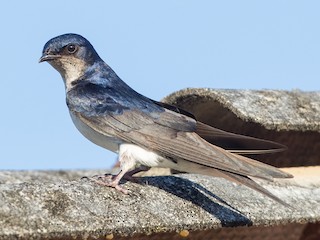
The Grey-breasted Martin is a medium-sized migratory swallow characterized by its iridescent dark blue-black upperparts and contrasting grey underparts. It is a highly aerial feeder, often seen gracefully soaring and diving over open areas, water bodies, and human habitations.
Size & lifespan
- Length
- 18-20 cm
- Wingspan
- 39-41 cm
- Weight
- 36-49 g
- Lifespan
- Typically 5-7 years in the wild, though can reach up to 10 years.
- Diet
- Strictly insectivorous, feeding on a wide variety of flying insects caught in mid-air. This includes flies, beetles, moths, butterflies, bees, wasps, and dragonflies.
Physical characteristics
- Plumage
- Adult males and females are similar. Upperparts are glossy, iridescent steel-blue to blue-black. The head and nape are also dark blue-black. Underparts are smoky grey, becoming whiter on the lower belly and undertail coverts. The throat and upper breast are concolorous with the grey underparts. The wings and tail are blackish. Juveniles have duller, less iridescent upperparts and browner underparts.
- Beak shape
- Short, conical, and broad at the base, perfectly adapted for hawking insects in flight.
- Eye color
- Dark brown
- Leg color
- Black
- Distinguishing features
- The combination of glossy dark blue-black upperparts and clear smoky grey underparts is the primary distinguishing feature. Its relatively large size for a swallow also stands out.
- Juvenile appearance
- Juveniles are duller than adults, with less intense iridescence on the upperparts. Their underparts are a duller, often brownish-grey and can appear streaky, especially on the breast, before their first pre-basic molt.
- Seasonal changes
- No significant seasonal plumage changes. Plumage remains consistent throughout the year, aside from the molting process.
- Sexual dimorphism
- Minimal. Males and females are largely alike in plumage. Some sources suggest males may be slightly more iridescent, but this is often not reliably distinguishable in the field.
How to identify
- 1
Plumage Coloration
Look for the stark contrast between iridescent blue-black upperparts and smoky grey underparts. This is the most reliable field mark.
- 2
Size and Shape
It's a relatively large swallow with a typical swallow-like, deeply forked tail (though less deeply forked than barn swallows) and broad, pointed wings.
- 3
Flight Pattern
Observe its strong, soaring flight with graceful glides mixed with deep wing beats. It often flies higher than other swallows, but also patrols lower over open areas.
- 4
Vocalizations
Listen for its distinctive gurgling, burry warble or sharp 'scheep' calls, especially around potential nesting sites or roosts.
Habitat & range
- Biomes
- Tropical and subtropical regions, including forests (edges), open woodlands, savannas, grasslands, agricultural areas, urban and suburban environments, and coastal areas.
- Geographic range
- Breeding range extends from Mexico, through Central America, and into South America as far south as Argentina. Also found on Trinidad and Tobago.
- Elevation range
- Typically found from sea level up to 2000 meters (approx. 6500 feet), occasionally higher.
- Preferred environments
- Highly adaptable, preferring open areas with access to water. Commonly found in human-modified landscapes such as towns, villages, and around bridges, buildings, and other man-made structures for nesting. Also frequents forest clearings, pastures, and riparian zones.
Behavior
- Activity time
- Diurnal. Most active during daylight hours, especially morning and late afternoon.
- Feeding habits
- Aerial insectivore, capturing all prey in flight. It performs impressive acrobatic maneuvers, including swift turns, dives, and glides, to catch a wide range of flying insects. Often forages at various heights, sometimes high in the sky, other times closer to the ground or over water.
- Social behavior
- Highly social, particularly outside the breeding season when they form large communal roosts, sometimes with other swallow species. During breeding, they can nest solitarily, in small groups, or in loose colonies.
- Flight pattern
- Graceful, strong, and agile. Characterized by powerful, shallow wingbeats interspersed with long glides. Often circles at height or flies low over open fields and water bodies. Highly maneuverable during insect pursuit.
- Migration pattern
- Northern populations (Mexico, Central America) are partially migratory, with some individuals making altitudinal movements or short-distance migrations south for the winter. Southern populations are largely resident or undertake regional movements. The species is known to make long-distance movements across its range.
- Territoriality
- While nesting, pairs or colonies will defend the immediate vicinity of their nest site. However, feeding areas are generally shared, and they are typically not aggressive towards other bird species unless directly threatened.
Song & calls
- Song
- A series of burry, gurgling, and sometimes squeaky notes, often described as a rich, liquid warble. It can be quite varied and pleasant. Often sings from a perch or in flight.
- Call
- Common calls include a sharp 'scheep' or 'churp' note, sometimes given repeatedly. Also a distinct, rather harsh 'cheh' or 'jree' when alarmed or interacting.
- When they vocalize
- Most vocal during the breeding season, especially around nesting sites. Calls are often given during feeding flights and when congregating at roosts.
Breeding & reproduction
- Breeding season
- Varies geographically. In Mexico and Central America, typically from March to August. In South America, often from September to March, encompassing the local summer months.
- Nesting habits
- Nests in natural cavities, such as tree hollows or rock crevices, but very frequently utilizes artificial structures. These include holes in buildings, bridges, eaves, lamp posts, and occasionally martin houses. The nest is a cup-shaped structure made of grasses, leaves, and mud, often lined with finer materials like feathers. Both sexes contribute to nest building, incubation, and chick rearing.
- Clutch size
- 2-5 eggs, most commonly 3 or 4.
- Egg description
- 2-5 (typically 3-4) pure white, unspotted, slightly glossy, oval-shaped eggs.
- Incubation period
- Approximately 15-18 days, primarily by the female, though the male may assist.
- Fledging period
- 21-28 days. Young birds are fed by both parents until they fledge and often for a period afterward.
- Parental care
- Both parents are actively involved in feeding the nestlings and fledglings. They bring a constant supply of insects to the nest. After fledging, the young birds remain dependent on their parents for a short period, receiving food and learning foraging skills.
Where to find
Urban/Suburban Areas
Often found nesting and foraging in cities and towns, around buildings, bridges, and other structures.
Open Countryside
Look over pastures, agricultural fields, and savannas, especially near water sources.
Water Bodies
Frequently seen foraging over rivers, lakes, and coastal areas where insect prey is abundant.
Forest Edges/Clearings
Can be found along the edges of forests or in large clearings, but generally prefers more open habitats.
Field tips
- Scan the Sky. Grey-breasted Martins are highly aerial, so spend time looking up, especially over open areas or near water. They often perch conspicuously on wires or antennas.
- Check Man-Made Structures. Bridges, large buildings with eaves, and even martin houses are prime locations for observing them, particularly during the breeding season when they are nesting.
- Listen for Calls. Their distinctive gurgling calls can often betray their presence before they are visually detected, especially at dawn and dusk around roosts.
- Evening Roosts. In non-breeding periods, look for large communal roosts, often in reed beds or large trees, where they gather in significant numbers at dusk.
Similar species
Purple Martin
Progne subis
Adult male Purple Martins are entirely glossy blue-black. Female and juvenile Purple Martins have a darker breast and belly often with an indistinct white undertail coverts patch, differing from the Grey-breasted Martin's extensive smoky grey underparts. Range overlap primarily in Central America and Mexico.
Southern Martin
Progne modesta
The Southern Martin is very similar and was formerly considered a subspecies of the Grey-breasted Martin. Distinguishing features are subtle: Southern Martins tend to be slightly smaller and have a more uniform grey underside, often lacking the paler belly/undertail coverts. Range is primarily in southern South America.
Brown-chested Martin
Progne tapera
The Brown-chested Martin has distinctly brown upperparts (not blue-black) and a prominent dark brown breast band across its otherwise white underside, making it very different from the Grey-breasted Martin's grey breast.
Quick facts
- Diet:
- Strictly insectivorous
- Sociality:
- Social, colonial breeder
- Flight:
- Strong, agile, and graceful
- Nesting Sites:
- Cavities, often man-made structures
- Global Status:
- Least Concern
Fun facts
- Grey-breasted Martins are highly adaptable and have successfully colonized urban environments, often nesting directly on human structures.
- Like other swallows, they play a crucial ecological role in controlling insect populations, consuming thousands of flying insects daily.
- They are known for their impressive aerial agility, making sharp turns and dives to catch fast-moving insect prey.
- Some populations exhibit partial migration, making altitudinal or short-distance seasonal movements rather than long-distance ones.
Scientific classification
- Kingdom
- Animalia
- Phylum
- Chordata
- Class
- Aves
- Order
- Passeriformes
- Family
- Hirundinidae
- Genus
- Progne
- Species
- Progne chalybea
Explore the Grey-breasted Martin
Identify birds anywhere
Free on iOS, Android, and Web. Photo & sound identification, full species database, and your personal life list.