
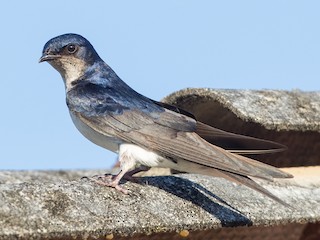
Where does the Grey-breasted Martin live?
Progne chalybea
Spotted a bird? Identify it instantly with the Birdby app
Open the appThe Grey-breasted Martin lives in specific habitats and regions. Knowing where, and when, to look improves your chances of a successful sighting.
Biomes
Tropical and subtropical regions, including forests (edges), open woodlands, savannas, grasslands, agricultural areas, urban and suburban environments, and coastal areas.
Geographic range
Breeding range extends from Mexico, through Central America, and into South America as far south as Argentina. Also found on Trinidad and Tobago.
Preferred environments
Highly adaptable, preferring open areas with access to water. Commonly found in human-modified landscapes such as towns, villages, and around bridges, buildings, and other man-made structures for nesting. Also frequents forest clearings, pastures, and riparian zones.
Elevation range
Typically found from sea level up to 2000 meters (approx. 6500 feet), occasionally higher.
Where to look
Urban/Suburban Areas
Often found nesting and foraging in cities and towns, around buildings, bridges, and other structures.
Open Countryside
Look over pastures, agricultural fields, and savannas, especially near water sources.
Water Bodies
Frequently seen foraging over rivers, lakes, and coastal areas where insect prey is abundant.
Forest Edges/Clearings
Can be found along the edges of forests or in large clearings, but generally prefers more open habitats.
Field tips
- Scan the Sky. Grey-breasted Martins are highly aerial, so spend time looking up, especially over open areas or near water. They often perch conspicuously on wires or antennas.
- Check Man-Made Structures. Bridges, large buildings with eaves, and even martin houses are prime locations for observing them, particularly during the breeding season when they are nesting.
- Listen for Calls. Their distinctive gurgling calls can often betray their presence before they are visually detected, especially at dawn and dusk around roosts.
- Evening Roosts. In non-breeding periods, look for large communal roosts, often in reed beds or large trees, where they gather in significant numbers at dusk.
Migration
Northern populations (Mexico, Central America) are partially migratory, with some individuals making altitudinal movements or short-distance migrations south for the winter. Southern populations are largely resident or undertake regional movements. The species is known to make long-distance movements across its range.
Explore the Grey-breasted Martin
Identify birds anywhere
Free on iOS, Android, and Web. Photo & sound identification, full species database, and your personal life list.