
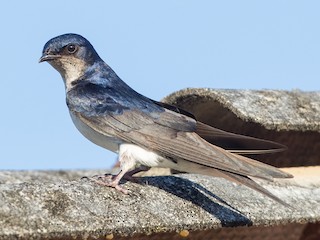
How to identify the Grey-breasted Martin
Progne chalybea
Spotted a bird? Identify it instantly with the Birdby app
Open the appTo correctly identify the Grey-breasted Martin (Progne chalybea), check each of these features. Birds can be tricky: habit, habitat, and call often confirm a sighting that a single photo cannot.
Size at a glance
- Length
- 18-20 cm
- Wingspan
- 39-41 cm
- Weight
- 36-49 g
Physical features to check
- 1
Plumage
Overall feather coloration and pattern.
Adult males and females are similar. Upperparts are glossy, iridescent steel-blue to blue-black. The head and nape are also dark blue-black. Underparts are smoky grey, becoming whiter on the lower belly and undertail coverts. The throat and upper breast are concolorous with the grey underparts. The wings and tail are blackish. Juveniles have duller, less iridescent upperparts and browner underparts.
- 2
Beak shape
Shape and color of the bill: a key field mark.
Short, conical, and broad at the base, perfectly adapted for hawking insects in flight.
- 3
Eye color
Iris color and any distinctive eye markings.
Dark brown
- 4
Leg color
Leg and foot color.
Black
- 5
Distinguishing features
Standout features that separate this species.
The combination of glossy dark blue-black upperparts and clear smoky grey underparts is the primary distinguishing feature. Its relatively large size for a swallow also stands out.
- 6
Juvenile appearance
How young birds differ from adults.
Juveniles are duller than adults, with less intense iridescence on the upperparts. Their underparts are a duller, often brownish-grey and can appear streaky, especially on the breast, before their first pre-basic molt.
- 7
Seasonal changes
Plumage variation between breeding and non-breeding seasons.
No significant seasonal plumage changes. Plumage remains consistent throughout the year, aside from the molting process.
- 8
Sexual dimorphism
How males and females differ.
Minimal. Males and females are largely alike in plumage. Some sources suggest males may be slightly more iridescent, but this is often not reliably distinguishable in the field.
Key field marks
- Plumage Coloration. Look for the stark contrast between iridescent blue-black upperparts and smoky grey underparts. This is the most reliable field mark.
- Size and Shape. It's a relatively large swallow with a typical swallow-like, deeply forked tail (though less deeply forked than barn swallows) and broad, pointed wings.
- Flight Pattern. Observe its strong, soaring flight with graceful glides mixed with deep wing beats. It often flies higher than other swallows, but also patrols lower over open areas.
- Vocalizations. Listen for its distinctive gurgling, burry warble or sharp 'scheep' calls, especially around potential nesting sites or roosts.
Explore the Grey-breasted Martin
Identify birds anywhere
Free on iOS, Android, and Web. Photo & sound identification, full species database, and your personal life list.