
Spotted a bird? Identify it instantly with the Birdby app
Open the appAbout
The Rose-ringed Parakeet is a medium-sized, long-tailed parrot, predominantly green, known for its distinctive rose-pink and black neck ring in adult males. It is native to a wide range across Africa and the Indian subcontinent, but has established feral populations in many urban areas worldwide due to escapes from captivity. Highly adaptable and intelligent, it is often seen in large, noisy flocks.
Size & lifespan
- Length
- 38-42 cm (including tail)
- Wingspan
- 42-48 cm
- Weight
- 115-140 g
- Lifespan
- Up to 20-30 years in the wild, longer in captivity
- Diet
- Herbivore (frugivore, granivore, nectarivore)
Physical characteristics
- Plumage
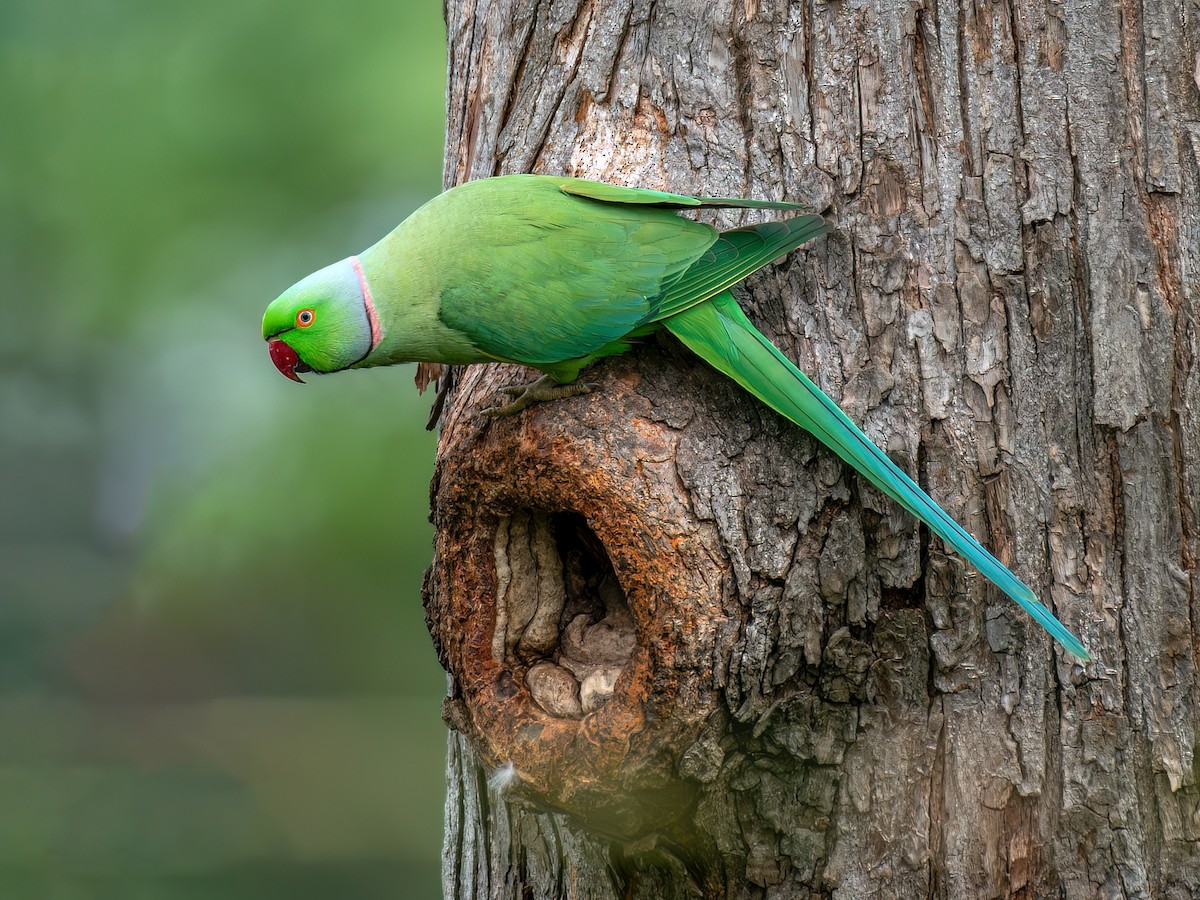
- Predominantly bright grass-green plumage. The underside is slightly paler, and the undertail coverts are yellowish-green. The flight feathers are darker green with bluish tips. The tail is long and tapered, with central feathers being blue-green and outer feathers green.
- Beak shape
- Strong, hooked, and reddish-pink to dark red, with a black tip on the upper mandible. The lower mandible is typically darker.
- Eye color
- Pale yellow to whitish iris with a prominent orange-red orbital ring.
- Leg color
- Greyish-pink to grey
- Distinguishing features
- Adult males possess a distinctive rose-pink collar around the nape and sides of the neck, bordered by a black stripe extending from the lower mandible to the sides of the neck. This 'rose-ring' is the most prominent field mark for males.
- Juvenile appearance
- Juveniles are similar to adult females, lacking the distinct neck ring. Their plumage is generally duller green, and their beak is paler, often brownish-orange, gradually developing the adult red coloration. The iris is darker, becoming paler with age.
- Seasonal changes
- No significant seasonal plumage changes. The plumage remains consistent throughout the year.
- Sexual dimorphism
- Males have a prominent rose-pink and black neck ring. Females lack this ring, having a paler, often greyish-green or dusky green shadow of a ring, or no ring at all. Juveniles resemble females.
How to identify
- 1
Size and Shape
Look for a medium-sized, slender parrot with a very long, pointed tail, which makes up about half of its total length.
- 2
Plumage Color
Observe the overall bright grass-green plumage. Note the slightly paler underside.
- 3
Beak Color
Identify the prominent reddish-pink to dark red, hooked beak with a black tip on the upper mandible.
- 4
Neck Ring (Males)
For adult males, look for the distinctive rose-pink collar on the nape and sides of the neck, bordered by a black stripe from the lower mandible. This is the most reliable male identification feature.
- 5
Absence of Neck Ring (Females/Juveniles)
Females and juveniles lack the prominent rose-pink and black neck ring, often showing a dusky green or greyish shadow of a ring, or no ring at all. Juveniles also have a paler, brownish-orange bill.
- 6
Vocalization
Listen for their loud, shrill, and piercing 'kree-kree-kree' or 'kyaak-kyaak' calls, often given in flight or when in flocks.
- 7
Flight Pattern
Observe their strong, direct, and swift flight with rapid wingbeats, often in noisy flocks.
Habitat & range
- Biomes
- Forest edges, woodlands, savannas, semi-arid regions, agricultural lands, urban parks, gardens, and suburban areas.
- Geographic range
- Native to two disjunct populations: one across a broad belt of Africa (from Mauritania and Senegal east to Ethiopia and Somalia) and another in the Indian subcontinent (from Pakistan, India, Nepal, and Bangladesh to Myanmar). Feral populations are established in numerous countries worldwide, including much of Western Europe (e.g., UK, Netherlands, Belgium, Germany, France, Spain, Italy), the Middle East, Japan, and parts of North America (e.g., Florida, California).
- Elevation range
- Sea level up to approximately 1,600 meters (5,200 feet), occasionally higher in some parts of its native range.
- Preferred environments
- Prefers open wooded habitats, cultivated areas, and urban environments with mature trees for roosting and nesting. Highly adaptable to human-modified landscapes.
Behavior
- Activity time
- Diurnal, most active during the early morning and late afternoon, with a midday rest period.
- Feeding habits
- Feeds primarily on seeds, fruits, berries, nuts, blossoms, and nectar. It can be a significant agricultural pest, especially in its native range, consuming ripening crops such as maize, millet, and sunflower. Forages in trees and on the ground.
- Social behavior
- Highly social, typically found in pairs or small family groups during the breeding season, but forms large, often noisy, communal roosts outside the breeding season, sometimes numbering thousands of individuals. These roosts can be quite spectacular.
- Flight pattern
- Strong, direct, and swift flight with rapid wingbeats. Often flies in noisy flocks, especially at dawn and dusk when commuting to and from roosting sites. Characterized by a distinctive undulating flight pattern over longer distances.
- Migration pattern
- Generally resident throughout its range, though some local movements may occur in response to food availability. Feral populations are also resident.
- Territoriality
- Pairs defend their nest site during the breeding season, but are generally not territorial outside of this period, especially when foraging or roosting in large flocks.
Song & calls
- Song
- Does not have a complex song. Vocalizations are primarily calls.
- Call
- A variety of loud, shrill, and piercing calls. The most common call is a harsh, ringing 'kree-kree-kree' or 'kyaak-kyaak'. Also produces squawks, screeches, and chattering sounds. Calls are often given in flight or when perched in flocks.
- When they vocalize
- Vocalizes frequently throughout the day, especially when flying, feeding, or at communal roosts at dawn and dusk.
Breeding & reproduction
- Breeding season
- Varies geographically: typically November-June in India, August-November in Africa, and February-June in feral European populations.
- Nesting habits
- Cavity nesters. They utilize natural tree hollows, old woodpecker holes, or crevices in buildings. They do not construct a nest but may line the cavity with wood chips or other debris. They often compete with native species for nesting sites in introduced ranges.
- Clutch size
- 2-6 eggs, typically 3-4.
- Egg description
- White, oval, smooth, and glossy. Approximately 30 x 24 mm.
- Incubation period
- 22-24 days, primarily by the female.
- Fledging period
- Approximately 7 weeks (45-55 days) after hatching. Young are fed by both parents.
- Parental care
- Both parents participate in feeding the chicks. The male often feeds the female during incubation. After fledging, juveniles remain with their parents for some time, forming family groups.
Where to find
Urban Parks and Gardens
Common in cities and towns, especially where there are mature trees, fruit trees, and bird feeders. Look in London, Amsterdam, Brussels, and many Indian cities.
Agricultural Areas
Often found in cultivated fields, orchards, and plantations where food sources are abundant, particularly in their native range.
Woodlands and Forest Edges
In native ranges, they inhabit open woodlands, savannas, and the edges of forests, especially near water sources.
Communal Roosts
At dawn and dusk, observe large flocks gathering at specific trees or groves for communal roosting. These can be very noisy and conspicuous.
Field tips
- Listen for Calls. Their loud, distinctive calls are often heard before the birds are seen, especially when they are flying overhead or in large flocks.
- Look in Trees. Scan the canopy of large trees, especially those with ripening fruits, seeds, or blossoms. They are often well-camouflaged by their green plumage.
- Visit Roosting Sites. Identify known communal roosting sites in urban areas and visit at dawn or dusk to witness large numbers of parakeets arriving or departing.
- Check Bird Feeders. In areas where they are established, they may visit garden bird feeders, especially for sunflower seeds.
- Observe Flight. Their fast, direct flight and long tail are good indicators, even at a distance. Look for flocks flying purposefully.
Similar species
Alexandrine Parakeet
Psittacula eupatria
Significantly larger (58-62 cm) with a much heavier bill. Males have a broader black neck stripe and a prominent maroon patch on the wing coverts, which is absent in the Rose-ringed Parakeet. The call of the Alexandrine is deeper and more resonant.
Plum-headed Parakeet
Psittacula cyanocephala
Smaller (33 cm) and more slender. Males have a distinctive plum-colored head with a black neck ring, while females have a greyish-blue head. Lacks the prominent red bill of the Rose-ringed Parakeet.
Mauritius Parakeet
Psittacula eques
Endemic to Mauritius, critically endangered. Similar in size but has a more robust bill and a slightly different shade of green. The male's neck ring is less distinct and often broken. Geographic range is a key differentiator.
Quick facts
- Native Range:
- Africa and Indian Subcontinent
- Introduced Range:
- Widespread globally, especially Europe, Middle East, Japan, North America
- Diet:
- Seeds, fruits, nuts, blossoms, nectar
- Sociality:
- Highly social, forms large flocks and communal roosts
- Nesting:
- Cavity nester (tree hollows, building crevices)
- Conservation Status:
- Least Concern (IUCN)
Fun facts
- The Rose-ringed Parakeet is one of the most widely distributed parrot species in the world, largely due to its popularity as a cage bird and subsequent escapes.
- In some parts of its introduced range, particularly in Europe, it is considered an invasive species due to competition with native birds for nesting sites and potential damage to crops.
- They are highly intelligent birds and can be taught to mimic human speech, though their natural calls are quite harsh.
- The species name 'krameri' honors Wilhelm Heinrich Kramer, an Austrian physician and naturalist.
- Feral populations in urban areas often show remarkable adaptability, utilizing artificial structures for nesting and feeding on a wide variety of cultivated plants.
Scientific classification
- Kingdom
- Animalia
- Phylum
- Chordata
- Class
- Aves
- Order
- Psittaciformes
- Family
- Psittaculidae
- Genus
- Psittacula
- Species
- Psittacula krameri
Explore the Rose-ringed Parakeet
Identify birds anywhere
Free on iOS, Android, and Web. Photo & sound identification, full species database, and your personal life list.