
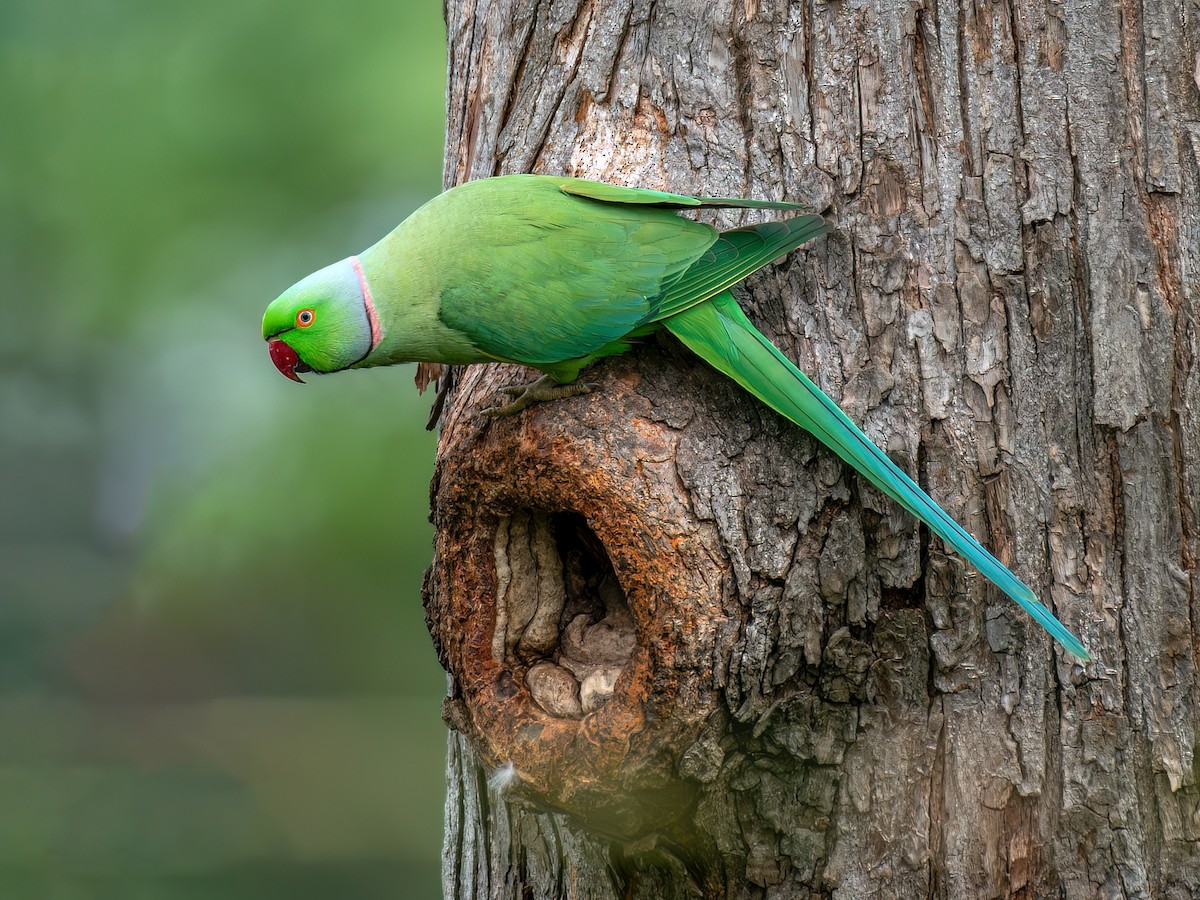
Where does the Rose-ringed Parakeet live?
Psittacula krameri
Spotted a bird? Identify it instantly with the Birdby app
Open the appThe Rose-ringed Parakeet lives in specific habitats and regions. Knowing where, and when, to look improves your chances of a successful sighting.
Biomes
Forest edges, woodlands, savannas, semi-arid regions, agricultural lands, urban parks, gardens, and suburban areas.
Geographic range
Native to two disjunct populations: one across a broad belt of Africa (from Mauritania and Senegal east to Ethiopia and Somalia) and another in the Indian subcontinent (from Pakistan, India, Nepal, and Bangladesh to Myanmar). Feral populations are established in numerous countries worldwide, including much of Western Europe (e.g., UK, Netherlands, Belgium, Germany, France, Spain, Italy), the Middle East, Japan, and parts of North America (e.g., Florida, California).
Preferred environments
Prefers open wooded habitats, cultivated areas, and urban environments with mature trees for roosting and nesting. Highly adaptable to human-modified landscapes.
Elevation range
Sea level up to approximately 1,600 meters (5,200 feet), occasionally higher in some parts of its native range.
Where to look
Urban Parks and Gardens
Common in cities and towns, especially where there are mature trees, fruit trees, and bird feeders. Look in London, Amsterdam, Brussels, and many Indian cities.
Agricultural Areas
Often found in cultivated fields, orchards, and plantations where food sources are abundant, particularly in their native range.
Woodlands and Forest Edges
In native ranges, they inhabit open woodlands, savannas, and the edges of forests, especially near water sources.
Communal Roosts
At dawn and dusk, observe large flocks gathering at specific trees or groves for communal roosting. These can be very noisy and conspicuous.
Field tips
- Listen for Calls. Their loud, distinctive calls are often heard before the birds are seen, especially when they are flying overhead or in large flocks.
- Look in Trees. Scan the canopy of large trees, especially those with ripening fruits, seeds, or blossoms. They are often well-camouflaged by their green plumage.
- Visit Roosting Sites. Identify known communal roosting sites in urban areas and visit at dawn or dusk to witness large numbers of parakeets arriving or departing.
- Check Bird Feeders. In areas where they are established, they may visit garden bird feeders, especially for sunflower seeds.
- Observe Flight. Their fast, direct flight and long tail are good indicators, even at a distance. Look for flocks flying purposefully.
Migration
Generally resident throughout its range, though some local movements may occur in response to food availability. Feral populations are also resident.
Explore the Rose-ringed Parakeet
Identify birds anywhere
Free on iOS, Android, and Web. Photo & sound identification, full species database, and your personal life list.