
Spotted a bird? Identify it instantly with the Birdby app
Open the appAbout
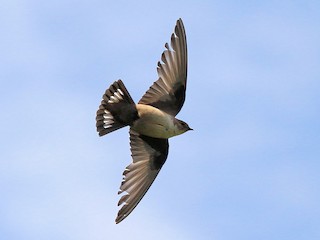
The Eurasian Crag Martin is a medium-sized passerine bird belonging to the swallow family. It is characterized by its dull brownish plumage, contrasting darker flight feathers, and a distinctive pattern of white spots on its undertail coverts, visible primarily in flight. Known for its agile flight and preference for mountainous and rocky habitats, it often nests on cliffs and man-made structures.
Size & lifespan
- Length
- 13-15 cm (5.1-5.9 in)
- Wingspan
- 32-34 cm (12.6-13.4 in)
- Weight
- 18-24 g (0.63-0.85 oz)
- Lifespan
- Typically 3-5 years, but can live up to 8 years in the wild.
- Diet
- Strictly insectivorous, primarily consuming small flying insects such as flies, midges, beetles, and sometimes small butterflies and moths, caught on the wing.
Physical characteristics
- Plumage
- Adults have a uniform dull grey-brown plumage on the upperparts (crown, back, wings, tail). The underparts are slightly paler, greyish-white on the throat and breast, fading to off-white on the belly. The undertail coverts are dark with conspicuous white oval spots on the inner webs of the outermost tail feathers, visible when the tail is fanned. Flight feathers are darker brown.
- Beak shape
- Small, flattened, and short, typical of aerial insectivores, adapted for catching insects in flight.
- Eye color
- Dark brown.
- Leg color
- Short, dark brown to blackish legs and feet, adapted for perching on vertical surfaces rather than walking.
- Distinguishing features
- The most reliable distinguishing feature is the series of white oval spots on the undertail coverts, visible when the tail is spread. Its plumage is generally paler and less contrasting than that of other hirundines. The short, broad wings and relatively square tail, compared to the deeply forked tails of typical swallows, are also characteristic.
- Juvenile appearance
- Juveniles resemble adults but have paler, looser plumage with buffy tips to the feathers of the upperparts, giving a slightly scaly appearance. The white spots on the undertail are less distinct in freshly fledged young.
- Seasonal changes
- No significant seasonal changes in plumage are observed. Plumage may appear slightly worn before the annual molt, which typically occurs after the breeding season.
- Sexual dimorphism
- Males and females are visually identical, exhibiting no significant sexual dimorphism in plumage or size.
How to identify
- 1
Plumage Coloration
Look for the uniform dull grey-brown upperparts and paler underparts, which distinguishes it from the contrasting dark and white plumage of most other hirundines.
- 2
Tail Pattern
The most crucial field mark: observe the undertail coverts for the series of prominent white oval spots on the outer tail feathers when the bird spreads its tail in flight or landing. The tail itself is relatively square to slightly forked.
- 3
Flight Style
Note its distinctive leisurely flight, characterized by slow, rather heavy wingbeats and graceful glides, often close to cliff faces or structures. It's less frenetic than a swift or typical swallow.
- 4
Habitat Preference
Its strong association with rocky outcrops, cliffs, bridges, and tall buildings is a key indicator. If you see a hirundine flying near such structures in mountainous or hilly terrain, it's a good candidate.
- 5
Vocalization
Listen for its characteristic soft, dry 'trrr' or 'chrr' contact call, particularly while it's in flight around its nesting or foraging areas.
Habitat & range
- Biomes
- Montane regions, rocky gorges, cliffs, canyons, coastal cliffs, and increasingly, urban and suburban environments with tall buildings and bridges.
- Geographic range
- Found across Southern Europe, North Africa, the Middle East, and central Asia, extending eastward to the Himalayas and China. It is largely migratory in the colder northern and eastern parts of its range, wintering in Africa and India, while resident in the warmer southern and western areas.
- Elevation range
- Typically breeds at altitudes from sea level up to 5,000 meters (16,400 feet) in the Himalayas, often at higher elevations during summer.
- Preferred environments
- Prefers environments with vertical rock faces for nesting and open airspace for foraging, such as mountains, ravines, and coastal cliffs. Increasingly adapts to human-made structures like bridges, dams, and tall buildings.
Behavior
- Activity time
- Diurnal. Active forager during daylight hours.
- Feeding habits
- Forages exclusively on the wing, catching flying insects in continuous, agile flight. It typically hunts close to cliff faces or structures, often performing acrobatic maneuvers. It may concentrate feeding activity in areas with insect swarms.
- Social behavior
- Generally breeds in loose colonies, sometimes solitary. Outside the breeding season, they may form larger flocks, occasionally mixed with other hirundines, gathering at roost sites.
- Flight pattern
- Flight is strong, agile, and graceful, characterized by slow, measured wingbeats interspersed with glides, often close to cliff faces. It is less erratic and faster than that of the Eurasian Sand Martin, and less buoyant than the Common Swift.
- Migration pattern
- Northern and eastern populations are migratory, moving south to winter in North Africa, the Levant, and parts of India. Southern and western populations (e.g., Iberia, parts of Italy, North Africa) are largely resident or undertake short-distance dispersive movements. Spring migration occurs from March to May, and autumn migration from September to November.
- Territoriality
- While nesting, pairs defend a small area immediately around their nest. They are generally tolerant of other breeding pairs in loose colonies.
Song & calls
- Song
- The song is a simple, dry, scratchy twittering, often delivered from a perch or in flight. It lacks the musical quality of many other swallow songs.
- Call
- The most common call is a soft, dry 'trrr' or 'chrr', often given in flight. An alarm call is a more insistent, slightly harsher version of the contact call.
- When they vocalize
- Calls are given frequently during flight and around nesting sites. Song is primarily heard during the breeding season.
Breeding & reproduction
- Breeding season
- Typically from April to July, with two broods common in many areas, sometimes three.
- Nesting habits
- Nests are constructed primarily by the female, from mud pellets gathered from puddles or stream banks, lined with grass and feathers. They are semicircular or quarter-cup shaped, built on vertical surfaces under overhangs, ledges, or eaves of buildings and bridges. Often built in loose colonies.
- Clutch size
- Usually 3-5 eggs.
- Egg description
- Typically 2-5 (usually 3-4) glossy white eggs, sometimes with fine reddish-brown speckles, particularly at the blunt end.
- Incubation period
- 13-17 days, primarily by the female, but both parents may participate.
- Fledging period
- 22-32 days, both parents feed the young.
- Parental care
- Both parents are actively involved in incubation, brooding, and feeding the nestlings. Juveniles are fed by parents for a period after fledging.
Where to find
Mountainous Regions
Search in rocky gorges, cliffs, and mountain valleys, especially those with good air currents for insect foraging.
Coastal Cliffs
Along coastlines with suitable cliff faces, particularly in the Mediterranean and Atlantic regions.
Man-made Structures
Increasingly found around bridges (especially arches), large dams, quarries, and tall, modern buildings in urban and suburban areas, preferring structures that mimic natural cliffs.
Rivers and Lakes
Often found foraging over water bodies in mountainous regions where insect prey is abundant.
Field tips
- Scan Cliff Faces. Continuously scan cliff faces, under ledges, and cave entrances for individuals perching or flying in and out of potential nest sites.
- Observe Flight Pattern. Pay attention to their distinctive flight style – slow wingbeats and gliding – as they patrol the air near vertical structures. This can help differentiate them at a distance.
- Look for White Tail Spots. When a bird is flying towards or away from you, or banking, try to catch a glimpse of the fanned tail. The white spots are diagnostic.
- Listen for Calls. Their soft, dry calls are often heard before the bird is seen, especially when a pair is active around a nest site.
- Visit Known Breeding Sites. Consult local birding guides or websites for known nesting locations in your area, particularly bridges or cliff networks.
Similar species
Barn Swallow
Hirundo rustica
Barn Swallows have iridescent blue upperparts, creamy-white underparts, and a deeply forked tail with long streamers. They also have a rufous chin and throat. Eurasian Crag Martins are dull grey-brown overall with a square tail and white spots.
House Martin
Delichon urbicum
House Martins have glossy blue-black upperparts and pure white underparts and rump, providing a strong contrast. Their tail is shorter and less deeply forked than a Barn Swallow's, but lacks the white spots of the Crag Martin. They often nest higher on buildings, usually under eaves.
Sand Martin (Bank Swallow)
Riparia riparia
Sand Martins are smaller and browner overall than Crag Martins, with a distinct brown breast band and more pointed wings. They nest in burrows in sandy banks. Crag Martins lack a breast band and have white spots on the undertail.
Pale Crag Martin
Ptyonoprogne obsoleta
Pale Crag Martins are generally paler and more sandy-coloured, particularly on the underparts, and are found in drier, more arid regions. Their white tail spots can be less distinct, but identification often requires careful observation of overall tone and precise range.
African Rock Martin
Ptyonoprogne fuligula
The African Rock Martin is often darker and sootier brown than the Eurasian Crag Martin and has a less distinct white tail spot pattern. Its range is confined to Africa, largely separated from the Eurasian species except for limited overlap zones.
Quick facts
- Primary Habitat:
- Cliffs and rocky areas
- Diet:
- Insects caught in flight
- Nest Type:
- Mud cup nest on vertical surfaces
- Migration:
- Partial migrant; resident in warmer areas
- Identification Key:
- White spots on undertail coverts
Fun facts
- The Eurasian Crag Martin is one of the few hirundines that regularly perches on vertical rock faces, holding on with its strong, short claws.
- Its dull coloration provides excellent camouflage against the rocky cliffs it inhabits.
- In some parts of its range, it has shown a remarkable adaptation to urban environments, using tall buildings and bridges as surrogate cliffs for nesting.
- Unlike many swallows, it often forages by making wide, sweeping circles high above its nesting site rather than just skimming low over water.
Scientific classification
- Kingdom
- Animalia
- Phylum
- Chordata
- Class
- Aves
- Order
- Passeriformes
- Family
- Hirundinidae
- Genus
- Ptyonoprogne
- Species
- Ptyonoprogne rupestris
Explore the Eurasian Crag Martin
Identify birds anywhere
Free on iOS, Android, and Web. Photo & sound identification, full species database, and your personal life list.