
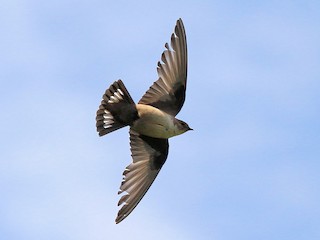
How to identify the Eurasian Crag Martin
Ptyonoprogne rupestris
Spotted a bird? Identify it instantly with the Birdby app
Open the appTo correctly identify the Eurasian Crag Martin (Ptyonoprogne rupestris), check each of these features. Birds can be tricky: habit, habitat, and call often confirm a sighting that a single photo cannot.
Size at a glance
- Length
- 13-15 cm (5.1-5.9 in)
- Wingspan
- 32-34 cm (12.6-13.4 in)
- Weight
- 18-24 g (0.63-0.85 oz)
Physical features to check
- 1
Plumage
Overall feather coloration and pattern.
Adults have a uniform dull grey-brown plumage on the upperparts (crown, back, wings, tail). The underparts are slightly paler, greyish-white on the throat and breast, fading to off-white on the belly. The undertail coverts are dark with conspicuous white oval spots on the inner webs of the outermost tail feathers, visible when the tail is fanned. Flight feathers are darker brown.
- 2
Beak shape
Shape and color of the bill: a key field mark.
Small, flattened, and short, typical of aerial insectivores, adapted for catching insects in flight.
- 3
Eye color
Iris color and any distinctive eye markings.
Dark brown.
- 4
Leg color
Leg and foot color.
Short, dark brown to blackish legs and feet, adapted for perching on vertical surfaces rather than walking.
- 5
Distinguishing features
Standout features that separate this species.
The most reliable distinguishing feature is the series of white oval spots on the undertail coverts, visible when the tail is spread. Its plumage is generally paler and less contrasting than that of other hirundines. The short, broad wings and relatively square tail, compared to the deeply forked tails of typical swallows, are also characteristic.
- 6
Juvenile appearance
How young birds differ from adults.
Juveniles resemble adults but have paler, looser plumage with buffy tips to the feathers of the upperparts, giving a slightly scaly appearance. The white spots on the undertail are less distinct in freshly fledged young.
- 7
Seasonal changes
Plumage variation between breeding and non-breeding seasons.
No significant seasonal changes in plumage are observed. Plumage may appear slightly worn before the annual molt, which typically occurs after the breeding season.
- 8
Sexual dimorphism
How males and females differ.
Males and females are visually identical, exhibiting no significant sexual dimorphism in plumage or size.
Key field marks
- Plumage Coloration. Look for the uniform dull grey-brown upperparts and paler underparts, which distinguishes it from the contrasting dark and white plumage of most other hirundines.
- Tail Pattern. The most crucial field mark: observe the undertail coverts for the series of prominent white oval spots on the outer tail feathers when the bird spreads its tail in flight or landing. The tail itself is relatively square to slightly forked.
- Flight Style. Note its distinctive leisurely flight, characterized by slow, rather heavy wingbeats and graceful glides, often close to cliff faces or structures. It's less frenetic than a swift or typical swallow.
- Habitat Preference. Its strong association with rocky outcrops, cliffs, bridges, and tall buildings is a key indicator. If you see a hirundine flying near such structures in mountainous or hilly terrain, it's a good candidate.
- Vocalization. Listen for its characteristic soft, dry 'trrr' or 'chrr' contact call, particularly while it's in flight around its nesting or foraging areas.
Explore the Eurasian Crag Martin
Identify birds anywhere
Free on iOS, Android, and Web. Photo & sound identification, full species database, and your personal life list.