
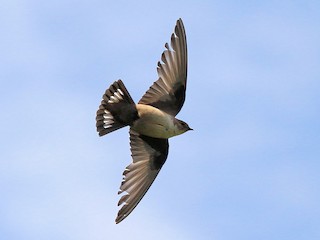
Where does the Eurasian Crag Martin live?
Ptyonoprogne rupestris
Spotted a bird? Identify it instantly with the Birdby app
Open the appThe Eurasian Crag Martin lives in specific habitats and regions. Knowing where, and when, to look improves your chances of a successful sighting.
Biomes
Montane regions, rocky gorges, cliffs, canyons, coastal cliffs, and increasingly, urban and suburban environments with tall buildings and bridges.
Geographic range
Found across Southern Europe, North Africa, the Middle East, and central Asia, extending eastward to the Himalayas and China. It is largely migratory in the colder northern and eastern parts of its range, wintering in Africa and India, while resident in the warmer southern and western areas.
Preferred environments
Prefers environments with vertical rock faces for nesting and open airspace for foraging, such as mountains, ravines, and coastal cliffs. Increasingly adapts to human-made structures like bridges, dams, and tall buildings.
Elevation range
Typically breeds at altitudes from sea level up to 5,000 meters (16,400 feet) in the Himalayas, often at higher elevations during summer.
Where to look
Mountainous Regions
Search in rocky gorges, cliffs, and mountain valleys, especially those with good air currents for insect foraging.
Coastal Cliffs
Along coastlines with suitable cliff faces, particularly in the Mediterranean and Atlantic regions.
Man-made Structures
Increasingly found around bridges (especially arches), large dams, quarries, and tall, modern buildings in urban and suburban areas, preferring structures that mimic natural cliffs.
Rivers and Lakes
Often found foraging over water bodies in mountainous regions where insect prey is abundant.
Field tips
- Scan Cliff Faces. Continuously scan cliff faces, under ledges, and cave entrances for individuals perching or flying in and out of potential nest sites.
- Observe Flight Pattern. Pay attention to their distinctive flight style – slow wingbeats and gliding – as they patrol the air near vertical structures. This can help differentiate them at a distance.
- Look for White Tail Spots. When a bird is flying towards or away from you, or banking, try to catch a glimpse of the fanned tail. The white spots are diagnostic.
- Listen for Calls. Their soft, dry calls are often heard before the bird is seen, especially when a pair is active around a nest site.
- Visit Known Breeding Sites. Consult local birding guides or websites for known nesting locations in your area, particularly bridges or cliff networks.
Migration
Northern and eastern populations are migratory, moving south to winter in North Africa, the Levant, and parts of India. Southern and western populations (e.g., Iberia, parts of Italy, North Africa) are largely resident or undertake short-distance dispersive movements. Spring migration occurs from March to May, and autumn migration from September to November.
Explore the Eurasian Crag Martin
Identify birds anywhere
Free on iOS, Android, and Web. Photo & sound identification, full species database, and your personal life list.