
Spotted a bird? Identify it instantly with the Birdby app
Open the appAbout
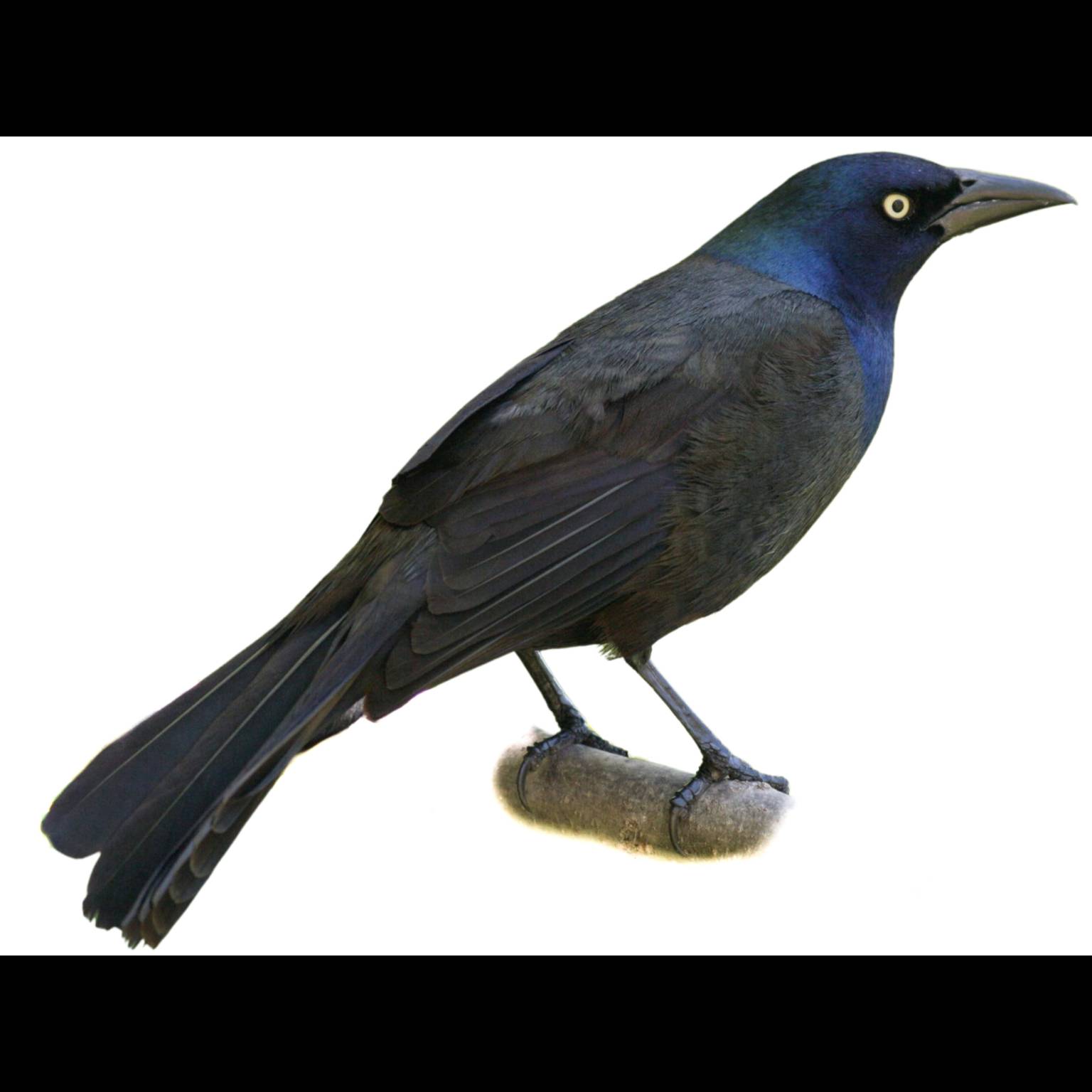
The Common Grackle is a large, iridescent blackbird with a long tail and a stout bill. It is a highly adaptable species, often found in open woodlands, agricultural areas, and urban environments across much of North America. Known for its distinctive calls and social behavior, especially during migration and roosting.
Size & lifespan
- Length
- 28-34 cm (11-13.4 in)
- Wingspan
- 36-46 cm (14.2-18.1 in)
- Weight
- 74-142 g (2.6-5.0 oz)
- Lifespan
- Average 4-7 years in the wild, up to 20 years recorded
- Diet
- Omnivore
Physical characteristics
- Plumage
- Adult males are entirely iridescent black, appearing purple, blue, green, or bronze depending on the light, particularly on the head and neck. The body is typically bronze-purple. Adult females are similar but often duller, with less intense iridescence and sometimes a slightly browner cast. Both sexes have a long, keel-shaped tail.
- Beak shape
- Stout, conical, and sharply pointed, black in color.
- Eye color
- Pale yellow, contrasting sharply with the dark plumage.
- Leg color
- Black
- Distinguishing features
- Large size, long keel-shaped tail (especially noticeable in flight), iridescent plumage, and bright yellow eyes.
- Juvenile appearance
- Juveniles are dull brown overall, lacking the iridescence of adults. Their eyes are dark brown, gradually changing to pale yellow over their first few months.
- Seasonal changes
- No significant seasonal plumage changes; iridescence may appear more vibrant in fresh plumage after molting.
- Sexual dimorphism
- Males are typically larger and have more pronounced iridescence than females. Females may appear duller and sometimes have a slightly shorter tail.
How to identify
- 1
Size and Shape
Look for a relatively large, slender blackbird with a long, wedge-shaped body and a distinctive long, keel-shaped tail, especially prominent in flight.
- 2
Plumage Color and Iridescence
Observe the overall glossy black plumage. In good light, look for iridescent sheens of purple, blue, green, or bronze, particularly on the head and neck. The body often has a bronze-purple hue.
- 3
Eye Color
Note the striking pale yellow eyes, which contrast sharply with the dark head. This is a key field mark for adults.
- 4
Tail Shape
Pay attention to the tail, which is long and often held in a V-shape or 'keel' during flight, especially when landing or taking off.
- 5
Vocalizations
Listen for their characteristic harsh, squeaky, 'rusty gate' song and sharp 'check' calls.
- 6
Behavior
Look for them foraging on the ground in open areas, often in flocks, or gathering in large communal roosts.
Habitat & range
- Biomes
- Forest edges, open woodlands, grasslands, agricultural fields, suburban parks, urban areas, marshes, and riparian zones.
- Geographic range
- Breeds across most of North America east of the Rocky Mountains, from central Canada south to the Gulf Coast of the United States. Winters primarily in the southern and eastern United States.
- Elevation range
- Typically found from sea level up to approximately 1,500 meters (5,000 feet).
- Preferred environments
- Highly adaptable, preferring open areas with scattered trees, often near water. Commonly found in human-modified landscapes such as parks, golf courses, and agricultural fields.
Behavior
- Activity time
- Diurnal
- Feeding habits
- Highly opportunistic omnivores. Diet includes a wide variety of insects (beetles, grasshoppers, caterpillars), spiders, earthworms, small fish, frogs, mice, eggs and nestlings of other birds, and carrion. They also consume significant amounts of seeds, grains (especially corn), berries, and fruits. They forage on the ground, in trees, and in shallow water. Known to 'dip' food in water before eating, a behavior called 'dunking'.
- Social behavior
- Highly social, especially outside the breeding season. They form large flocks, sometimes numbering in the thousands or even millions, often mixing with other blackbird species (Red-winged Blackbirds, European Starlings, Brown-headed Cowbirds) for foraging and roosting. During the breeding season, they are more territorial but may nest in loose colonies.
- Flight pattern
- Strong, direct, and somewhat undulating flight with steady wingbeats. The long, keel-shaped tail is often held in a V-shape during flight, especially when gliding or landing.
- Migration pattern
- Partial migrant. Northern populations are migratory, moving south for the winter. Southern populations are largely resident. Migratory movements occur in large flocks, often in late fall and early spring.
- Territoriality
- During the breeding season, males defend a small territory around the nest site. Outside of breeding, they are not territorial and gather in large communal roosts.
Song & calls
- Song
- A harsh, unmusical, squeaky song described as a 'rusty gate' sound, often a series of creaking notes followed by a high-pitched whistle or gurgle: 'squeee-eek-tsee-tsee'.
- Call
- Common calls include a sharp 'check' or 'chink' note, especially when alarmed or in flight. They also produce a variety of harsh rattles and whistles within their flocks.
- When they vocalize
- Most vocal during the breeding season and at communal roosts, but calls can be heard year-round.
Breeding & reproduction
- Breeding season
- Typically April to July, with peak activity in May and June.
- Nesting habits
- Nests are usually built in dense trees or shrubs, often conifers, 3-10 meters (10-30 feet) above the ground. They may also nest in cavities, old buildings, or even on utility poles. Nests are bulky cups made of twigs, grasses, mud, and sometimes human debris, lined with finer materials.
- Clutch size
- 3-7 eggs (average 4-5)
- Egg description
- 3-7 eggs (typically 4-5), pale blue to greenish-blue, heavily marked with dark brown, purple, or black spots and blotches, especially at the larger end.
- Incubation period
- 12-14 days
- Fledging period
- 12-17 days after hatching
- Parental care
- Both parents participate in nest building, incubation (primarily female), and feeding of the young. Young are fed a diet rich in insects.
Where to find
Parks and Suburban Areas
Common in urban and suburban parks, backyards, and golf courses, especially where there are open lawns and scattered trees.
Agricultural Fields
Frequently found in cornfields and other agricultural landscapes, where they feed on grains and insects.
Open Woodlands and Forest Edges
Look for them at the edges of forests, in open woodlands, and along riparian corridors.
Wetlands and Marshes
Can be found foraging and nesting near water bodies, including marshes and pond edges.
Communal Roosts
During fall and winter, look for massive flocks gathering at dusk in large trees or dense vegetation for communal roosting, often with other blackbird species.
Field tips
- Look for Iridescence. The iridescent plumage is best seen in direct sunlight. Observe them from different angles to appreciate the shifting colors.
- Listen for Calls. Their distinctive 'rusty gate' song and sharp 'check' calls are often heard before the bird is seen, especially in spring.
- Observe Flocking Behavior. Outside of the breeding season, look for large, noisy flocks, often mixed with other blackbirds, foraging in fields or gathering at roosts.
- Check for Yellow Eyes. The bright yellow eye is a crucial identification feature for adult Common Grackles, distinguishing them from some similar species.
- Watch for 'Dunking' Behavior. If near water, you might observe them dipping food items into the water before consuming them.
Similar species
Boat-tailed Grackle
Quiscalus major
Boat-tailed Grackles are larger, especially the males, with an even longer, more pronounced keel-shaped tail. Males are glossy black with a purplish sheen, while females are duller brown. Their range is restricted to coastal areas of the southeastern U.S. and Gulf Coast. Common Grackles have bright yellow eyes, while Boat-tailed Grackles have dark eyes in the eastern part of their range and yellow eyes in the western part, making eye color less reliable for distinction in some areas.
Great-tailed Grackle
Quiscalus mexicanus
Great-tailed Grackles are also larger than Common Grackles, with an extremely long tail, particularly in males. Males are iridescent black with a purplish-blue sheen. Females are dark brown with a paler throat. Their range is primarily in the southwestern U.S., Mexico, and Central America. Common Grackles have bright yellow eyes, while Great-tailed Grackles have yellow eyes, but their larger size and longer tail are key differentiators.
Brewer's Blackbird
Euphagus cyanocephalus
Brewer's Blackbirds are smaller and have a shorter tail than Common Grackles. Males are glossy black with a purplish head and greenish body, and bright yellow eyes. Females are dull gray-brown with dark eyes. The head shape is also different, with Brewer's having a more rounded head. Common Grackles have a more pronounced keel-shaped tail and a more bronze-purple body iridescence.
Quick facts
- Distinctive Feature:
- Bright yellow eyes and long, keel-shaped tail
- Dietary Flexibility:
- Highly opportunistic omnivore, adapting to available food sources
- Social Behavior:
- Forms massive flocks outside of breeding season
- Vocalization:
- Harsh, squeaky 'rusty gate' song
- Habitat Adaptability:
- Thrives in both natural and human-modified landscapes
Fun facts
- Common Grackles are known for their intelligence and problem-solving abilities, including using tools to access food.
- They engage in 'anting,' where they rub ants on their feathers, possibly to help remove parasites or to apply formic acid as a pesticide.
- Their long, keel-shaped tail acts like a rudder, helping them maneuver in flight, especially when landing.
- Common Grackles are one of the few bird species known to occasionally prey on other birds' eggs and nestlings.
- During migration and winter, their communal roosts can contain hundreds of thousands, or even millions, of individuals, creating spectacular aerial displays at dusk and dawn.
Scientific classification
- Kingdom
- Animalia
- Phylum
- Chordata
- Class
- Aves
- Order
- Passeriformes
- Family
- Icteridae
- Genus
- Quiscalus
- Species
- Quiscalus quiscula
Explore the Common Grackle
Identify birds anywhere
Free on iOS, Android, and Web. Photo & sound identification, full species database, and your personal life list.