
Spotted a bird? Identify it instantly with the Birdby app
Open the appAbout
The Black Phoebe is a small, distinctive flycatcher known for its striking black and white plumage and its characteristic tail-wagging behavior. It is a common sight near water sources across its range, often perching conspicuously and sallying out to catch insects.
Size & lifespan
- Length
- 16-17 cm (6.3-6.7 in)
- Wingspan
- 25-28 cm (9.8-11 in)
- Weight
- 15-22 g (0.5-0.8 oz)
- Lifespan
- Typically 2-5 years in the wild, with records up to 8 years.
- Diet
- Insectivore, primarily feeding on flying insects.
Physical characteristics
- Plumage
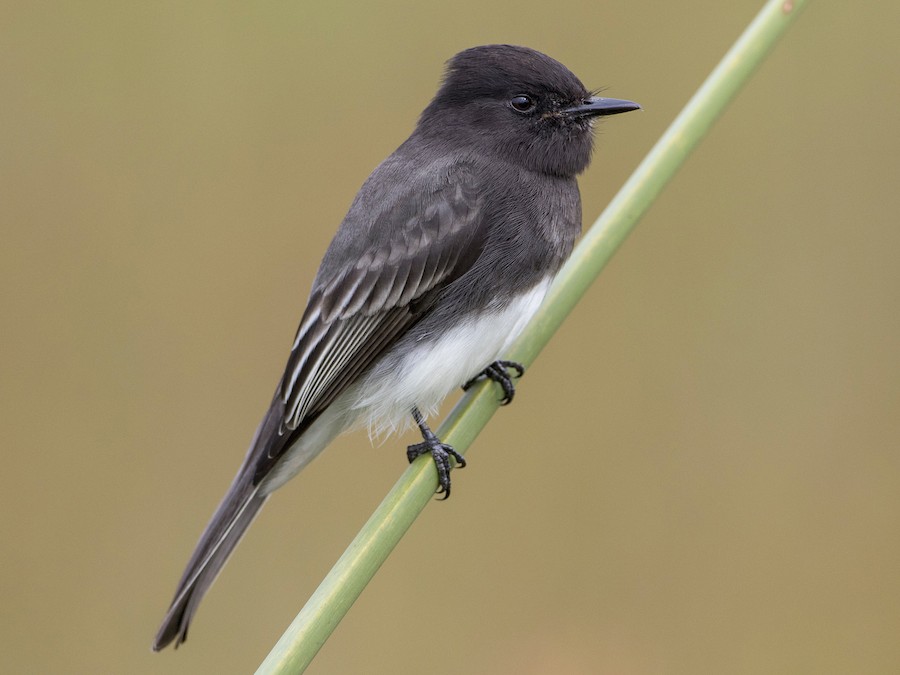
- Adults are largely sooty black over the head, back, wings, and breast, contrasting sharply with a clean white belly and undertail coverts. The flanks may show some dusky streaking. The black extends down the sides of the breast, creating a distinct line against the white belly.
- Beak shape
- Small, flattened, and triangular bill, typical of flycatchers, adapted for catching insects in flight. The bill is entirely black.
- Eye color
- Dark brown
- Leg color
- Black
- Distinguishing features
- The most striking feature is the stark contrast between the sooty black upperparts and breast and the pure white belly. The constant tail-wagging (up and down) is a key behavioral identifier. They also have a slight crest that can be raised.
- Juvenile appearance
- Juveniles resemble adults but have a brownish wash to their black plumage, especially on the back and head, and often show two faint, rusty or buffy wing-bars. The white belly is less pristine, sometimes with dusky mottling.
- Seasonal changes
- No significant seasonal plumage changes. They maintain their black and white coloration year-round.
- Sexual dimorphism
- None; males and females are virtually identical in plumage and size.
How to identify
- 1
Plumage Coloration
Look for the striking contrast: sooty black head, back, wings, and breast, sharply delineated from a pure white belly and undertail coverts.
- 2
Tail Wagging
Observe its behavior. Black Phoebes constantly pump their tail up and down while perched, a very reliable field mark.
- 3
Habitat Association
Always look for them near water sources – streams, ponds, irrigation ditches, or even garden fountains. They prefer open areas adjacent to water.
- 4
Perching Style
They often perch conspicuously on low branches, rocks, fences, or wires, typically in an upright posture, scanning for insects.
- 5
Vocalization
Listen for their distinctive 'tsee-wit, tsee-woo' song or sharp 'chip' calls.
Habitat & range
- Biomes
- Riparian zones, woodlands, chaparral, suburban and urban areas, agricultural lands.
- Geographic range
- Western North America, from southwestern Oregon, California, Nevada, Utah, Arizona, New Mexico, and Texas, south through Mexico and Central America to Argentina. Also found in parts of South America.
- Elevation range
- Sea level up to 3,000 meters (10,000 feet), though most common below 2,000 meters (6,500 feet).
- Preferred environments
- Always associated with water, including streams, rivers, ponds, lakes, irrigation ditches, and even garden fountains. Requires open areas for foraging and vertical surfaces (cliffs, bridges, buildings) for nesting.
Behavior
- Activity time
- Diurnal.
- Feeding habits
- Primarily an aerial insectivore. It perches conspicuously, often on a low branch or rock near water, and sallies out to catch flying insects (flies, bees, wasps, beetles, moths) in mid-air. It may also glean insects from foliage or the ground. They often return to the same perch after a successful sally.
- Social behavior
- Generally solitary or found in pairs, especially during the breeding season. They are not typically found in flocks.
- Flight pattern
- Direct and agile flight when sallying for insects. When moving between perches, it's typically a short, undulating flight. Characterized by frequent hovering during foraging.
- Migration pattern
- Mostly resident throughout its range, particularly in the warmer parts of its distribution. Northernmost populations (e.g., parts of Oregon, northern California) may undertake short-distance altitudinal or partial migrations to warmer, lower elevations during winter. Southern populations are entirely resident.
- Territoriality
- Highly territorial, especially during the breeding season. Pairs will defend their nesting and foraging areas from other phoebes and sometimes other small birds.
Song & calls
- Song
- A distinctive, often repeated, two-part song described as 'tsee-wit, tsee-woo' or 'tsee-wee, tsee-woo', with the second note lower pitched. It can also be a rapid, high-pitched 'chip-chip-chip-cheer'. The song is often delivered from a prominent perch.
- Call
- A sharp, clear 'chip' or 'tsip' call, often given singly or in a series. Also a softer 'peep' call. The calls are frequently accompanied by tail-wagging.
- When they vocalize
- Vocalizes year-round, but most frequently and intensely during the breeding season (spring and summer) to establish and defend territories and attract mates.
Breeding & reproduction
- Breeding season
- Typically from March to August, varying geographically. Can raise multiple broods (2-3) per season.
- Nesting habits
- Nests are cup-shaped, made of mud pellets mixed with grass and moss, and lined with finer materials like hair and feathers. They are almost always built on vertical surfaces under an overhang, such as cliffs, rock ledges, bridges, culverts, eaves of buildings, or even abandoned wells. They often reuse nests from previous years.
- Clutch size
- 3-6 eggs, most commonly 3-4.
- Egg description
- Typically 3-6 eggs, pure white, sometimes with a few fine reddish-brown spots, especially at the larger end. Eggs are oval-shaped.
- Incubation period
- 15-17 days, primarily by the female.
- Fledging period
- 18-21 days after hatching. Both parents feed the nestlings.
- Parental care
- Both parents participate in feeding the young. The female primarily incubates, but both defend the nest and care for the fledglings for several weeks after they leave the nest.
Where to find
Riparian Areas
Along streams, rivers, and creeks, especially where there are open banks and some trees or shrubs for perching.
Ponds and Lakes
Around the edges of still or slow-moving water bodies, including reservoirs and artificial ponds.
Urban and Suburban Parks
In parks with water features, fountains, or irrigated lawns, they can become quite tame and accustomed to human presence.
Agricultural Areas
Near irrigation canals, ditches, and farm ponds.
Coastal Bluffs and Canyons
Along coastal cliffs and in canyons with seeps or small streams.
Field tips
- Look for Movement. Their constant tail-wagging makes them easy to spot even when perched. Watch for their quick sallies from a perch to catch insects.
- Listen for Calls. Their distinctive song and calls are often the first indication of their presence, especially in dense riparian vegetation.
- Check Under Structures. Look under bridges, culverts, and building eaves, as these are favored nesting sites and often good places to find them foraging nearby.
- Visit Water Sources. Focus your birding efforts around any body of water, no matter how small, in their known range.
- Be Patient. While often conspicuous, they can be elusive. Find a good spot near water and observe quietly.
Similar species
Eastern Phoebe
Sayornis phoebe
The Eastern Phoebe is duller, lacking the extensive black on the head and breast. It is grayish-brown above and whitish below, with a dusky wash on the flanks. It also wags its tail, but its overall coloration is much less contrasting than the Black Phoebe.
Say's Phoebe
Sayornis saya
Say's Phoebe has a grayish-brown head and back, a pale gray breast, and a distinctive rusty-orange belly and undertail coverts. It also wags its tail but is easily distinguished by its color pattern.
Dark-capped Flycatcher
Myiarchus tuberculifer
Found in Central and South America, the Dark-capped Flycatcher is generally smaller, has a more olive-brown back, a darker cap, and a pale yellow belly. It lacks the stark black and white contrast of the Black Phoebe and does not exhibit the constant tail-wagging.
Quick facts
- Distinctive Feature:
- Sooty black and white plumage with constant tail-wagging.
- Habitat Preference:
- Always near water.
- Diet:
- Flying insects.
- Nesting Sites:
- Vertical surfaces under overhangs (cliffs, bridges, buildings).
- Migration:
- Mostly resident.
Fun facts
- Black Phoebes are one of the few flycatchers that frequently reuse their mud nests, sometimes for many years in a row.
- Their scientific name 'Sayornis' honors Thomas Say, an early American naturalist, and 'nigricans' means 'blackish', referring to its dark plumage.
- They are known to catch insects as large as dragonflies and even small fish or tadpoles from the water surface.
- The Black Phoebe's tail-wagging behavior is thought to help flush out insects, making them easier to spot and catch.
- Despite their preference for natural water bodies, they have adapted well to human-modified landscapes, often nesting on man-made structures and foraging in irrigated areas.
Scientific classification
- Kingdom
- Animalia
- Phylum
- Chordata
- Class
- Aves
- Order
- Passeriformes
- Family
- Tyrannidae
- Genus
- Sayornis
- Species
- Sayornis nigricans
Explore the Black Phoebe
Identify birds anywhere
Free on iOS, Android, and Web. Photo & sound identification, full species database, and your personal life list.