
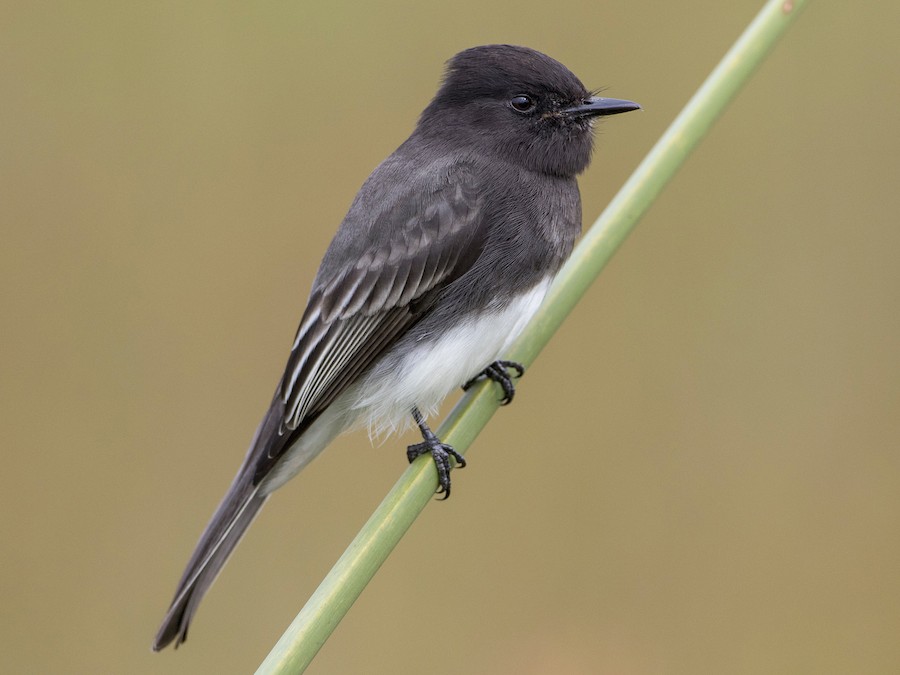
Where does the Black Phoebe live?
Sayornis nigricans
Spotted a bird? Identify it instantly with the Birdby app
Open the appThe Black Phoebe lives in specific habitats and regions. Knowing where, and when, to look improves your chances of a successful sighting.
Biomes
Riparian zones, woodlands, chaparral, suburban and urban areas, agricultural lands.
Geographic range
Western North America, from southwestern Oregon, California, Nevada, Utah, Arizona, New Mexico, and Texas, south through Mexico and Central America to Argentina. Also found in parts of South America.
Preferred environments
Always associated with water, including streams, rivers, ponds, lakes, irrigation ditches, and even garden fountains. Requires open areas for foraging and vertical surfaces (cliffs, bridges, buildings) for nesting.
Elevation range
Sea level up to 3,000 meters (10,000 feet), though most common below 2,000 meters (6,500 feet).
Where to look
Riparian Areas
Along streams, rivers, and creeks, especially where there are open banks and some trees or shrubs for perching.
Ponds and Lakes
Around the edges of still or slow-moving water bodies, including reservoirs and artificial ponds.
Urban and Suburban Parks
In parks with water features, fountains, or irrigated lawns, they can become quite tame and accustomed to human presence.
Agricultural Areas
Near irrigation canals, ditches, and farm ponds.
Coastal Bluffs and Canyons
Along coastal cliffs and in canyons with seeps or small streams.
Field tips
- Look for Movement. Their constant tail-wagging makes them easy to spot even when perched. Watch for their quick sallies from a perch to catch insects.
- Listen for Calls. Their distinctive song and calls are often the first indication of their presence, especially in dense riparian vegetation.
- Check Under Structures. Look under bridges, culverts, and building eaves, as these are favored nesting sites and often good places to find them foraging nearby.
- Visit Water Sources. Focus your birding efforts around any body of water, no matter how small, in their known range.
- Be Patient. While often conspicuous, they can be elusive. Find a good spot near water and observe quietly.
Migration
Mostly resident throughout its range, particularly in the warmer parts of its distribution. Northernmost populations (e.g., parts of Oregon, northern California) may undertake short-distance altitudinal or partial migrations to warmer, lower elevations during winter. Southern populations are entirely resident.
Explore the Black Phoebe
Identify birds anywhere
Free on iOS, Android, and Web. Photo & sound identification, full species database, and your personal life list.