
How to identify the Black Phoebe
Sayornis nigricans
Spotted a bird? Identify it instantly with the Birdby app
Open the appTo correctly identify the Black Phoebe (Sayornis nigricans), check each of these features. Birds can be tricky: habit, habitat, and call often confirm a sighting that a single photo cannot.
Size at a glance
- Length
- 16-17 cm (6.3-6.7 in)
- Wingspan
- 25-28 cm (9.8-11 in)
- Weight
- 15-22 g (0.5-0.8 oz)
Physical features to check
- 1
Plumage
Overall feather coloration and pattern.
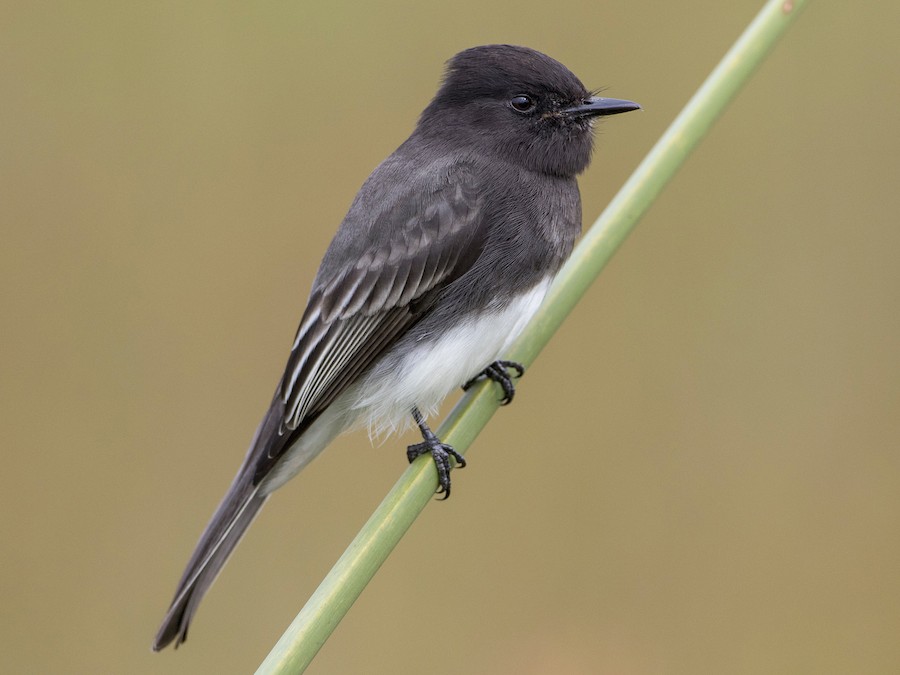
Adults are largely sooty black over the head, back, wings, and breast, contrasting sharply with a clean white belly and undertail coverts. The flanks may show some dusky streaking. The black extends down the sides of the breast, creating a distinct line against the white belly.
- 2
Beak shape
Shape and color of the bill: a key field mark.
Small, flattened, and triangular bill, typical of flycatchers, adapted for catching insects in flight. The bill is entirely black.
- 3
Eye color
Iris color and any distinctive eye markings.
Dark brown
- 4
Leg color
Leg and foot color.
Black
- 5
Distinguishing features
Standout features that separate this species.
The most striking feature is the stark contrast between the sooty black upperparts and breast and the pure white belly. The constant tail-wagging (up and down) is a key behavioral identifier. They also have a slight crest that can be raised.
- 6
Juvenile appearance
How young birds differ from adults.
Juveniles resemble adults but have a brownish wash to their black plumage, especially on the back and head, and often show two faint, rusty or buffy wing-bars. The white belly is less pristine, sometimes with dusky mottling.
- 7
Seasonal changes
Plumage variation between breeding and non-breeding seasons.
No significant seasonal plumage changes. They maintain their black and white coloration year-round.
- 8
Sexual dimorphism
How males and females differ.
None; males and females are virtually identical in plumage and size.
Key field marks
- Plumage Coloration. Look for the striking contrast: sooty black head, back, wings, and breast, sharply delineated from a pure white belly and undertail coverts.
- Tail Wagging. Observe its behavior. Black Phoebes constantly pump their tail up and down while perched, a very reliable field mark.
- Habitat Association. Always look for them near water sources – streams, ponds, irrigation ditches, or even garden fountains. They prefer open areas adjacent to water.
- Perching Style. They often perch conspicuously on low branches, rocks, fences, or wires, typically in an upright posture, scanning for insects.
- Vocalization. Listen for their distinctive 'tsee-wit, tsee-woo' song or sharp 'chip' calls.
Explore the Black Phoebe
Identify birds anywhere
Free on iOS, Android, and Web. Photo & sound identification, full species database, and your personal life list.