
Spotted a bird? Identify it instantly with the Birdby app
Open the appAbout
The Eastern Phoebe is a small, drab flycatcher known for its distinctive tail-wagging behavior and its clear, emphatic 'fee-bee' call. It is one of the earliest migratory birds to return in spring and one of the last to leave in fall, often nesting near human structures.
Size & lifespan
- Length
- 14-17 cm (5.5-6.7 in)
- Wingspan
- 26-30 cm (10.2-11.8 in)
- Weight
- 16-21 g (0.6-0.7 oz)
- Lifespan
- Typically 2-5 years in the wild, with a maximum recorded lifespan of over 10 years.
- Diet
- Insectivore, primarily feeding on flying insects, but also consuming some berries and small fruits, especially during migration or colder weather.
Physical characteristics
- Plumage
- Adults have dull grayish-brown upperparts, a slightly darker head, and whitish underparts. The breast and flanks often have a faint yellowish wash, particularly in fresh fall plumage. The wings and tail are dusky brown, lacking prominent wing bars or eye-rings. The tail is plain and often twitched or pumped up and down.
- Beak shape
- Small, flattened, and triangular bill, dark in color, adapted for catching insects in flight. The lower mandible is often paler at the base.
- Eye color
- Dark brown.
- Leg color
- Dark gray to black.
- Distinguishing features
- The most distinctive field mark is its constant tail-wagging or pumping motion, even when perched. It lacks prominent eye-rings or wing bars, which helps distinguish it from other flycatchers. Its overall drab appearance is also a key feature.
- Juvenile appearance
- Juveniles resemble adults but often have a more pronounced yellowish wash on the underparts and faint buffy wing bars, which are lost after their first prebasic molt.
- Seasonal changes
- Plumage remains largely consistent throughout the year. Fresh fall plumage may appear slightly more olive-brown on the back and have a more noticeable yellowish wash on the flanks and belly compared to worn breeding plumage.
- Sexual dimorphism
- Males and females are virtually identical in plumage and size.
How to identify
- 1
Tail Wagging
Look for the characteristic constant pumping or wagging of the tail, even when perched. This is the most reliable field mark.
- 2
Plumage
Observe the dull grayish-brown upperparts and whitish underparts, lacking strong markings like eye-rings or wing bars (though juveniles may have faint ones).
- 3
Vocalization
Listen for the clear, emphatic, two-part 'fee-bee' song, often repeated. This is a strong auditory cue.
- 4
Perching and Feeding Behavior
Watch for its typical flycatcher behavior: perching upright on an exposed branch, sallying out to catch insects in flight, and returning to a perch.
- 5
Nest Location
During breeding season, check under eaves, bridges, culverts, and rock ledges for their distinctive mud and moss nests.
Habitat & range
- Biomes
- Forest edges, open woodlands, suburban and rural areas, farms, parks, and riparian zones.
- Geographic range
- Breeds across eastern North America, from southeastern Canada south to the southeastern United States. Winters primarily in the southeastern United States, Mexico, and Central America.
- Elevation range
- Typically found from sea level up to approximately 1,500 meters (5,000 feet), though occasionally higher in mountainous regions.
- Preferred environments
- Prefers areas with open understories, access to water, and vertical structures (cliffs, bridges, buildings) for nesting. Often found near streams, ponds, and clearings.
Behavior
- Activity time
- Diurnal.
- Feeding habits
- Primarily an aerial insectivore. It perches on an exposed branch or structure, sallies out to catch flying insects (like flies, bees, wasps, beetles, moths) in mid-air, and then returns to the same or a nearby perch. It also gleans insects from foliage and occasionally eats berries.
- Social behavior
- Generally solitary or found in pairs during the breeding season. Not typically seen in large flocks, even during migration.
- Flight pattern
- Direct and undulating flight when traveling longer distances. When sallying for insects, flight is quick, agile, and erratic, often involving sharp turns and hovering.
- Migration pattern
- A medium-distance migrant. They are among the earliest spring migrants, arriving in breeding grounds in March and April, and among the last to depart in fall, often staying until October or November. They migrate individually or in loose groups.
- Territoriality
- Males establish and defend breeding territories through vocalizations and displays. Both sexes defend the nest site.
Song & calls
- Song
- The primary song is a distinctive, two-part, emphatic 'fee-bee' or 'fiss-bzzzt', often repeated rapidly. The first syllable is clear and whistled, while the second is buzzy and lower-pitched. There can be variations, sometimes sounding like 'fee-b-b-bee'.
- Call
- Common calls include a sharp 'chip' or 'tsip' note, often given when agitated or as a contact call. They also have a soft 'tew' call.
- When they vocalize
- Sings frequently from early morning to late evening during the breeding season, often from an exposed perch. Calls are given year-round.
Breeding & reproduction
- Breeding season
- Typically April to August, with two broods common in many areas.
- Nesting habits
- Nests are typically built on sheltered ledges or vertical surfaces, often under bridges, eaves of buildings, rock ledges, culverts, or in abandoned wells. The nest is a cup-shaped structure made of mud, moss, and plant fibers, often lined with fine grasses and hair. They frequently reuse nest sites, sometimes building a new nest on top of an old one.
- Clutch size
- 3-8 eggs, typically 4-6.
- Egg description
- Usually 3-8 (most commonly 4-6) pure white, unmarked eggs. Occasionally, a few reddish-brown spots may be present on the larger end.
- Incubation period
- 15-16 days, primarily by the female.
- Fledging period
- 15-16 days after hatching. Young leave the nest but are still fed by parents for a period.
- Parental care
- Both parents feed the nestlings and fledglings. The female primarily incubates, but the male often brings food to her on the nest.
Where to find
Forest Edges and Open Woodlands
Look along the borders of deciduous or mixed forests, especially near clearings or water.
Near Water Bodies
Often found near streams, rivers, ponds, and lakes, as these areas provide abundant insect prey.
Human Structures
Check under bridges, culverts, eaves of barns, sheds, and houses, where they frequently build nests.
Parks and Suburban Gardens
They adapt well to human-modified landscapes, especially those with mature trees and open spaces.
Field tips
- Listen for the Song. The 'fee-bee' song is very distinctive and often given repeatedly, making it easy to locate the bird even before seeing it.
- Watch for Tail Wagging. Once you spot a drab, small bird on an exposed perch, look for the characteristic tail-pumping motion. This is a definitive identifier.
- Observe Flycatching Behavior. Look for birds making short, quick flights from a perch to catch insects in the air, then returning to the same or a nearby perch.
- Check Nesting Sites. During spring and summer, actively look for their mud nests on sheltered ledges of human structures or natural rock formations.
- Be Patient. While often conspicuous, their drab plumage can make them blend in. Patience and careful observation of behavior will aid identification.
Similar species
Eastern Wood-Pewee
Contopus virens
Eastern Wood-Pewees have more prominent wing bars, a more upright posture, and a less noticeable tail-wag. Their song is a distinctive, slurred 'pee-a-wee' or 'pee-ooh'. They also tend to prefer denser forest interiors.
Say's Phoebe
Sayornis saya
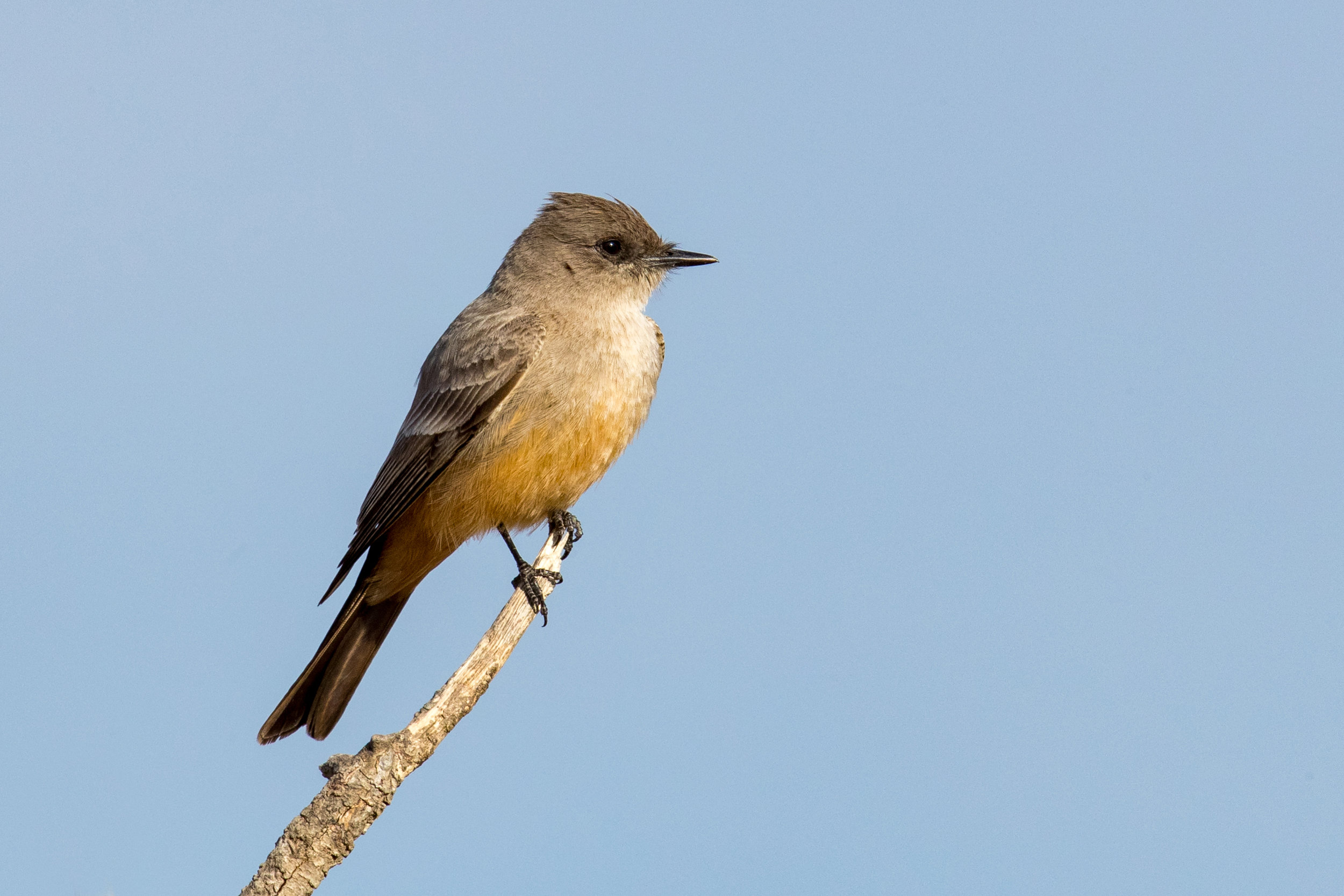
Say's Phoebes are found in western North America. They have a darker, sooty-gray head and back, and a distinctive rusty-orange belly and undertail coverts, which Eastern Phoebes lack. Their call is a soft, whistled 'pee-eer'.
Black Phoebe
Sayornis nigricans
Black Phoebes are found in western North America. They are entirely sooty black with a contrasting white belly and undertail coverts. Their call is a sharp 'chip' or 'tseep'.
Least Flycatcher
Empidonax minimus
Least Flycatchers are smaller, have a more distinct eye-ring, and two prominent wing bars. They lack the constant tail-wagging of the Eastern Phoebe. Their song is a sharp, emphatic 'che-bek'.
Quick facts
- Key ID Feature:
- Constant tail-wagging
- Distinctive Call:
- 'Fee-bee' song
- Diet:
- Mainly flying insects
- Nesting:
- Mud nests on sheltered ledges (bridges, buildings)
- Migration:
- Early spring arrival, late fall departure
Fun facts
- The Eastern Phoebe was the first bird species to be banded in North America, by John James Audubon in 1803, who tied silver threads to their legs to study their return to nesting sites.
- They are one of the few passerines that regularly build nests out of mud, often incorporating moss and plant fibers.
- Eastern Phoebes are known for their strong site fidelity, often returning to the exact same nesting site year after year, sometimes for multiple generations.
- Their scientific name, 'Sayornis phoebe', directly references their characteristic call, 'phoebe', and honors Thomas Say, an early American naturalist.
- Despite their drab appearance, their constant tail-wagging and distinctive call make them easily identifiable and a welcome sign of spring in many areas.
Scientific classification
- Kingdom
- Animalia
- Phylum
- Chordata
- Class
- Aves
- Order
- Passeriformes
- Family
- Tyrannidae
- Genus
- Sayornis
- Species
- Sayornis phoebe
Explore the Eastern Phoebe
Identify birds anywhere
Free on iOS, Android, and Web. Photo & sound identification, full species database, and your personal life list.