
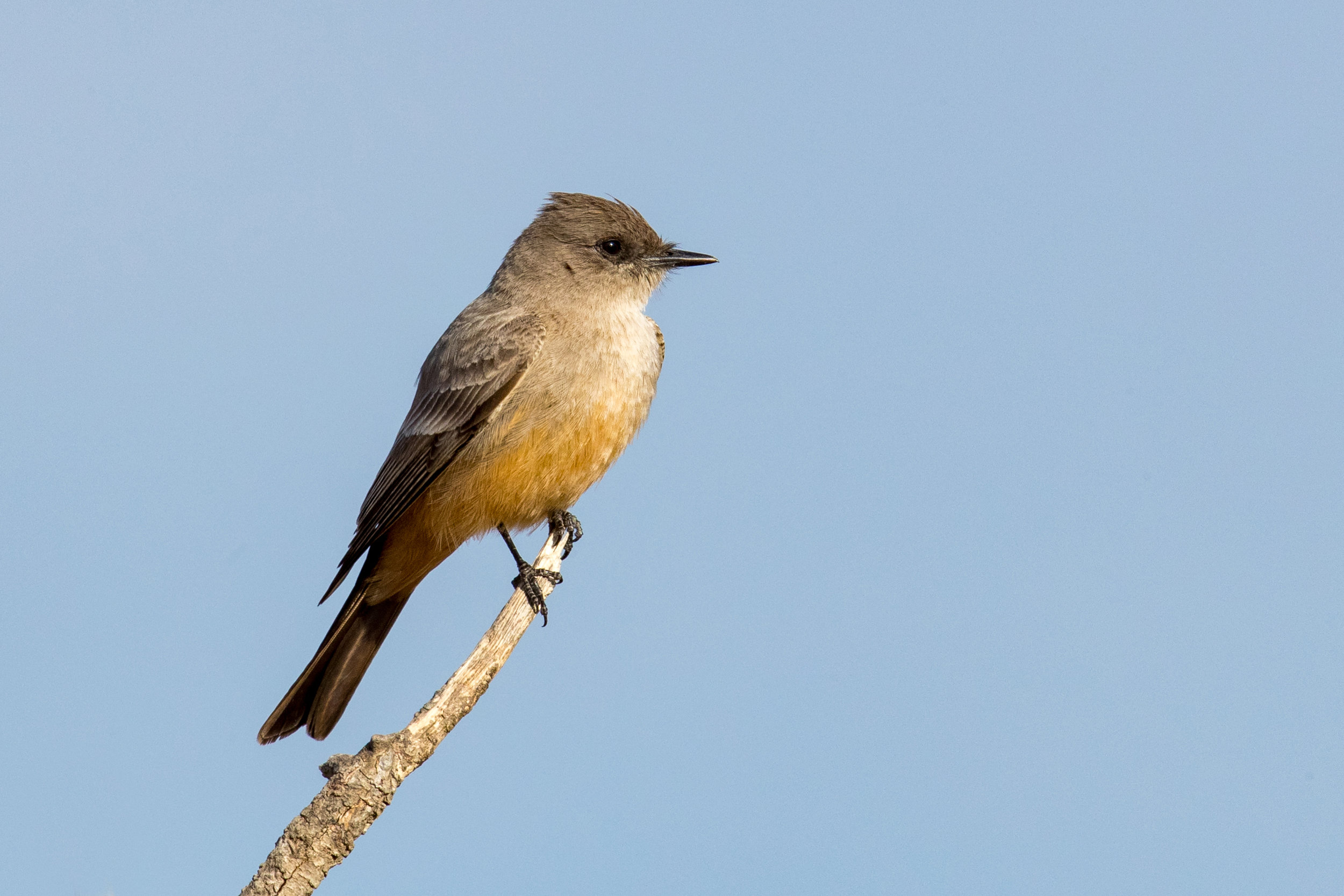
How to identify the Eastern Phoebe
Sayornis phoebe
Spotted a bird? Identify it instantly with the Birdby app
Open the appTo correctly identify the Eastern Phoebe (Sayornis phoebe), check each of these features. Birds can be tricky: habit, habitat, and call often confirm a sighting that a single photo cannot.
Size at a glance
- Length
- 14-17 cm (5.5-6.7 in)
- Wingspan
- 26-30 cm (10.2-11.8 in)
- Weight
- 16-21 g (0.6-0.7 oz)
Physical features to check
- 1
Plumage
Overall feather coloration and pattern.
Adults have dull grayish-brown upperparts, a slightly darker head, and whitish underparts. The breast and flanks often have a faint yellowish wash, particularly in fresh fall plumage. The wings and tail are dusky brown, lacking prominent wing bars or eye-rings. The tail is plain and often twitched or pumped up and down.
- 2
Beak shape
Shape and color of the bill: a key field mark.
Small, flattened, and triangular bill, dark in color, adapted for catching insects in flight. The lower mandible is often paler at the base.
- 3
Eye color
Iris color and any distinctive eye markings.
Dark brown.
- 4
Leg color
Leg and foot color.
Dark gray to black.
- 5
Distinguishing features
Standout features that separate this species.
The most distinctive field mark is its constant tail-wagging or pumping motion, even when perched. It lacks prominent eye-rings or wing bars, which helps distinguish it from other flycatchers. Its overall drab appearance is also a key feature.
- 6
Juvenile appearance
How young birds differ from adults.
Juveniles resemble adults but often have a more pronounced yellowish wash on the underparts and faint buffy wing bars, which are lost after their first prebasic molt.
- 7
Seasonal changes
Plumage variation between breeding and non-breeding seasons.
Plumage remains largely consistent throughout the year. Fresh fall plumage may appear slightly more olive-brown on the back and have a more noticeable yellowish wash on the flanks and belly compared to worn breeding plumage.
- 8
Sexual dimorphism
How males and females differ.
Males and females are virtually identical in plumage and size.
Key field marks
- Tail Wagging. Look for the characteristic constant pumping or wagging of the tail, even when perched. This is the most reliable field mark.
- Plumage. Observe the dull grayish-brown upperparts and whitish underparts, lacking strong markings like eye-rings or wing bars (though juveniles may have faint ones).
- Vocalization. Listen for the clear, emphatic, two-part 'fee-bee' song, often repeated. This is a strong auditory cue.
- Perching and Feeding Behavior. Watch for its typical flycatcher behavior: perching upright on an exposed branch, sallying out to catch insects in flight, and returning to a perch.
- Nest Location. During breeding season, check under eaves, bridges, culverts, and rock ledges for their distinctive mud and moss nests.
Explore the Eastern Phoebe
Identify birds anywhere
Free on iOS, Android, and Web. Photo & sound identification, full species database, and your personal life list.