
Spotted a bird? Identify it instantly with the Birdby app
Open the appAbout
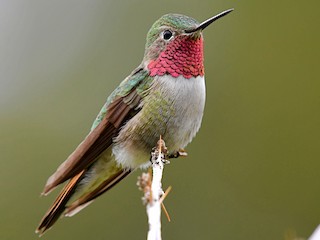
The Broad-tailed Hummingbird is a medium-sized hummingbird noted for the distinctive trilling sound made by the male's wingtips in flight. It is largely a migratory species, breeding at higher elevations in the western United States and migrating to Mexico for the winter. Males are easily identified by their iridescent rose-magenta gorget, while females are less colorful with green backs and pale undersides. They are a common and widespread species within their range.
Size & lifespan
- Length
- 10-10.5 cm (3.9-4.1 inches)
- Wingspan
- 13-14 cm (5.1-5.5 inches)
- Weight
- 3-4 grams (0.11-0.14 oz)
- Lifespan
- Typically 3-5 years in the wild; maximum recorded age is 12 years
- Diet
- Primarily nectar from a variety of flowering plants and small insects (gnats, flies, aphids, spiders) captured in flight or gleaned from foliage.
Physical characteristics
- Plumage
- Adult male: Iridescent green upperparts, flanks, and crown. Rose-magenta gorget (throat patch) that can appear dull brown or black in poor light. White breast band and pale grayish belly. Tail is primarily dark, with outer tail feathers showing rufous at the base and black tips, giving a broad appearance. Adult female: Green upperparts and crown. White underparts with buff or rufous wash on the flanks. Outer tail feathers have rufous at the base, followed by a black band, and white tips. Throat is typically pale or whitish, often with small dusky spots or faint iridescent coppery-pink specks, particularly in older females. Juvenile: Resembles adult female plumage. Juvenile males may have a few iridescent gorget feathers appearing in their first fall/winter.
- Beak shape
- Long, straight, and slender black bill.
- Eye color
- Dark brown.
- Leg color
- Dull black or dark gray.
- Distinguishing features
- The male's distinctive metallic, cricket-like wing trill during flight is a key identification feature, audible even when the bird is not visible. The broad shape of the tail, especially visible in flight or during display, is also characteristic. The coloration of the male's gorget (rose-magenta) is unique among common North American hummingbirds.
- Juvenile appearance
- Juveniles largely resemble adult females, characterized by green upperparts, buffy flanks, and white underparts. Juvenile males may develop small, scattered iridescent gorget feathers on their throat before their first definitive adult plumage. Their tail feathers are also similar to the female's.
- Seasonal changes
- No significant seasonal plumage changes in adults. Juveniles molt into adult-like plumage in their first fall/winter.
- Sexual dimorphism
- Pronounced. Males have a brilliant rose-magenta gorget and are more iridescent green overall. Females lack the strong gorget, having a white throat often with dusky spots or faint iridescent markings, and are generally duller.
How to identify
- 1
Male's Wing Trill
Listen for the unique, metallic, cricket-like trilling sound produced by the male's wingtips in flight. This is the most reliable field mark for identification, even when the bird is high up or in poor light.
- 2
Male Gorget Color
Observe the male's throat patch. It is a brilliant rose-magenta, which distinguishes it from the orange-red of a Rufous or the rose-pink of an Anna's. Note it can appear dark in shade.
- 3
Tail Shape and Color
When perched or in flight, observe the tail. Broad-taileds have relatively broad tail feathers. Females and juveniles show rufous at the base of the outer tail feathers, followed by a black band and white tips. The male's tail is dark with rufous bases and dark tips on outer feathers.
- 4
Female Throat Markings
Female Broad-taileds typically have a plain white throat, sometimes with fine dusky spots or occasional faint coppery-pink flecks, distinguishing them from the more extensively spotted throats of some female Rufous or the pure white throats of some other species.
- 5
Overall Size and Shape
Broad-taileds are medium-sized hummingbirds. Their relatively stocky appearance and broader tail can help distinguish them from the smaller, slimmer Calliope Hummingbird.
Habitat & range
- Biomes
- Montane forests, open woodlands, scrub, canyons, meadows, and subalpine areas.
- Geographic range
- Breeding range extends from eastern California, Nevada, Utah, Arizona, New Mexico, Colorado, Wyoming, and Idaho south through mountains of Mexico to Oaxaca. Winters from Mexico south to Guatemala.
- Elevation range
- Breeds at elevations typically between 1,500 and 3,300 meters (5,000-11,000 feet); can be found at lower elevations during migration.
- Preferred environments
- Prefers flowering mountain meadows, aspen groves, pine-oak woodlands, riparian corridors, and suburban gardens at appropriate elevations. They are often found near streams or water sources.
Behavior
- Activity time
- Diurnal. Most active during daylight hours, especially in the early morning and late afternoon.
- Feeding habits
- Hover-feeds on nectar from a wide variety of tubular flowers, particularly red and orange ones. Also captures small insects in mid-air (hawking) or gleans them from foliage. Will readily visit hummingbird feeders.
- Social behavior
- Generally solitary, except during breeding. Individuals are often territorial around good food sources or nesting sites.
- Flight pattern
- Rapid, agile flight with characteristic hovering while feeding. Males produce a loud, distinctive high-pitched trilling sound with their wings during flight, especially when displaying or flying rapidly.
- Migration pattern
- Long-distance migrant. Breeds in montane regions of the western U.S. and migrates south to the highlands of Mexico for the winter. Males typically depart breeding grounds earlier than females and juveniles. They follow a loop migration, often taking a different route in spring than in fall.
- Territoriality
- Highly territorial, especially males defending feeding sites (flowers or feeders) and potential nesting areas. They will chase other hummingbirds and even larger birds away from their territory.
Song & calls
- Song
- Hummingbirds do not truly 'sing' in the way passerines do. The primary 'song' of the male Broad-tailed Hummingbird is the unique, metallic, cricket-like trilling sound produced by its specialized wingtip feathers during flight. This sound is often part of its courtship display. The sound is a high-pitched, almost buzzing 'chrrrrr' or 'zzzzzz'.
- Call
- Calls include sharp, dry 'chip' notes, often given when agitated or interacting with other birds. They may also give softer 'tchip' or 'teek' calls.
- When they vocalize
- The wing trill is heard most frequently during the breeding season when males are establishing and defending territories and performing courtship displays. Call notes are given year-round, especially when surprised or interacting with rivals.
Breeding & reproduction
- Breeding season
- Typically late April to early August, with peak activity in June and July.
- Nesting habits
- Female builds a small, cup-shaped nest, usually 1-4.5 meters (3-15 feet) high, often on a downward-sloping branch, in conifers or deciduous trees or shrubs. Nests are meticulously constructed from plant down, spider silk, and lichen, camouflaged to blend with the branch. Nests are often reused or built upon in subsequent years.
- Clutch size
- 2 eggs (rarely 1 or 3).
- Egg description
- Two pure white, oval eggs.
- Incubation period
- 16-17 days, solely by the female.
- Fledging period
- 21-26 days after hatching.
- Parental care
- Only the female cares for the eggs and young. She incubates, feeds, and defends the nest and chicks until they fledge.
Where to find
Mountain Meadows
During the breeding season, look for them in high-elevation mountain meadows with abundant wildflowers.
Pine-Oak Woodlands and Aspen Groves
They are commonly found in these forest types, especially edges and clearings where flowers are present.
Riparian Areas
Canyons and areas along streams with flowering plants provide good habitat.
Suburban Gardens (at appropriate elevations)
If you live in or visit their breeding range in the West, they will readily visit backyard hummingbird feeders and gardens with nectar plants.
Field tips
- Listen for the Male's Trill. Even if you can't see the bird, the distinctive wing trill of the male is often the first indication of its presence. Listen for it in open areas during the breeding season.
- Observe Feeding Behavior. Watch patches of tubular flowers, especially red and orange ones, at higher elevations. Broad-tailed Hummingbirds are often seen vigorously feeding at these sources.
- Set Up Feeders. In their breeding range, a well-maintained sugar-water feeder can attract them to your yard for easy viewing.
- Be Patient and Still. Hummingbirds are notoriously fast. Find a good vantage point near flowering plants or feeders and sit quietly. They will often approach once they settle down.
- Study Tail Patterns. For females, specifically focus on the rufous-black-white pattern on the outer tail feathers, as this is a key diagnostic feature.
Similar species
Rufous Hummingbird
Selasphorus rufus
Male Rufous Hummingbirds have extensive rufous on their back and flanks, and an iridescent orange-red gorget, contrasting with the Broad-tailed's green back and rose-magenta gorget. Female Rufous also show more rufous on their flanks and tail base, but are more difficult to distinguish from female Broad-tailed. The flight trill of the male Broad-tailed is generally diagnostic where ranges overlap.
Calliope Hummingbird
Selasphorus calliope
Calliope Hummingbirds are noticeably smaller than Broad-tailed Hummingbirds. Male Calliope has a streaky magenta gorget that extends laterally onto the neck, unlike the solid gorget of the Broad-tailed. Female Calliope also lack the strong rufous in the tail visible in female Broad-tailed. Also, the Calliope lacks the distinct wing trill of the Broad-tailed.
Anna's Hummingbird
Calypte anna
Male Anna's Hummingbirds have an iridescent rose-pink gorget and crown (top of head), while the Broad-tailed male has a green crown and its rose-magenta gorget does not extend onto the crown. Anna's typically lacks the strong green on the flanks seen in Broad-tailed. Anna's also lack the distinctive wing trill.
Quick facts
- Distinctive Feature:
- Male's shrill, cricket-like wing trill.
- Breeding Habitat:
- High-elevation mountains of the western U.S. and Mexico.
- Wintering Range:
- Highlands of Mexico to Guatemala.
- Primary Food:
- Flower nectar and small insects.
- Nest Builder:
- Female only.
- Egg Color:
- Pure white.
Fun facts
- The male Broad-tailed Hummingbird's wing trill is produced by modifications to its outermost primary feathers, which vibrate rapidly to create the sound.
- They are one of the highest-elevation breeding hummingbirds in North America, often found above 2,500 meters (8,000 feet).
- During cold mountain nights, Broad-tailed Hummingbirds can enter torpor, a state of reduced metabolic activity, to conserve energy, sometimes reducing their body temperature by as much as 20 degrees Celsius.
- These hummingbirds show fidelity to specific breeding and wintering sites, often returning to the exact same mountain meadows or valleys year after year.
- The species name 'platycercus' comes from Greek words 'platys' (broad) and 'kerkos' (tail), referring to the relatively broad tail feathers, especially noticeable in males during displays.
Scientific classification
- Kingdom
- Animalia
- Phylum
- Chordata
- Class
- Aves
- Order
- Apodiformes
- Family
- Trochilidae
- Genus
- Selasphorus
- Species
- Selasphorus platycercus
Explore the Broad-tailed Hummingbird
Identify birds anywhere
Free on iOS, Android, and Web. Photo & sound identification, full species database, and your personal life list.