
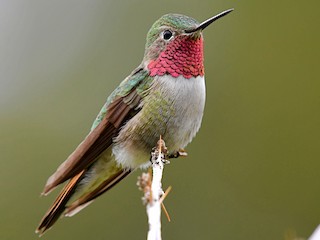
Where does the Broad-tailed Hummingbird live?
Selasphorus platycercus
Spotted a bird? Identify it instantly with the Birdby app
Open the appThe Broad-tailed Hummingbird lives in specific habitats and regions. Knowing where, and when, to look improves your chances of a successful sighting.
Biomes
Montane forests, open woodlands, scrub, canyons, meadows, and subalpine areas.
Geographic range
Breeding range extends from eastern California, Nevada, Utah, Arizona, New Mexico, Colorado, Wyoming, and Idaho south through mountains of Mexico to Oaxaca. Winters from Mexico south to Guatemala.
Preferred environments
Prefers flowering mountain meadows, aspen groves, pine-oak woodlands, riparian corridors, and suburban gardens at appropriate elevations. They are often found near streams or water sources.
Elevation range
Breeds at elevations typically between 1,500 and 3,300 meters (5,000-11,000 feet); can be found at lower elevations during migration.
Where to look
Mountain Meadows
During the breeding season, look for them in high-elevation mountain meadows with abundant wildflowers.
Pine-Oak Woodlands and Aspen Groves
They are commonly found in these forest types, especially edges and clearings where flowers are present.
Riparian Areas
Canyons and areas along streams with flowering plants provide good habitat.
Suburban Gardens (at appropriate elevations)
If you live in or visit their breeding range in the West, they will readily visit backyard hummingbird feeders and gardens with nectar plants.
Field tips
- Listen for the Male's Trill. Even if you can't see the bird, the distinctive wing trill of the male is often the first indication of its presence. Listen for it in open areas during the breeding season.
- Observe Feeding Behavior. Watch patches of tubular flowers, especially red and orange ones, at higher elevations. Broad-tailed Hummingbirds are often seen vigorously feeding at these sources.
- Set Up Feeders. In their breeding range, a well-maintained sugar-water feeder can attract them to your yard for easy viewing.
- Be Patient and Still. Hummingbirds are notoriously fast. Find a good vantage point near flowering plants or feeders and sit quietly. They will often approach once they settle down.
- Study Tail Patterns. For females, specifically focus on the rufous-black-white pattern on the outer tail feathers, as this is a key diagnostic feature.
Migration
Long-distance migrant. Breeds in montane regions of the western U.S. and migrates south to the highlands of Mexico for the winter. Males typically depart breeding grounds earlier than females and juveniles. They follow a loop migration, often taking a different route in spring than in fall.
Explore the Broad-tailed Hummingbird
Identify birds anywhere
Free on iOS, Android, and Web. Photo & sound identification, full species database, and your personal life list.