
Spotted a bird? Identify it instantly with the Birdby app
Open the appAbout
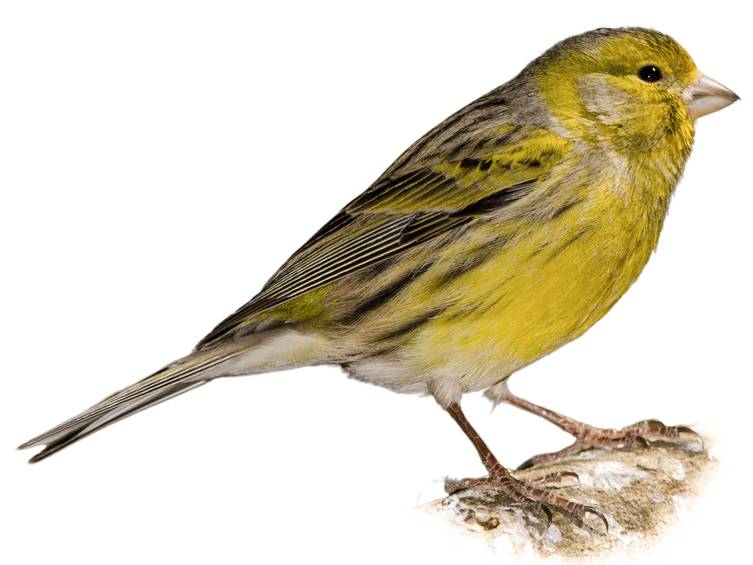
The Canary, also known as the Island Canary, Atlantic Canary, or Wild Canary, is a small passerine bird belonging to the finch family Fringillidae. It is native to the Macaronesian Islands of the Azores, Madeira, and the Canary Islands. Its wild form is typically greenish-yellow, contrasting with the bright yellow domestic canaries. Renowned for its melodious song, it has been widely domesticated and bred for centuries, leading to numerous color and song varieties.
Size & lifespan
- Length
- 12.5-13.5 cm
- Wingspan
- 20-23 cm
- Weight
- 12-20 g
- Lifespan
- 5-10 years (wild), up to 15 years (captivity)
- Diet
- Granivore (seeds, especially small seeds of grasses and weeds), supplemented with small insects and fruit.
Physical characteristics
- Plumage
- Wild Canaries typically exhibit a greenish-yellow plumage, with streaky brown markings on the back and flanks. The underparts are generally paler yellow, becoming whiter on the belly. The head and breast are often brighter yellow in males. Females tend to be duller, with more greyish tones and less extensive yellow. Flight feathers and tail feathers are dark brown with yellowish-green edges.
- Beak shape
- Small, conical, and pointed beak, adapted for cracking seeds. Color is typically horn-colored or greyish.
- Eye color
- Dark brown.
- Leg color
- Pinkish-brown to greyish-brown.
- Distinguishing features
- Small size, conical bill, streaky back, and overall greenish-yellow coloration. The bright yellow domestic canary is a selectively bred variant and not representative of the wild form.
- Juvenile appearance
- Juveniles are duller and more heavily streaked than adults, particularly on the underparts. They have a more brownish-grey wash overall, with less distinct yellow coloration.
- Seasonal changes
- No significant seasonal plumage changes. Plumage remains consistent throughout the year, with some wear and fading occurring before the annual molt.
- Sexual dimorphism
- Males are generally brighter and more extensively yellow on the head and breast, with less streaking than females. Females are duller, with more greyish tones and heavier streaking on the flanks and back. However, this can be subtle and difficult to discern in the field.
How to identify
- 1
Size and Shape
Small, compact finch with a relatively short tail and a conical bill.
- 2
Plumage Coloration (Wild)
Look for a greenish-yellow overall hue, with streaky brown on the back and flanks. Males are brighter yellow on the head and breast. Avoid confusing with domestic bright yellow canaries.
- 3
Behavior
Often seen foraging on the ground or in low vegetation. Flight is typically undulating. Can be found in small flocks outside of breeding season.
- 4
Song
Listen for its characteristic rich, varied, and melodious song, a series of trills, whistles, and warbles.
- 5
Habitat
Confined to the Macaronesian Islands (Canary Islands, Azores, Madeira) in open woodlands, scrub, and cultivated areas.
Habitat & range
- Biomes
- Subtropical forests, woodlands, scrublands, agricultural areas, gardens, and urban parks.
- Geographic range
- Endemic to the Macaronesian archipelagos: Canary Islands, Azores, and Madeira.
- Elevation range
- Sea level up to 1,500 meters (occasionally higher in some areas).
- Preferred environments
- Prefers open woodlands, laurel forests, pine forests, and areas with scattered trees and shrubs. Also common in cultivated lands, orchards, and human-modified landscapes where food and nesting sites are available.
Behavior
- Activity time
- Diurnal, active during daylight hours.
- Feeding habits
- Primarily a ground feeder, foraging for small seeds of grasses, weeds, and herbs. They will also feed on buds, small fruits, and occasionally small insects, especially during the breeding season to supplement protein for chicks. They often feed in small flocks.
- Social behavior
- Typically seen in pairs during the breeding season, but forms small to large flocks outside of breeding, especially when foraging. Can be quite gregarious.
- Flight pattern
- Undulating flight pattern, typical of finches, with rapid wing beats followed by a brief glide.
- Migration pattern
- Resident throughout its range; does not undertake long-distance migrations. Local movements may occur in response to food availability or weather conditions.
- Territoriality
- Males establish and defend small breeding territories during the nesting season, primarily through song. Outside of breeding, they are less territorial.
Song & calls
- Song
- The song is a complex, varied, and melodious series of trills, whistles, chirps, and warbles, often delivered from a prominent perch. It is highly musical and can be quite prolonged, with males singing to attract mates and defend territory. The song is a key characteristic that led to its domestication.
- Call
- Common calls include a soft 'twee-twee-twee' or 'chip-chip' contact call, a sharper 'tsit' alarm call, and various chattering notes within flocks.
- When they vocalize
- Males sing most frequently during the breeding season (spring and early summer) to attract mates and establish territories. Calls are heard year-round, especially when foraging in flocks.
Breeding & reproduction
- Breeding season
- Typically from January/February to July, with peak activity in March-June. Can raise multiple broods per season.
- Nesting habits
- Nests are cup-shaped, built by the female, usually in a tree or shrub, often 1-3 meters above the ground. Constructed from twigs, grass, moss, and roots, lined with finer materials like hair, feathers, and plant down.
- Clutch size
- 3-5 eggs.
- Egg description
- 3-5 eggs per clutch, pale blue or bluish-green, often with reddish-brown spots or speckles, particularly at the larger end. Approximately 17 x 13 mm.
- Incubation period
- 13-14 days, primarily by the female.
- Fledging period
- 14-21 days after hatching. Young are fed by both parents.
- Parental care
- Both parents participate in feeding the nestlings and fledglings. The female primarily incubates, while the male often brings food to the incubating female and later to the chicks.
Where to find
Canary Islands
Common and widespread across all the main islands, particularly in areas with mixed woodland, scrub, and agricultural land.
Madeira
Found throughout the island, including coastal areas, cultivated land, and forested slopes.
Azores
Present on most islands of the archipelago, favoring similar habitats to those in the Canary Islands and Madeira.
Gardens and Parks
Can be found in urban and suburban green spaces within its native range, especially where there are seed-bearing plants.
Field tips
- Listen for the song. The Canary's distinctive and beautiful song is often the first indication of its presence, especially during the breeding season. Follow the sound to locate the bird.
- Check open areas with vegetation. Focus on areas with scattered trees, shrubs, and grassy patches where they forage for seeds. Look on the ground or in low bushes.
- Observe flocks. Outside of breeding, Canaries often form small flocks. Look for groups of small finches moving through vegetation or feeding together.
- Visit native range. To see the wild Canary, you must visit its native Macaronesian Islands. Domestic canaries are found worldwide in captivity.
Similar species
European Serin
Serinus serinus
The European Serin is smaller and has a more prominent yellow rump, brighter yellow on the face and breast, and heavier streaking on the flanks. Its song is also similar but often described as more 'jingling' or 'sizzling' and less varied than the Canary's.
Greenfinch
Chloris chloris
Greenfinches are larger and stockier with a thicker bill. They have prominent yellow patches in the wings and tail, and a more uniform olive-green plumage, lacking the extensive streaking of the wild Canary. Their call is a distinctive 'dzweee'.
Citril Finch
Carduelis citrinella
The Citril Finch has a more uniform greenish-yellow plumage with less streaking, particularly on the back. It also has a more distinct yellow supercilium and a grey nape. Its range is primarily in mountainous regions of mainland Europe.
Quick facts
- Native Range:
- Canary Islands, Azores, Madeira
- Diet:
- Seeds, small insects, fruit
- Conservation Status:
- Least Concern
- Distinguishing Feature:
- Melodious song, greenish-yellow plumage (wild form)
- Social Behavior:
- Pairs in breeding, flocks outside breeding
Fun facts
- The domestic canary (Serinus canaria domestica) was first bred from the wild Canary in the 17th century and has since been selectively bred into over 200 breeds, varying in color, song, and form.
- Canaries were historically used in coal mines as an early warning system for toxic gases like carbon monoxide, due to their high sensitivity to airborne pollutants. This gave rise to the idiom 'canary in a coal mine'.
- Despite its name, the Canary Islands are not named after the bird, but rather from the Latin 'Canariae Insulae' meaning 'Islands of the Dogs', referring to large dogs found there by ancient explorers. The bird was then named after the islands.
- Wild Canaries are known for their adaptability, thriving in both natural and human-modified landscapes across their island homes.
Scientific classification
- Kingdom
- Animalia
- Phylum
- Chordata
- Class
- Aves
- Order
- Passeriformes
- Family
- Fringillidae
- Genus
- Serinus
- Species
- Serinus canaria
Explore the Canary
Identify birds anywhere
Free on iOS, Android, and Web. Photo & sound identification, full species database, and your personal life list.