
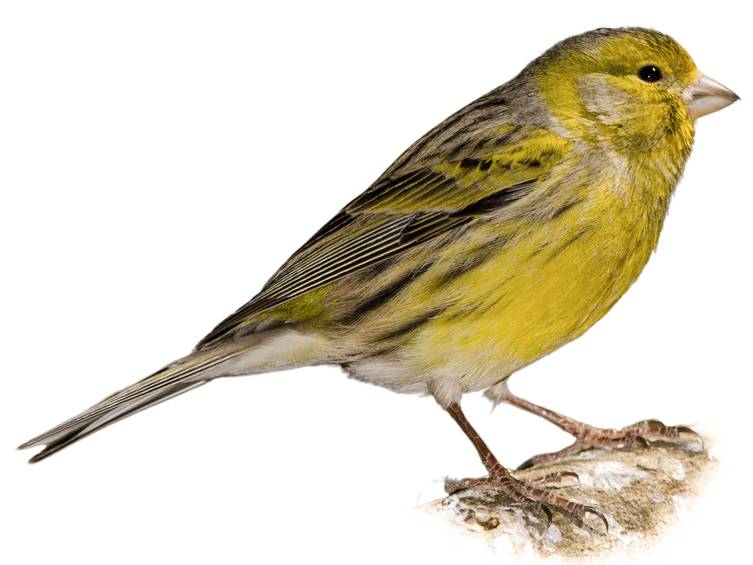
How to identify the Canary
Serinus canaria
Spotted a bird? Identify it instantly with the Birdby app
Open the appTo correctly identify the Canary (Serinus canaria), check each of these features. Birds can be tricky: habit, habitat, and call often confirm a sighting that a single photo cannot.
Size at a glance
- Length
- 12.5-13.5 cm
- Wingspan
- 20-23 cm
- Weight
- 12-20 g
Physical features to check
- 1
Plumage
Overall feather coloration and pattern.
Wild Canaries typically exhibit a greenish-yellow plumage, with streaky brown markings on the back and flanks. The underparts are generally paler yellow, becoming whiter on the belly. The head and breast are often brighter yellow in males. Females tend to be duller, with more greyish tones and less extensive yellow. Flight feathers and tail feathers are dark brown with yellowish-green edges.
- 2
Beak shape
Shape and color of the bill: a key field mark.
Small, conical, and pointed beak, adapted for cracking seeds. Color is typically horn-colored or greyish.
- 3
Eye color
Iris color and any distinctive eye markings.
Dark brown.
- 4
Leg color
Leg and foot color.
Pinkish-brown to greyish-brown.
- 5
Distinguishing features
Standout features that separate this species.
Small size, conical bill, streaky back, and overall greenish-yellow coloration. The bright yellow domestic canary is a selectively bred variant and not representative of the wild form.
- 6
Juvenile appearance
How young birds differ from adults.
Juveniles are duller and more heavily streaked than adults, particularly on the underparts. They have a more brownish-grey wash overall, with less distinct yellow coloration.
- 7
Seasonal changes
Plumage variation between breeding and non-breeding seasons.
No significant seasonal plumage changes. Plumage remains consistent throughout the year, with some wear and fading occurring before the annual molt.
- 8
Sexual dimorphism
How males and females differ.
Males are generally brighter and more extensively yellow on the head and breast, with less streaking than females. Females are duller, with more greyish tones and heavier streaking on the flanks and back. However, this can be subtle and difficult to discern in the field.
Key field marks
- Size and Shape. Small, compact finch with a relatively short tail and a conical bill.
- Plumage Coloration (Wild). Look for a greenish-yellow overall hue, with streaky brown on the back and flanks. Males are brighter yellow on the head and breast. Avoid confusing with domestic bright yellow canaries.
- Behavior. Often seen foraging on the ground or in low vegetation. Flight is typically undulating. Can be found in small flocks outside of breeding season.
- Song. Listen for its characteristic rich, varied, and melodious song, a series of trills, whistles, and warbles.
- Habitat. Confined to the Macaronesian Islands (Canary Islands, Azores, Madeira) in open woodlands, scrub, and cultivated areas.
Explore the Canary
Identify birds anywhere
Free on iOS, Android, and Web. Photo & sound identification, full species database, and your personal life list.