
Spotted a bird? Identify it instantly with the Birdby app
Open the appAbout
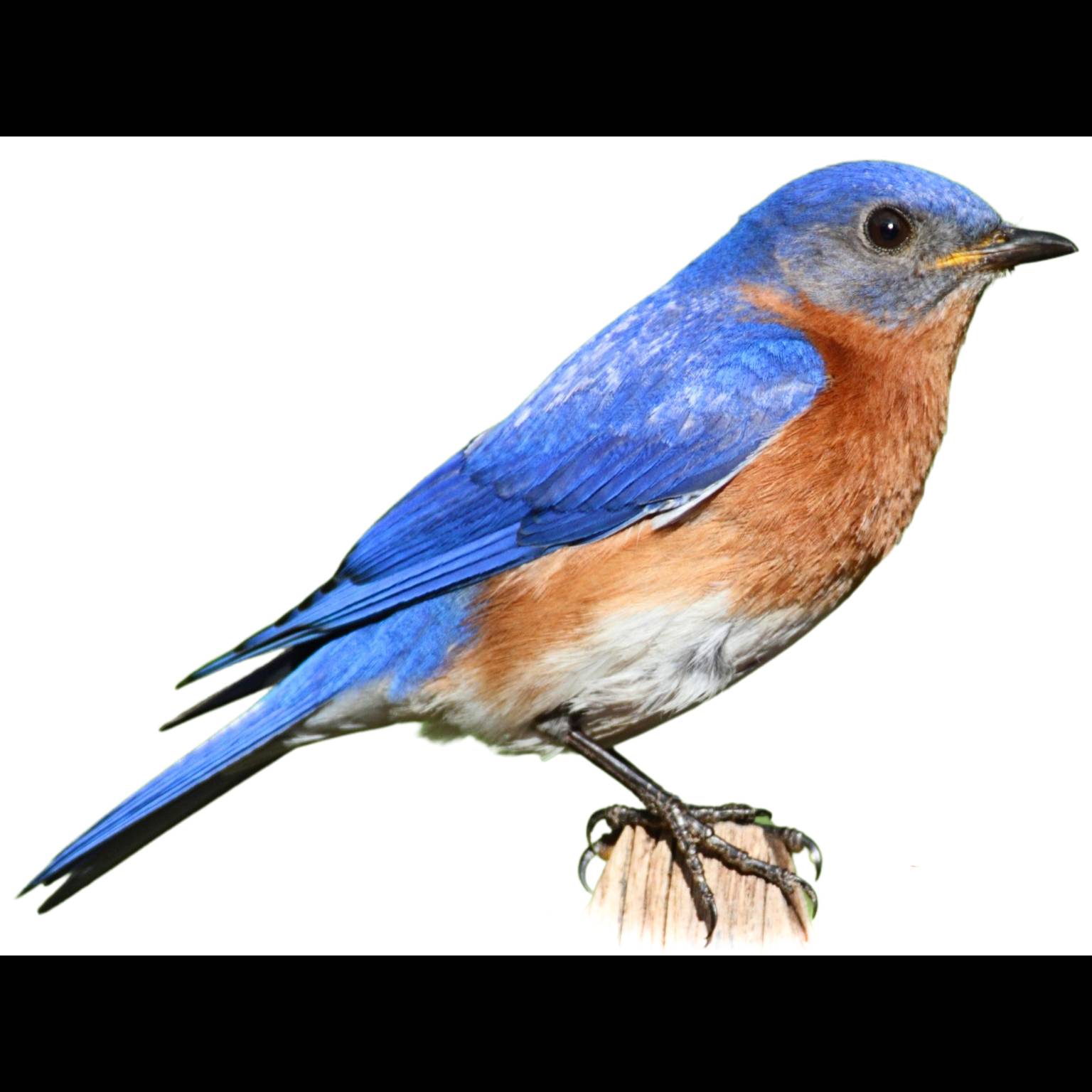
The Eastern Bluebird is a small thrush known for its vibrant blue plumage in males and more subdued coloration in females. It is a beloved species across eastern North America, often associated with open woodlands, orchards, and suburban areas. They are cavity nesters and have benefited greatly from human-provided nest boxes.
Size & lifespan
- Length
- 16-21 cm (6.3-8.3 in)
- Wingspan
- 30-32 cm (11.8-12.6 in)
- Weight
- 27-32 g (0.95-1.13 oz)
- Lifespan
- Typically 6-10 years in the wild, with a maximum recorded age of over 10 years.
- Diet
- Omnivore, primarily insectivorous during breeding season, shifting to fruits and berries in fall and winter.
Physical characteristics
- Plumage
- Males are brilliant sky-blue on the back, head, and wings, with a rusty-orange throat and breast, and a white belly. Females have a duller blue back, grayish-brown head, and a paler, more muted orange-brown breast. Juveniles are grayish-brown with white spotting on the back and breast, and blue only visible on the wings and tail.
- Beak shape
- Small, slender, and pointed, dark gray to black.
- Eye color
- Dark brown.
- Leg color
- Dark gray to black.
- Distinguishing features
- The combination of bright blue upperparts, rusty breast, and white belly is distinctive for adult males. Females are identified by their duller blue and rusty-orange coloration. Their upright posture when perched is also characteristic.
- Juvenile appearance
- Juveniles are mottled gray-brown with white spots on the back and breast, giving them a speckled appearance. Their wings and tail show hints of blue, which becomes more prominent as they mature.
- Seasonal changes
- Plumage does not change significantly between breeding and non-breeding seasons, though fresh fall plumage may appear slightly brighter before wear and tear. Males retain their vibrant blue year-round.
- Sexual dimorphism
- Pronounced. Males are much brighter and more intensely colored than females, especially the blue on the back and the rusty-orange on the breast.
How to identify
- 1
Coloration (Male)
Look for the brilliant sky-blue on the back, head, and wings, contrasting with the rusty-orange throat and breast, and white belly.
- 2
Coloration (Female)
Observe the duller blue on the back, grayish-brown head, and paler, muted orange-brown breast. The blue is less intense than in males.
- 3
Shape and Posture
Note their relatively plump body, short tail, and upright posture when perched on wires, branches, or posts.
- 4
Habitat
They are typically found in open woodlands, orchards, fields with scattered trees, and suburban areas, often near nest boxes.
- 5
Song and Calls
Listen for their soft, warbling 'chur-lee' song or their gentle 'tu-a-wee' call.
- 6
Foraging Behavior
Watch for them perching low and dropping to the ground to catch insects, or hovering briefly before pouncing.
Habitat & range
- Biomes
- Temperate forests, grasslands, open woodlands, orchards, agricultural fields, suburban parks, and golf courses.
- Geographic range
- Eastern North America, from southern Canada (Ontario, Quebec, Maritime provinces) south through the eastern United States to the Gulf Coast and into Mexico and Central America (Honduras, Nicaragua).
- Elevation range
- Typically found from sea level up to approximately 1,500 meters (5,000 feet), though occasionally higher in some parts of their range.
- Preferred environments
- Open areas with scattered trees, particularly those with dead trees or snags for nesting cavities, and short grass for foraging. They favor edges of forests, clearings, and areas with human-provided nest boxes.
Behavior
- Activity time
- Diurnal.
- Feeding habits
- Primarily insectivorous during spring and summer, catching insects (grasshoppers, crickets, beetles, caterpillars) from perches or by hovering. In fall and winter, their diet shifts to small fruits and berries (e.g., sumac, dogwood, hackberry, wild grape). They often forage by perching low and dropping to the ground to catch prey.
- Social behavior
- Typically seen in pairs during the breeding season. Outside of breeding, they may form small flocks, especially in winter, sometimes mixing with other species like American Robins or Cedar Waxwings.
- Flight pattern
- Direct and undulating, often with shallow wing beats. They can hover briefly while foraging. When flying between perches, they often make short, quick flights.
- Migration pattern
- Northern populations are migratory, moving south for the winter. Southern populations are largely resident. Migration occurs in loose flocks, typically during the day. They are short-distance migrants, generally not traveling far from their breeding grounds.
- Territoriality
- Males are territorial during the breeding season, defending nesting sites and foraging areas. They will aggressively chase away other bluebirds and potential predators from their nest site.
Song & calls
- Song
- A soft, warbling, gurgling song, often described as 'chur-lee, chur-lee' or 'tru-al-ly, tru-al-ly'. It's a pleasant, mellow sound, not particularly loud.
- Call
- Common calls include a soft 'tu-a-wee' or 'chur' call, often given when disturbed or communicating with a mate. They also have a sharp, alarm call, 'chatter' or 'chur-chur-chur', when predators are nearby.
- When they vocalize
- Most vocal during the breeding season (spring and early summer), but calls can be heard year-round, especially when foraging or interacting with other bluebirds.
Breeding & reproduction
- Breeding season
- Typically March to August, with multiple broods (2-3, sometimes 4) in a season.
- Nesting habits
- Cavity nesters, utilizing old woodpecker holes, natural tree cavities, or readily accepting human-made nest boxes. The female builds a cup-shaped nest of fine grasses, pine needles, and sometimes hair, inside the cavity.
- Clutch size
- 3-7 eggs.
- Egg description
- 3-7 (typically 4-5) pale blue, unmarked eggs. Occasionally, white eggs are laid.
- Incubation period
- 12-14 days, primarily by the female.
- Fledging period
- 15-20 days after hatching. Young are fed by both parents.
- Parental care
- Both parents feed the nestlings and fledglings. Males may continue to feed fledglings from the first brood while the female starts a second clutch.
Where to find
Open Woodlands and Forest Edges
Look in areas where forests meet open fields, as they prefer these transitional zones.
Orchards and Vineyards
These agricultural settings often provide suitable nesting cavities and foraging grounds.
Parks and Golf Courses
Well-maintained green spaces with scattered trees and open lawns are often frequented by bluebirds.
Suburban and Rural Backyards
If nest boxes are present, bluebirds are often found nesting and foraging in these areas.
Bluebird Trails
Dedicated routes with multiple nest boxes are excellent places to observe them, especially during breeding season.
Field tips
- Look for Nest Boxes. Eastern Bluebirds are highly dependent on nest boxes. If you see a bluebird box, there's a good chance bluebirds are nearby or using it.
- Scan Open Areas. They often perch on low branches, fences, or wires in open fields, scanning for insects on the ground.
- Listen for Their Song. Their soft, warbling song can be a good indicator of their presence, especially in spring and early summer.
- Observe Fruit-Bearing Shrubs. In fall and winter, check shrubs and trees with berries, as bluebirds will gather to feed on them.
- Be Patient and Quiet. Bluebirds can be somewhat shy. Move slowly and quietly to avoid startling them.
Similar species
Western Bluebird
Sialia mexicana
Western Bluebirds have a rusty patch on their back (males) and a more extensive rusty breast that extends to the upper back, often with a blue throat. Eastern Bluebirds have a solid blue back and a rusty throat/breast that does not extend to the back.
Mountain Bluebird
Sialia currucoides
Male Mountain Bluebirds are entirely sky-blue, lacking the rusty breast of the Eastern Bluebird. Females are duller, grayish-brown with blue only on the wings and tail, and lack any rusty coloration.
American Robin
Turdus migratorius
While also a thrush with a rusty breast, American Robins are significantly larger, have a darker gray back (not blue), and a more upright posture. Their foraging behavior (running and stopping on lawns) is also distinct.
Quick facts
- Primary Diet:
- Insects (summer), fruits/berries (winter)
- Nesting Type:
- Cavity nester
- Migration Status:
- Partial migrant
- Conservation Status:
- Least Concern
- Distinctive Feature:
- Vibrant blue back and rusty breast (male)
Fun facts
- Eastern Bluebirds were once in decline due to habitat loss and competition from introduced species like European Starlings and House Sparrows, but conservation efforts, particularly the widespread placement of nest boxes, have led to a significant population recovery.
- They are one of the earliest nesters in spring, sometimes starting as early as March in southern parts of their range.
- Bluebirds often reuse nest boxes for multiple broods within a single breeding season, and sometimes in subsequent years.
- The blue color in their feathers is structural, not pigment-based. It's caused by the way light scatters off tiny air pockets in the feather barbs.
- During winter, Eastern Bluebirds may form small, loose flocks and forage together, often seen in berry-laden trees.
Scientific classification
- Kingdom
- Animalia
- Phylum
- Chordata
- Class
- Aves
- Order
- Passeriformes
- Family
- Turdidae
- Genus
- Sialia
- Species
- Sialia sialis
Explore the Eastern Bluebird
Identify birds anywhere
Free on iOS, Android, and Web. Photo & sound identification, full species database, and your personal life list.