
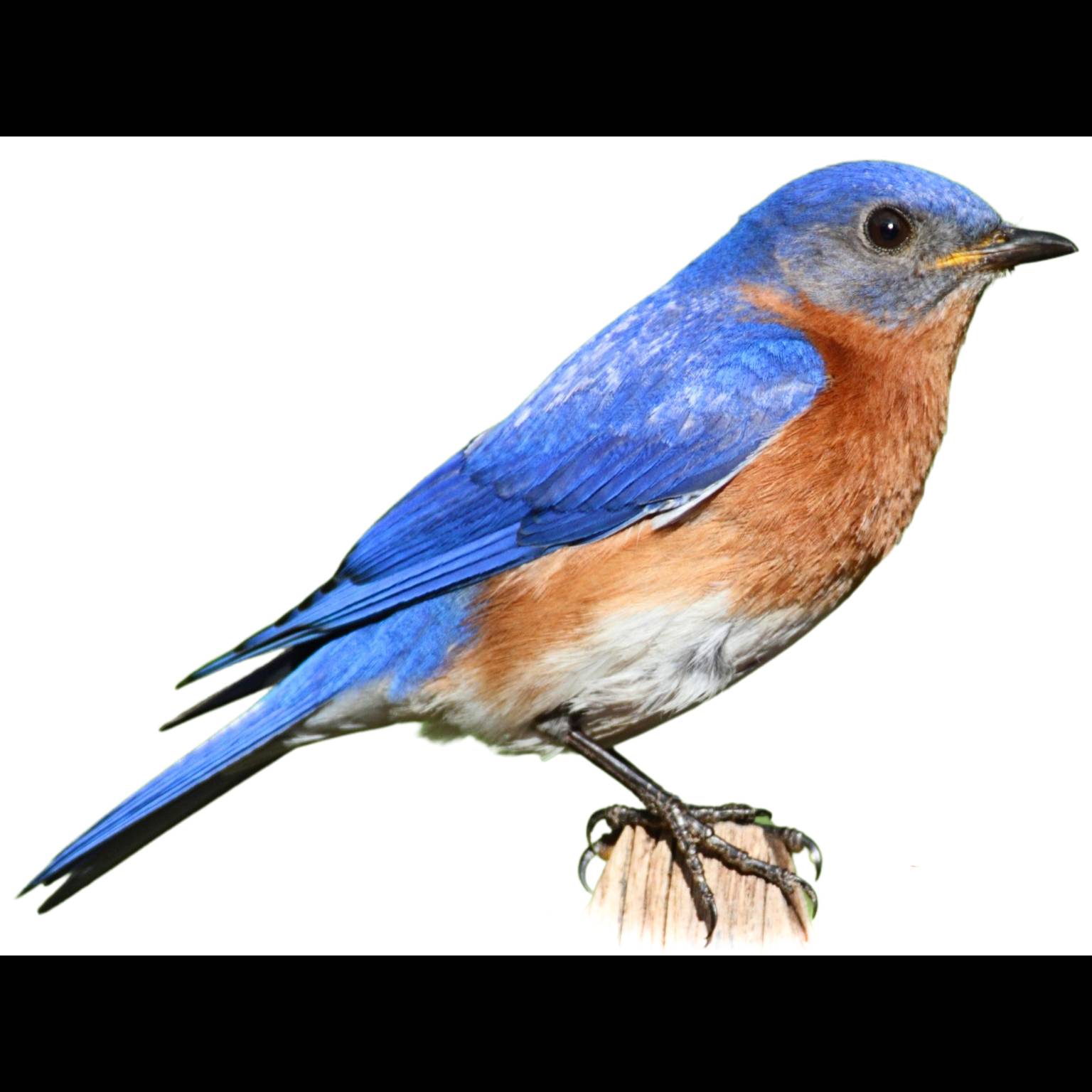
How to identify the Eastern Bluebird
Sialia sialis
Spotted a bird? Identify it instantly with the Birdby app
Open the appTo correctly identify the Eastern Bluebird (Sialia sialis), check each of these features. Birds can be tricky: habit, habitat, and call often confirm a sighting that a single photo cannot.
Size at a glance
- Length
- 16-21 cm (6.3-8.3 in)
- Wingspan
- 30-32 cm (11.8-12.6 in)
- Weight
- 27-32 g (0.95-1.13 oz)
Physical features to check
- 1
Plumage
Overall feather coloration and pattern.
Males are brilliant sky-blue on the back, head, and wings, with a rusty-orange throat and breast, and a white belly. Females have a duller blue back, grayish-brown head, and a paler, more muted orange-brown breast. Juveniles are grayish-brown with white spotting on the back and breast, and blue only visible on the wings and tail.
- 2
Beak shape
Shape and color of the bill: a key field mark.
Small, slender, and pointed, dark gray to black.
- 3
Eye color
Iris color and any distinctive eye markings.
Dark brown.
- 4
Leg color
Leg and foot color.
Dark gray to black.
- 5
Distinguishing features
Standout features that separate this species.
The combination of bright blue upperparts, rusty breast, and white belly is distinctive for adult males. Females are identified by their duller blue and rusty-orange coloration. Their upright posture when perched is also characteristic.
- 6
Juvenile appearance
How young birds differ from adults.
Juveniles are mottled gray-brown with white spots on the back and breast, giving them a speckled appearance. Their wings and tail show hints of blue, which becomes more prominent as they mature.
- 7
Seasonal changes
Plumage variation between breeding and non-breeding seasons.
Plumage does not change significantly between breeding and non-breeding seasons, though fresh fall plumage may appear slightly brighter before wear and tear. Males retain their vibrant blue year-round.
- 8
Sexual dimorphism
How males and females differ.
Pronounced. Males are much brighter and more intensely colored than females, especially the blue on the back and the rusty-orange on the breast.
Key field marks
- Coloration (Male). Look for the brilliant sky-blue on the back, head, and wings, contrasting with the rusty-orange throat and breast, and white belly.
- Coloration (Female). Observe the duller blue on the back, grayish-brown head, and paler, muted orange-brown breast. The blue is less intense than in males.
- Shape and Posture. Note their relatively plump body, short tail, and upright posture when perched on wires, branches, or posts.
- Habitat. They are typically found in open woodlands, orchards, fields with scattered trees, and suburban areas, often near nest boxes.
- Song and Calls. Listen for their soft, warbling 'chur-lee' song or their gentle 'tu-a-wee' call.
- Foraging Behavior. Watch for them perching low and dropping to the ground to catch insects, or hovering briefly before pouncing.
Explore the Eastern Bluebird
Identify birds anywhere
Free on iOS, Android, and Web. Photo & sound identification, full species database, and your personal life list.