
Spotted a bird? Identify it instantly with the Birdby app
Open the appAbout
The Common Eider is the largest duck in the Northern Hemisphere, renowned for its distinctive appearance, particularly the striking black and white plumage of the breeding male. It is a highly marine species, spending most of its life in coastal waters, diving for mollusks and crustaceans. Its down feathers are highly prized for insulation, historically leading to its protection in many areas.
Size & lifespan
- Length
- 50-71 cm (20-28 in)
- Wingspan
- 80-110 cm (31-43 in)
- Weight
- 1.8-2.9 kg (4.0-6.4 lbs), with some males reaching up to 3.1 kg (6.8 lbs)
- Lifespan
- Typically 10-20 years in the wild, with records up to 22 years.
- Diet
- Carnivore (primarily mollusks and crustaceans)
Physical characteristics
- Plumage
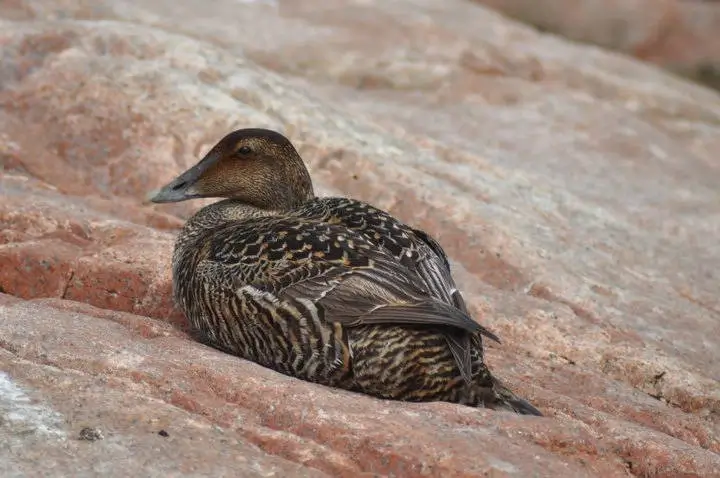
- Adult breeding males are unmistakable with a largely white body, black cap, black flanks, and a distinctive pale green nape patch. Adult females are mottled brown, providing excellent camouflage. Non-breeding males resemble females but retain some white in the wings and often have a darker head.
- Beak shape
- Large, wedge-shaped bill that slopes smoothly into the forehead, giving a distinctive profile. Bill color varies by subspecies and sex; typically yellowish-orange to greenish-grey in males, duller in females.
- Eye color
- Dark brown.
- Leg color
- Dull greenish-grey to blackish.
- Distinguishing features
- The unique head profile (bill sloping into forehead), large size, and the male's striking black and white pattern are key. Females are heavily barred brown, but their large size and head shape are still diagnostic.
- Juvenile appearance
- Juveniles resemble adult females but are generally duller and more uniformly brown, lacking the distinct barring of adult females. Young males gradually acquire adult plumage over 2-3 years.
- Seasonal changes
- Males undergo a post-breeding eclipse plumage, becoming duller and more brownish, resembling females but retaining some white on the wings and often a darker head. They regain their striking breeding plumage by late autumn/early winter.
- Sexual dimorphism
- Pronounced. Males are larger and have striking black and white plumage with green and pinkish tinges. Females are smaller and cryptically mottled brown.
How to identify
- 1
Size and Shape
Look for a very large, heavy-bodied duck with a distinctive wedge-shaped head profile where the bill slopes smoothly into the forehead.
- 2
Male Plumage (Breeding)
Unmistakable: white back, breast, and flanks; black cap, belly, and tail; pale green nape patch. A black line runs from the cap down the back of the neck.
- 3
Female Plumage
Mottled brown overall with fine black barring. Look for the characteristic head shape and large size to distinguish from other female ducks. The bill is duller than the male's.
- 4
Flight
Heavy, direct flight with rapid wingbeats, often in lines or V-formations low over the water.
- 5
Vocalization
Listen for the male's soft, cooing 'ah-ooooh' and the female's harsh 'garr-garr-garr' call.
- 6
Behavior
Often seen in large rafts on coastal waters, diving frequently for food. Nests colonially on islands.
Habitat & range
- Biomes
- Marine, Coastal
- Geographic range
- Circumpolar in the Northern Hemisphere. Breeds along Arctic and subarctic coasts of North America, Europe, and Asia. Winters further south along temperate coasts, including the Atlantic and Pacific coasts of North America, and the coasts of Europe and Asia.
- Elevation range
- Sea level to a few meters above sea level for nesting.
- Preferred environments
- Rocky coasts, islands, skerries, and sheltered bays with abundant shellfish beds. Prefers shallow coastal waters for feeding and often nests on small, predator-free islands or coastal tundra.
Behavior
- Activity time
- Diurnal, though they may feed at night during periods of low tide or high food availability.
- Feeding habits
- Primarily a diving duck, feeding mainly on mollusks (especially mussels, clams, and periwinkles) and crustaceans (crabs, amphipods). They can dive to depths of 20 meters (65 feet) or more, using their powerful feet for propulsion. Food is swallowed whole, and shells are crushed in their muscular gizzard.
- Social behavior
- Highly social, especially outside the breeding season, forming large rafts of thousands of individuals. During breeding, they are colonial nesters, often forming dense colonies on islands. Females show communal care of ducklings, forming 'crèches' where several females guard a large group of young.
- Flight pattern
- Strong, direct flight with rapid wingbeats. Often flies in long lines or V-formations low over the water. Appears heavy-bodied in flight.
- Migration pattern
- Partially migratory. Northern populations migrate south for the winter, while more southerly populations may be resident or undertake shorter coastal movements. Migration typically occurs along coastlines.
- Territoriality
- Males defend small territories around the female during courtship and early nesting, but females are not strongly territorial around their nests, often nesting in dense colonies.
Song & calls
- Song
- Males produce a distinctive, soft, cooing 'ah-ooooh' or 'coo-roo-ooo' call during courtship, often described as a 'song'. This sound is surprisingly gentle for such a large duck.
- Call
- Females have a harsh, guttural 'garr-garr-garr' or 'karr-karr-karr' call, especially when alarmed or with ducklings. Both sexes may emit low grunts or growls.
- When they vocalize
- Males vocalize most frequently during the breeding season and courtship. Females call when disturbed or communicating with their young.
Breeding & reproduction
- Breeding season
- May to July, varying with latitude. Nesting typically begins in late May or early June.
- Nesting habits
- Nests are typically built on the ground, often in dense colonies on small islands, coastal headlands, or tundra, usually close to the water. The nest is a shallow scrape lined with vegetation and heavily insulated with the female's soft down feathers, which are plucked from her breast.
- Clutch size
- 3-7 eggs
- Egg description
- 3-7 (typically 4-6) large, smooth, olive-buff to pale greenish-grey eggs, unspotted.
- Incubation period
- 25-28 days, incubated solely by the female.
- Fledging period
- 65-75 days. Ducklings are precocial and leave the nest shortly after hatching, but are dependent on the female for protection and guidance.
- Parental care
- Only the female cares for the eggs and young. Males depart shortly after incubation begins. Females often form crèches, pooling their ducklings for collective protection against predators.
Where to find
Coastal Waters
Look for them in shallow marine waters, especially near rocky shores, islands, and sheltered bays. They prefer areas with abundant shellfish beds.
Breeding Islands
During the breeding season, they can be found nesting in dense colonies on small, predator-free islands and coastal tundra in Arctic and subarctic regions.
Wintering Grounds
In winter, they concentrate in large flocks along temperate coastlines, often in areas with strong currents or upwellings that keep waters ice-free.
Field tips
- Use a spotting scope or binoculars. Common Eiders are often found far from shore in large rafts, so optics are essential for good views and identification.
- Visit coastal areas in winter. This is often the best time to see large concentrations of Common Eiders, especially in more southerly parts of their range.
- Look for diving behavior. Their frequent, prolonged dives are a key feeding behavior and can help locate them.
- Listen for calls. The male's distinctive cooing call can be heard during the breeding season, even from a distance.
Similar species
King Eider
Somateria spectabilis
Male King Eiders have a prominent orange frontal shield on the bill, a blue-grey crown, and a more complex head pattern with black and white markings. Female King Eiders are generally darker and more rufous-brown than Common Eiders, with a more rounded head profile and a less pronounced slope from bill to forehead.
Spectacled Eider
Somateria fischeri
Male Spectacled Eiders are distinguished by large, white 'spectacles' around their eyes. Females are similar to Common Eiders but have a more distinct pale patch around the eye and a different bill shape.
Steller's Eider
Polysticta stelleri
Steller's Eider is significantly smaller than the Common Eider. Males have a white head with a green patch behind the eye and a black collar. Females are also smaller and have a different plumage pattern, lacking the strong barring of Common Eider females.
Quick facts
- Largest Duck:
- The largest duck in the Northern Hemisphere.
- Eiderdown:
- Famous for its exceptionally warm and lightweight down feathers, used for insulation.
- Diet Specialization:
- Specialized mollusk-eaters, capable of crushing shells in their gizzard.
- Crèche Behavior:
- Females often form 'crèches' where multiple females collectively guard a large group of ducklings.
- Head Profile:
- Distinctive wedge-shaped head with the bill sloping smoothly into the forehead.
Fun facts
- The Common Eider's down is so insulating that it has been harvested for centuries to fill duvets and winter clothing. In some areas, eiderdown collection is a sustainable practice, with collectors carefully removing down from abandoned nests after the ducklings have hatched.
- Eiders are incredibly hardy birds, capable of surviving in extremely cold Arctic waters thanks to their dense plumage and a thick layer of subcutaneous fat.
- The scientific name 'Somateria' comes from Greek words meaning 'body' and 'wool', referring to their famous down.
- Common Eiders have specialized salt glands above their eyes that allow them to excrete excess salt, enabling them to drink seawater.
Scientific classification
- Kingdom
- Animalia
- Phylum
- Chordata
- Class
- Aves
- Order
- Anseriformes
- Family
- Anatidae
- Genus
- Somateria
- Species
- Somateria mollissima
Explore the Common Eider
Identify birds anywhere
Free on iOS, Android, and Web. Photo & sound identification, full species database, and your personal life list.