
How to identify the Common Eider
Somateria mollissima
Spotted a bird? Identify it instantly with the Birdby app
Open the appTo correctly identify the Common Eider (Somateria mollissima), check each of these features. Birds can be tricky: habit, habitat, and call often confirm a sighting that a single photo cannot.
Size at a glance
- Length
- 50-71 cm (20-28 in)
- Wingspan
- 80-110 cm (31-43 in)
- Weight
- 1.8-2.9 kg (4.0-6.4 lbs), with some males reaching up to 3.1 kg (6.8 lbs)
Physical features to check
- 1
Plumage
Overall feather coloration and pattern.
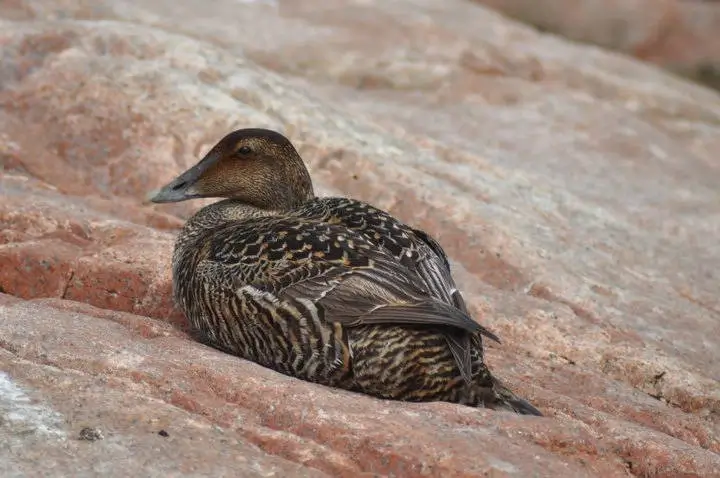
Adult breeding males are unmistakable with a largely white body, black cap, black flanks, and a distinctive pale green nape patch. Adult females are mottled brown, providing excellent camouflage. Non-breeding males resemble females but retain some white in the wings and often have a darker head.
- 2
Beak shape
Shape and color of the bill: a key field mark.
Large, wedge-shaped bill that slopes smoothly into the forehead, giving a distinctive profile. Bill color varies by subspecies and sex; typically yellowish-orange to greenish-grey in males, duller in females.
- 3
Eye color
Iris color and any distinctive eye markings.
Dark brown.
- 4
Leg color
Leg and foot color.
Dull greenish-grey to blackish.
- 5
Distinguishing features
Standout features that separate this species.
The unique head profile (bill sloping into forehead), large size, and the male's striking black and white pattern are key. Females are heavily barred brown, but their large size and head shape are still diagnostic.
- 6
Juvenile appearance
How young birds differ from adults.
Juveniles resemble adult females but are generally duller and more uniformly brown, lacking the distinct barring of adult females. Young males gradually acquire adult plumage over 2-3 years.
- 7
Seasonal changes
Plumage variation between breeding and non-breeding seasons.
Males undergo a post-breeding eclipse plumage, becoming duller and more brownish, resembling females but retaining some white on the wings and often a darker head. They regain their striking breeding plumage by late autumn/early winter.
- 8
Sexual dimorphism
How males and females differ.
Pronounced. Males are larger and have striking black and white plumage with green and pinkish tinges. Females are smaller and cryptically mottled brown.
Key field marks
- Size and Shape. Look for a very large, heavy-bodied duck with a distinctive wedge-shaped head profile where the bill slopes smoothly into the forehead.
- Male Plumage (Breeding). Unmistakable: white back, breast, and flanks; black cap, belly, and tail; pale green nape patch. A black line runs from the cap down the back of the neck.
- Female Plumage. Mottled brown overall with fine black barring. Look for the characteristic head shape and large size to distinguish from other female ducks. The bill is duller than the male's.
- Flight. Heavy, direct flight with rapid wingbeats, often in lines or V-formations low over the water.
- Vocalization. Listen for the male's soft, cooing 'ah-ooooh' and the female's harsh 'garr-garr-garr' call.
- Behavior. Often seen in large rafts on coastal waters, diving frequently for food. Nests colonially on islands.
Explore the Common Eider
Identify birds anywhere
Free on iOS, Android, and Web. Photo & sound identification, full species database, and your personal life list.