
Spotted a bird? Identify it instantly with the Birdby app
Open the appAbout
The Magellanic Penguin is a medium-sized penguin species characterized by its distinctive black and white plumage, notably the double black band across its chest. It is a migratory species, breeding in large colonies along the coasts of Argentina and Chile and migrating north during the austral winter. These penguins are expert swimmers, using their flipper-like wings to 'fly' underwater in pursuit of prey. They are social birds, often seen in large groups, especially during the breeding season.
Size & lifespan
- Length
- 61-76 cm (24-30 in)
- Wingspan
- 30-36 cm (12-14 in) (flipper length)
- Weight
- 2.7-6.5 kg (6.0-14.3 lbs), varying seasonally
- Lifespan
- 15-20 years in the wild, up to 30 years in captivity
- Diet
- Primarily fish (e.g., anchovies, sardines, hake), squid, and crustaceans (e.g., krill).
Physical characteristics
- Plumage
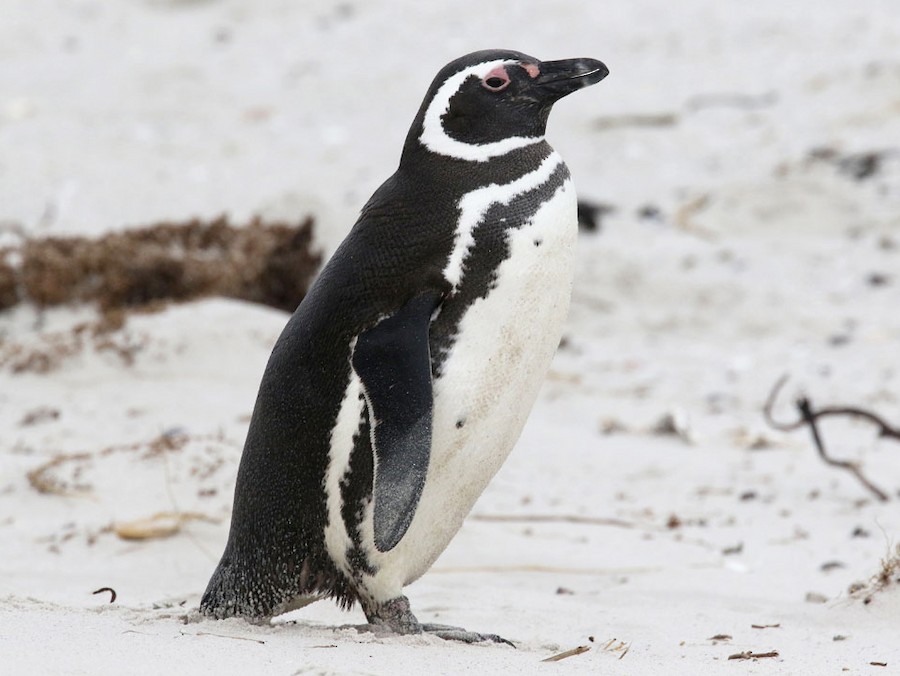
- Adults have blackbacks and white underparts. A prominent, double black band crosses the chest, with an additional black band extending from the back of the head down to the chest bands. A white band runs from above the eye, around the black ear coverts, and down to meet the white throat. Flight feathers are black, and the tail is short and black. The underparts are white with black spots on the flanks.
- Beak shape
- Moderately long and stout, dark grey to black with a pale grey or pinkish patch at the base of the lower mandible and sometimes a narrow white stripe near the tip, especially on the upper mandible.
- Eye color
- Brown with a ring of bare pink skin around the eye.
- Leg color
- Blackish to pinkish-grey feet with black claws.
- Distinguishing features
- The most distinctive feature is the double black band across the chest. The bare pink skin around the eye is also a good field mark. Their overall sleek, torpedo-like body shape is characteristic of penguins.
- Juvenile appearance
- Juveniles are greyish-blue on their backs and have a single, broader grey band across the chest, rather than the double black bands of adults. Their faces are a duller grey, lacking the crisp white head markings of adults. The pink eye ring is less developed or absent.
- Seasonal changes
- Plumage does not change seasonally, but individuals undergo a complete molt annually after the breeding season, usually starting in late summer to early autumn, during which they may appear scruffy and remain on land until their new feathers are fully grown.
- Sexual dimorphism
- Males and females are generally monomorphic in plumage, though males tend to be slightly larger and have thicker bills than females.
How to identify
- 1
Double Black Chest Band
Look for the two distinct black bands that arc across the white chest, separated by a thin white stripe. This is the most reliable field mark for adults.
- 2
Head Pattern
Observe the white stripe extending from above the eye, around the ear coverts, and down to the throat, framing the black head. The bare pinkish skin around the eye is also a good indicator.
- 3
Size and Stature
It's a medium-sized penguin. While size can be hard to gauge without comparison, it's generally larger than Galapagos Penguins and slightly smaller than King Penguins (which have completely different plumage).
- 4
Vocalization
Listen for their characteristic loud, braying call, which sounds much like a donkey. This is particularly noticeable in breeding colonies.
- 5
Juvenile Plumage
Note the greyish back and a single, broad grey band on the chest of juveniles, lacking the crisp adult patterns.
Habitat & range
- Biomes
- Temperate coastal areas, offshore marine environments, islands with accessible nesting sites.
- Geographic range
- Breeds along the coasts of Argentina and Chile, particularly in Patagonia and the Falkland Islands (Malvinas). During the non-breeding season, they migrate north along both the Atlantic and Pacific coasts of South America, reaching as far north as southern Brazil and Peru.
- Elevation range
- Sea level for breeding and foraging. Nests are typically dug into soft soil or under bushes.
- Preferred environments
- Rocky or sandy coastlines for breeding colonies, often utilizing burrows. Forage in cold, productive marine waters over continental shelves.
Behavior
- Activity time
- Diurnal, actively foraging during daylight hours. Nesting activity is also primarily diurnal, though pairs may be active at their burrows at night, especially during incubation.
- Feeding habits
- Pursuit diver, excellent swimmer. Forages solitarily or in groups, diving to depths of 20-50 meters, but capable of deeper dives (up to 100 meters). They use their powerful flippers for propulsion and their webbed feet for steering. Prey is swallowed whole underwater.
- Social behavior
- Highly colonial during the breeding season, forming large nesting aggregations that can number in the hundreds of thousands. They are generally social at sea as well. During breeding, pairs establish and defend territories around their nests.
- Flight pattern
- Flightless bird; propels itself through water using flippers.
- Migration pattern
- Strongly migratory. After breeding, adults and juveniles migrate north to warmer waters with more abundant food sources during the austral winter (April-August). Atlantic populations migrate north along the South American coast to southern Brazil, while Pacific populations migrate north along the Chilean and Peruvian coasts.
- Territoriality
- Highly territorial around their nest burrows during the breeding season. Pairs will aggressively defend their immediate nesting area against other penguins and potential predators. This territorial defense includes vocalizations, bill-jousting, and flipper slapping.
Song & calls
- Song
- Often referred to as a 'braying' or 'donkey-like' call, especially during courtship and territorial defense. This loud, repetitive sound is produced with the bill pointed skyward, often at their burrow entrance. It serves to attract mates and warn rivals.
- Call
- In addition to the braying, Magellanic Penguins produce a variety of squawks, growls, and hissing sounds. Hissing is often used as a warning when approached or threatened. Contact calls are also used between mates and between parents and chicks.
- When they vocalize
- Most vocal during the breeding season, particularly around the colony, during courtship, nest defense, and when feeding chicks. Calls are also heard at sea, but less frequently and usually as contact calls within foraging groups.
Breeding & reproduction
- Breeding season
- Begins in September or early October with arrival at colonies, laying eggs from mid-October to November. Chicks fledge around January-February.
- Nesting habits
- Nests in burrows that they dig in soft soil under bushes or rocks, or sometimes in shallow depressions on open ground. They often return to the same burrow year after year. Colonies are dense and can stretch for miles along the coast.
- Clutch size
- Typically 2 eggs, laid approximately 3-4 days apart.
- Egg description
- Typically two elliptical, dull white or bluish-white eggs, often stained by the nest environment. The first egg is usually slightly larger than the second.
- Incubation period
- Approximately 39-42 days for each egg. Both parents share incubation duties, taking turns lasting several days.
- Fledging period
- Chicks fledge (become independent and go to sea) at around 60-90 days old, depending on food availability and colony conditions.
- Parental care
- Both parents participate equally in incubation and chick-rearing. After hatching, one parent guards the chicks while the other forages, switching roles periodically. As chicks grow, both parents forage, returning to feed their young via regurgitation. Chicks remain in the burrow until nearly fledged.
Where to find
Breeding Colonies
The largest and most accessible breeding colonies are found along the Atlantic coast of Patagonia, Argentina (e.g., Punta Tombo, Cabo Dos Bahías) and on the Falkland Islands (Malvinas). Smaller colonies exist along the Chilean coast.
Coastal Waters
During migration and the non-breeding season, they can be sighted in coastal waters from southern Brazil down to Tierra del Fuego on the Atlantic side, and along the coast of Chile and Peru on the Pacific side. Boat tours often encounter them foraging.
Burrows
Within colonies, look for penguins entering and exiting burrows dug into soft soil or under dense vegetation. These burrows are their nesting sites.
Field tips
- Visit Breeding Colonies During the Breeding Season. The best time to observe large numbers of Magellanic Penguins is from October to March when they are at their breeding colonies. October-November is peak egg-laying and early incubation, while December-February is when chicks are present.
- Observe Behavior from a Distance. Maintain a respectful distance from penguins, especially around nests. Many colonies have designated viewing paths to minimize disturbance. Observe their braying calls, courtship rituals, and chick-feeding without interfering.
- Look for Molting Individuals in Late Summer/Autumn. After the breeding season (typically March-April), some individuals will be seen on land undergoing their annual catastrophic molt, during which they cannot enter the water to feed. They may appear disheveled during this period.
- Consider Boat Tours for Offshore Sightings. To see them foraging or migrating, a boat tour along the coast can be productive, especially outside the main breeding areas or during migration peaks.
Similar species
Humboldt Penguin
Spheniscus humboldti
The Humboldt Penguin has a single black band across its chest, whereas the Magellanic Penguin has a distinctive double black band. The white stripe on the head is also generally broader and more prominent on the Humboldt, and the bare skin around the eye is more extensive and pinker red than the Magellanic's duller pink.
African Penguin
Spheniscus demersus
Like the Humboldt, the African Penguin typically has a single, often irregular, black band across its chest, distinguishing it from the Magellanic's double band. The bare skin around the eye is also pinkish, but is geographically separated from the Magellanic Penguin, found off the coast of Southern Africa.
Galapagos Penguin
Spheniscus mendiculus
The Galapagos Penguin is much smaller than the Magellanic Penguin and also has a single black band across its chest, sometimes incomplete. Its range is restricted to the Galapagos Islands, making geographic separation a key differentiator.
Quick facts
- Name Origin:
- Named after Ferdinand Magellan, who first sighted them in 1520 during his circumnavigation of the globe.
- Burrow Nesters:
- Unlike many other penguin species, Magellanic Penguins primarily nest in burrows, which provide protection from predators and the elements.
- Ecological Role:
- They are important predators in the marine food web and themselves serve as prey for larger marine mammals and birds.
- Conservation Threats:
- Major threats include oil pollution, fishing bycatch, climate change leading to shifts in prey distribution, and habitat degradation at breeding sites.
Fun facts
- Magellanic Penguins can swim at speeds up to 25 kilometers per hour (15 mph) underwater.
- They have a specialized gland above their eyes that filters salt from seawater, allowing them to drink sea water without becoming dehydrated.
- During their annual molt, Magellanic Penguins cannot enter the water to feed because their feathers are no longer waterproof. They must fast during this period, losing up to half their body weight.
- Their elaborate braying call is so loud and distinctive that early explorers often mistook them for donkeys.
- Magellanic Penguins form strong pair bonds and often return to the same mate and nest burrow year after year.
Scientific classification
- Kingdom
- Animalia
- Phylum
- Chordata
- Class
- Aves
- Order
- Sphenisciformes
- Family
- Spheniscidae
- Genus
- Spheniscus
- Species
- Spheniscus magellanicus
Explore the Magellanic Penguin
Identify birds anywhere
Free on iOS, Android, and Web. Photo & sound identification, full species database, and your personal life list.