
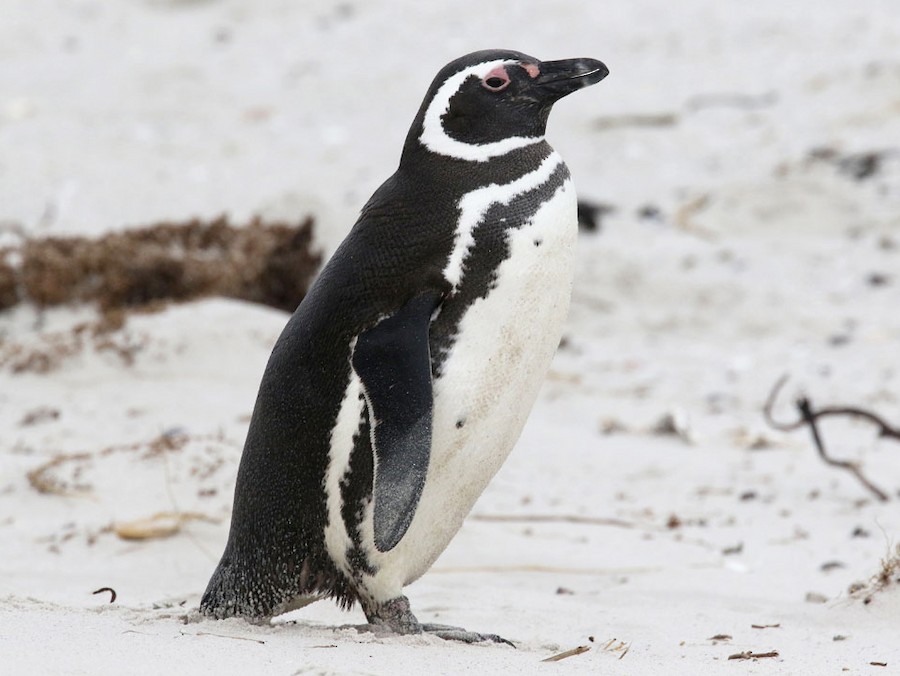
Where does the Magellanic Penguin live?
Spheniscus magellanicus
Spotted a bird? Identify it instantly with the Birdby app
Open the appThe Magellanic Penguin lives in specific habitats and regions. Knowing where, and when, to look improves your chances of a successful sighting.
Biomes
Temperate coastal areas, offshore marine environments, islands with accessible nesting sites.
Geographic range
Breeds along the coasts of Argentina and Chile, particularly in Patagonia and the Falkland Islands (Malvinas). During the non-breeding season, they migrate north along both the Atlantic and Pacific coasts of South America, reaching as far north as southern Brazil and Peru.
Preferred environments
Rocky or sandy coastlines for breeding colonies, often utilizing burrows. Forage in cold, productive marine waters over continental shelves.
Elevation range
Sea level for breeding and foraging. Nests are typically dug into soft soil or under bushes.
Where to look
Breeding Colonies
The largest and most accessible breeding colonies are found along the Atlantic coast of Patagonia, Argentina (e.g., Punta Tombo, Cabo Dos Bahías) and on the Falkland Islands (Malvinas). Smaller colonies exist along the Chilean coast.
Coastal Waters
During migration and the non-breeding season, they can be sighted in coastal waters from southern Brazil down to Tierra del Fuego on the Atlantic side, and along the coast of Chile and Peru on the Pacific side. Boat tours often encounter them foraging.
Burrows
Within colonies, look for penguins entering and exiting burrows dug into soft soil or under dense vegetation. These burrows are their nesting sites.
Field tips
- Visit Breeding Colonies During the Breeding Season. The best time to observe large numbers of Magellanic Penguins is from October to March when they are at their breeding colonies. October-November is peak egg-laying and early incubation, while December-February is when chicks are present.
- Observe Behavior from a Distance. Maintain a respectful distance from penguins, especially around nests. Many colonies have designated viewing paths to minimize disturbance. Observe their braying calls, courtship rituals, and chick-feeding without interfering.
- Look for Molting Individuals in Late Summer/Autumn. After the breeding season (typically March-April), some individuals will be seen on land undergoing their annual catastrophic molt, during which they cannot enter the water to feed. They may appear disheveled during this period.
- Consider Boat Tours for Offshore Sightings. To see them foraging or migrating, a boat tour along the coast can be productive, especially outside the main breeding areas or during migration peaks.
Migration
Strongly migratory. After breeding, adults and juveniles migrate north to warmer waters with more abundant food sources during the austral winter (April-August). Atlantic populations migrate north along the South American coast to southern Brazil, while Pacific populations migrate north along the Chilean and Peruvian coasts.
Explore the Magellanic Penguin
Identify birds anywhere
Free on iOS, Android, and Web. Photo & sound identification, full species database, and your personal life list.