
How to identify the Magellanic Penguin
Spheniscus magellanicus
Spotted a bird? Identify it instantly with the Birdby app
Open the appTo correctly identify the Magellanic Penguin (Spheniscus magellanicus), check each of these features. Birds can be tricky: habit, habitat, and call often confirm a sighting that a single photo cannot.
Size at a glance
- Length
- 61-76 cm (24-30 in)
- Wingspan
- 30-36 cm (12-14 in) (flipper length)
- Weight
- 2.7-6.5 kg (6.0-14.3 lbs), varying seasonally
Physical features to check
- 1
Plumage
Overall feather coloration and pattern.
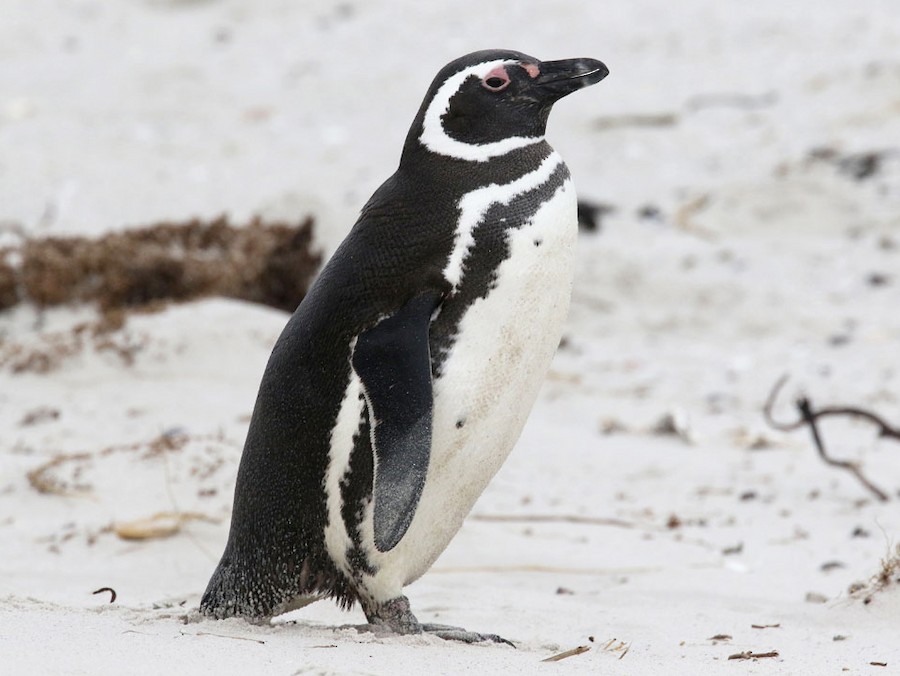
Adults have blackbacks and white underparts. A prominent, double black band crosses the chest, with an additional black band extending from the back of the head down to the chest bands. A white band runs from above the eye, around the black ear coverts, and down to meet the white throat. Flight feathers are black, and the tail is short and black. The underparts are white with black spots on the flanks.
- 2
Beak shape
Shape and color of the bill: a key field mark.
Moderately long and stout, dark grey to black with a pale grey or pinkish patch at the base of the lower mandible and sometimes a narrow white stripe near the tip, especially on the upper mandible.
- 3
Eye color
Iris color and any distinctive eye markings.
Brown with a ring of bare pink skin around the eye.
- 4
Leg color
Leg and foot color.
Blackish to pinkish-grey feet with black claws.
- 5
Distinguishing features
Standout features that separate this species.
The most distinctive feature is the double black band across the chest. The bare pink skin around the eye is also a good field mark. Their overall sleek, torpedo-like body shape is characteristic of penguins.
- 6
Juvenile appearance
How young birds differ from adults.
Juveniles are greyish-blue on their backs and have a single, broader grey band across the chest, rather than the double black bands of adults. Their faces are a duller grey, lacking the crisp white head markings of adults. The pink eye ring is less developed or absent.
- 7
Seasonal changes
Plumage variation between breeding and non-breeding seasons.
Plumage does not change seasonally, but individuals undergo a complete molt annually after the breeding season, usually starting in late summer to early autumn, during which they may appear scruffy and remain on land until their new feathers are fully grown.
- 8
Sexual dimorphism
How males and females differ.
Males and females are generally monomorphic in plumage, though males tend to be slightly larger and have thicker bills than females.
Key field marks
- Double Black Chest Band. Look for the two distinct black bands that arc across the white chest, separated by a thin white stripe. This is the most reliable field mark for adults.
- Head Pattern. Observe the white stripe extending from above the eye, around the ear coverts, and down to the throat, framing the black head. The bare pinkish skin around the eye is also a good indicator.
- Size and Stature. It's a medium-sized penguin. While size can be hard to gauge without comparison, it's generally larger than Galapagos Penguins and slightly smaller than King Penguins (which have completely different plumage).
- Vocalization. Listen for their characteristic loud, braying call, which sounds much like a donkey. This is particularly noticeable in breeding colonies.
- Juvenile Plumage. Note the greyish back and a single, broad grey band on the chest of juveniles, lacking the crisp adult patterns.
Explore the Magellanic Penguin
Identify birds anywhere
Free on iOS, Android, and Web. Photo & sound identification, full species database, and your personal life list.