
Spotted a bird? Identify it instantly with the Birdby app
Open the appAbout
The American Goldfinch is a small North American migratory songbird in the finch family. It is known for its striking sexual dimorphism, particularly the bright yellow plumage of the breeding male. It is a granivorous species, specializing in seeds, especially thistle and sunflower, and is often seen at bird feeders.
Size & lifespan
- Length
- 11-14 cm (4.3-5.5 in)
- Wingspan
- 19-22 cm (7.5-8.7 in)
- Weight
- 11-20 g (0.39-0.71 oz)
- Lifespan
- 3-7 years (up to 10 years recorded in the wild)
- Diet
- Granivore (primarily seeds, especially thistle, dandelion, sunflower, and other composite plants)
Physical characteristics
- Plumage
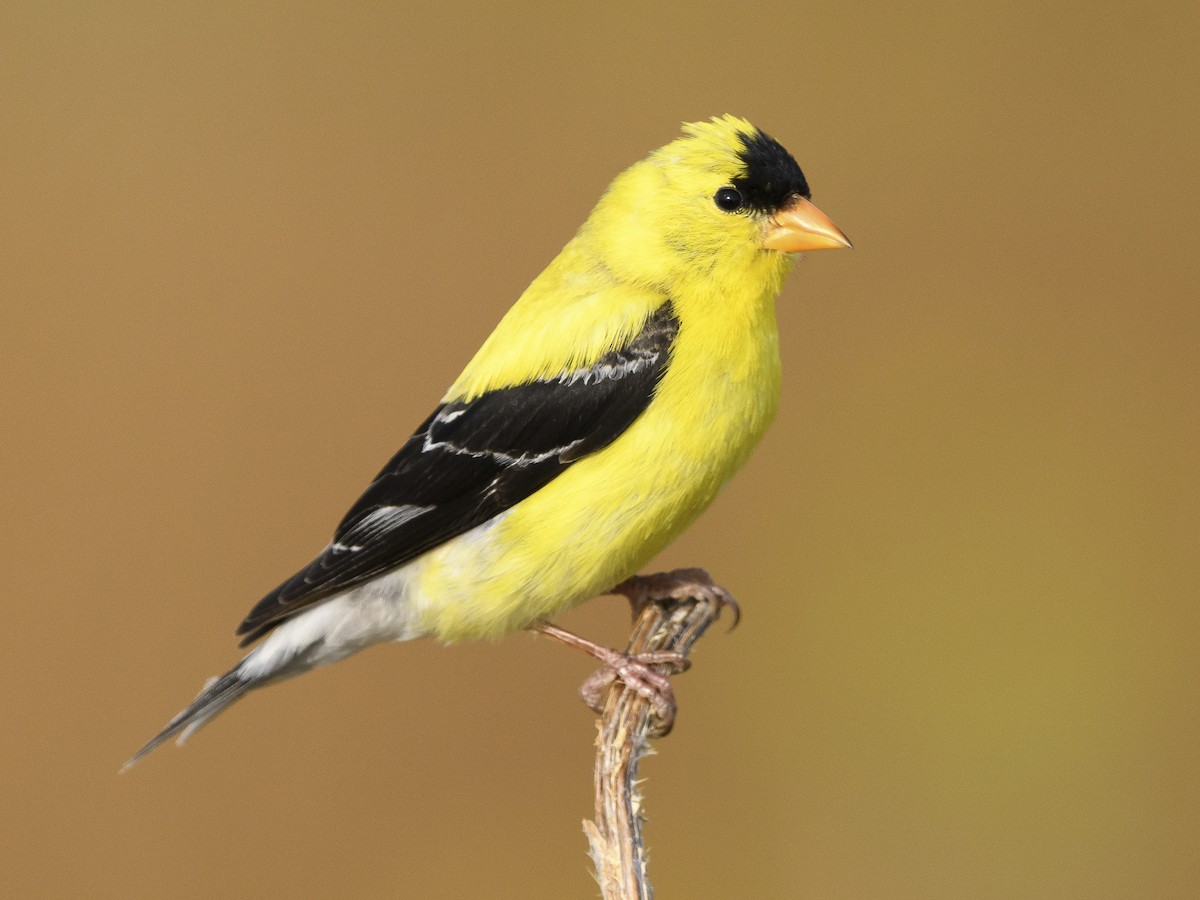
- Breeding male: Brilliant lemon yellow body, black cap, black wings with white wing bars, and white rump. Breeding female: Dull yellow-olive body, dusky wings with two pale wing bars, and no black cap. Non-breeding plumage (both sexes): Dull yellowish-brown overall, with dusky wings and faint wing bars. Juveniles: Dull brown with faint streaking, buffy wing bars.
- Beak shape
- Small, conical, and pointed, adapted for extracting seeds. Pinkish-orange in breeding males, duller in females and non-breeding birds.
- Eye color
- Dark brown.
- Leg color
- Pinkish-brown to flesh-colored.
- Distinguishing features
- The undulating flight pattern, often described as 'bouncy' or 'rollercoaster-like', is highly characteristic. The bright yellow and black of the breeding male are unmistakable. White wing bars are present in all plumages.
- Juvenile appearance
- Juveniles are dull brown or buffy-brown overall, often with faint streaking on the breast and flanks. They have dusky wings with buffy wing bars, lacking the distinct white of adults. They molt into their first basic (non-breeding) plumage in late summer.
- Seasonal changes
- Males undergo a complete molt twice a year. In spring, they molt into their vibrant yellow breeding plumage. In late summer/early fall, they molt into a duller, yellowish-brown basic (non-breeding) plumage. Females also undergo seasonal molts, but their plumage changes are less dramatic, shifting from a duller yellow-olive in breeding season to a more grayish-brown in winter.
- Sexual dimorphism
- Pronounced. Breeding males are bright yellow with a black cap; females are duller yellow-olive without a black cap. This difference is less stark in non-breeding plumage.
How to identify
- 1
Plumage (Breeding Male)
Look for the unmistakable bright lemon-yellow body, contrasting with a solid black cap, black wings with prominent white wing bars, and a white rump.
- 2
Plumage (Breeding Female)
Observe the duller yellow-olive body, dusky wings with two pale wing bars, and the absence of a black cap. They are generally brighter yellow than non-breeding birds.
- 3
Plumage (Non-breeding/Winter)
Both sexes become duller, a yellowish-brown or olive-brown overall, with dusky wings and faint wing bars. Males retain some yellow on the shoulders and face, but the black cap is lost. Look for the characteristic flight and calls.
- 4
Flight Pattern
Watch for the distinctive undulating, 'bouncy' flight, where the bird dips down between bursts of wing beats.
- 5
Calls and Song
Listen for the 'po-ta-to-chip' or 'per-chick-o-ree' call given in flight, and the long, musical, rambling song of warbles and trills.
- 6
Feeding Behavior
Observe them clinging to seed heads, often upside down, extracting seeds. They are frequent visitors to nyjer and sunflower feeders.
Habitat & range
- Biomes
- Open woodlands, fields, meadows, suburban gardens, riparian areas, and cultivated lands.
- Geographic range
- Breeds across southern Canada and the northern United States. Winters across the southern United States and into Mexico.
- Elevation range
- Typically found from sea level up to approximately 2,000 meters (6,500 feet), though less common at higher elevations.
- Preferred environments
- Areas with abundant thistle, dandelion, and other seed-producing plants, often near water sources. They favor edge habitats, such as the borders of forests and open fields, and are common in parks and backyards with feeders.
Behavior
- Activity time
- Diurnal.
- Feeding habits
- Primarily granivorous, specializing in small seeds, particularly those from composite plants like thistle, dandelion, and sunflower. They are agile foragers, often clinging to seed heads upside down. They will also consume tree buds and occasionally insects, especially to feed young. They are frequent visitors to bird feeders offering nyjer (thistle) or black oil sunflower seeds.
- Social behavior
- Highly social, especially outside the breeding season, forming large flocks that can number in the hundreds. During breeding, they are more territorial but may nest in loose colonies. They often feed in mixed-species flocks with other finches.
- Flight pattern
- Distinctive undulating or 'bouncy' flight, characterized by a series of short, rapid wing beats followed by a brief glide with wings folded against the body, creating an up-and-down motion.
- Migration pattern
- Partial migrant. Northern populations migrate south for the winter, while southern populations may be resident or undertake short-distance movements. Migration occurs in flocks, typically during the day.
- Territoriality
- Males defend a small territory around the nest during the breeding season, but feeding territories are not strictly maintained, and they often forage communally.
Song & calls
- Song
- A long, rambling, and musical series of warbles, trills, and twitters, often interspersed with 'swee-swee-swee' notes. It is often described as a 'potato-chip' song, due to the 'per-chick-o-ree' or 'po-ta-to-chip' call notes incorporated into the song, especially during flight.
- Call
- Common calls include a distinctive 'po-ta-to-chip' or 'per-chick-o-ree' call given in flight, a plaintive 'sweeet' call, and a rapid 'tsee-tsee-tsee' alarm call.
- When they vocalize
- Most vocal during the breeding season (late spring to late summer), with males singing frequently to attract mates and defend territory. Calls are given year-round, especially during flight and when foraging in flocks.
Breeding & reproduction
- Breeding season
- Late June to September, later than most other North American songbirds, coinciding with the peak availability of thistle and other seeds for feeding young.
- Nesting habits
- Nests are typically built in deciduous shrubs or small trees, 1-10 meters (3-30 feet) above the ground. The female constructs a tightly woven, cup-shaped nest from plant fibers, spider silk, and thistle down, making it so dense it can hold water. The rim is often decorated with bark strips or lichen.
- Clutch size
- 3-7 eggs, usually 4-6.
- Egg description
- 3-7 (typically 4-6) pale bluish-white eggs, sometimes with faint brown speckles, measuring approximately 16 x 12 mm.
- Incubation period
- 12-14 days, primarily by the female.
- Fledging period
- 11-17 days after hatching. Young are fed by both parents.
- Parental care
- Female incubates eggs and broods young. Both parents feed the nestlings, primarily with regurgitated seeds. Males often feed the female on the nest during incubation.
Where to find
Backyards and Gardens
Common visitors to bird feeders, especially those offering nyjer (thistle) or black oil sunflower seeds. Plant native thistles or sunflowers to attract them.
Open Fields and Meadows
Look for them in areas with tall grasses and wildflowers, particularly where thistle and dandelion are abundant.
Riparian Areas
Often found along stream banks and river edges where there is a mix of open areas and shrubby vegetation.
Forest Edges and Shrublands
They prefer the interface between open areas and denser vegetation, providing both foraging opportunities and cover.
Field tips
- Provide appropriate food. Offer nyjer (thistle) seeds in a specialized feeder or black oil sunflower seeds in a tube feeder to attract them to your yard.
- Look for their flight. Their undulating flight pattern is a key identifier, even at a distance or in duller plumages.
- Listen for their calls. The 'po-ta-to-chip' call is very distinctive and often given in flight, helping to locate them before you see them.
- Observe feeding behavior. Watch for them clinging acrobatically to seed heads, especially thistle, in late summer and fall.
- Seasonal timing. While present year-round in much of their range, males are most vibrant and conspicuous during the late spring and summer breeding season.
Similar species
Lesser Goldfinch
Spinus psaltria
Smaller size, males have a black back (American Goldfinch males have a yellow back), and a less extensive black cap. Females are duller and grayer than American Goldfinch females. Range is primarily western North America.
Lawrence's Goldfinch
Spinus lawrencei
Males have a black face and breast patch, and a gray body. Females are also grayer. Less common and has a more restricted range in the southwestern United States. Call is a distinctive 'tinkling' sound.
Pine Siskin
Spinus pinus
Streaky brown overall with yellow patches in the wings and tail (often visible only in flight). Beak is more slender and pointed. Lacks the bright yellow and black cap of the breeding male American Goldfinch. Often found in coniferous forests.
Quick facts
- Primary Diet:
- Seeds (granivorous)
- Distinctive Flight:
- Undulating, 'bouncy' flight
- Breeding Plumage (Male):
- Bright yellow with black cap and wings
- Nesting Material:
- Thistle down, spider silk
- Breeding Season:
- Late summer (later than most songbirds)
Fun facts
- The American Goldfinch is one of the few bird species that undergoes a complete molt twice a year, once in spring and once in late summer/early fall.
- Their diet is almost exclusively seeds, making them one of the strictest vegetarians among birds. They even feed their young regurgitated seeds, unlike most songbirds that feed insects to their nestlings.
- The American Goldfinch is the state bird of Iowa, New Jersey, and Washington.
- Their nests are so tightly woven that they can sometimes hold water, which can be a problem for nestlings during heavy rains.
- They are often seen hanging upside down to extract seeds from thistle and sunflower heads, showcasing their acrobatic foraging skills.
Scientific classification
- Kingdom
- Animalia
- Phylum
- Chordata
- Class
- Aves
- Order
- Passeriformes
- Family
- Fringillidae
- Genus
- Spinus
- Species
- Spinus tristis
Explore the American Goldfinch
Identify birds anywhere
Free on iOS, Android, and Web. Photo & sound identification, full species database, and your personal life list.