
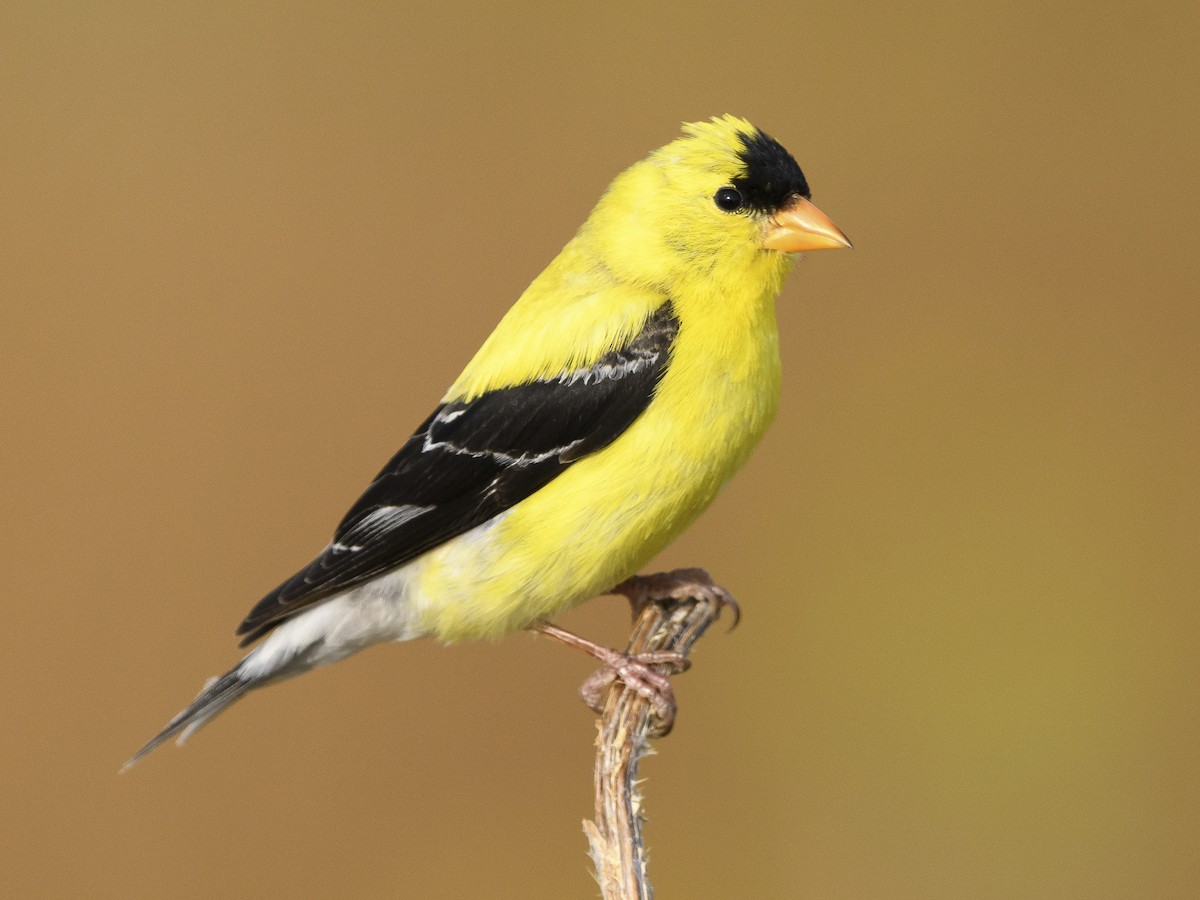
How to identify the American Goldfinch
Spinus tristis
Spotted a bird? Identify it instantly with the Birdby app
Open the appTo correctly identify the American Goldfinch (Spinus tristis), check each of these features. Birds can be tricky: habit, habitat, and call often confirm a sighting that a single photo cannot.
Size at a glance
- Length
- 11-14 cm (4.3-5.5 in)
- Wingspan
- 19-22 cm (7.5-8.7 in)
- Weight
- 11-20 g (0.39-0.71 oz)
Physical features to check
- 1
Plumage
Overall feather coloration and pattern.
Breeding male: Brilliant lemon yellow body, black cap, black wings with white wing bars, and white rump. Breeding female: Dull yellow-olive body, dusky wings with two pale wing bars, and no black cap. Non-breeding plumage (both sexes): Dull yellowish-brown overall, with dusky wings and faint wing bars. Juveniles: Dull brown with faint streaking, buffy wing bars.
- 2
Beak shape
Shape and color of the bill: a key field mark.
Small, conical, and pointed, adapted for extracting seeds. Pinkish-orange in breeding males, duller in females and non-breeding birds.
- 3
Eye color
Iris color and any distinctive eye markings.
Dark brown.
- 4
Leg color
Leg and foot color.
Pinkish-brown to flesh-colored.
- 5
Distinguishing features
Standout features that separate this species.
The undulating flight pattern, often described as 'bouncy' or 'rollercoaster-like', is highly characteristic. The bright yellow and black of the breeding male are unmistakable. White wing bars are present in all plumages.
- 6
Juvenile appearance
How young birds differ from adults.
Juveniles are dull brown or buffy-brown overall, often with faint streaking on the breast and flanks. They have dusky wings with buffy wing bars, lacking the distinct white of adults. They molt into their first basic (non-breeding) plumage in late summer.
- 7
Seasonal changes
Plumage variation between breeding and non-breeding seasons.
Males undergo a complete molt twice a year. In spring, they molt into their vibrant yellow breeding plumage. In late summer/early fall, they molt into a duller, yellowish-brown basic (non-breeding) plumage. Females also undergo seasonal molts, but their plumage changes are less dramatic, shifting from a duller yellow-olive in breeding season to a more grayish-brown in winter.
- 8
Sexual dimorphism
How males and females differ.
Pronounced. Breeding males are bright yellow with a black cap; females are duller yellow-olive without a black cap. This difference is less stark in non-breeding plumage.
Key field marks
- Plumage (Breeding Male). Look for the unmistakable bright lemon-yellow body, contrasting with a solid black cap, black wings with prominent white wing bars, and a white rump.
- Plumage (Breeding Female). Observe the duller yellow-olive body, dusky wings with two pale wing bars, and the absence of a black cap. They are generally brighter yellow than non-breeding birds.
- Plumage (Non-breeding/Winter). Both sexes become duller, a yellowish-brown or olive-brown overall, with dusky wings and faint wing bars. Males retain some yellow on the shoulders and face, but the black cap is lost. Look for the characteristic flight and calls.
- Flight Pattern. Watch for the distinctive undulating, 'bouncy' flight, where the bird dips down between bursts of wing beats.
- Calls and Song. Listen for the 'po-ta-to-chip' or 'per-chick-o-ree' call given in flight, and the long, musical, rambling song of warbles and trills.
- Feeding Behavior. Observe them clinging to seed heads, often upside down, extracting seeds. They are frequent visitors to nyjer and sunflower feeders.
Explore the American Goldfinch
Identify birds anywhere
Free on iOS, Android, and Web. Photo & sound identification, full species database, and your personal life list.