
Spotted a bird? Identify it instantly with the Birdby app
Open the appAbout
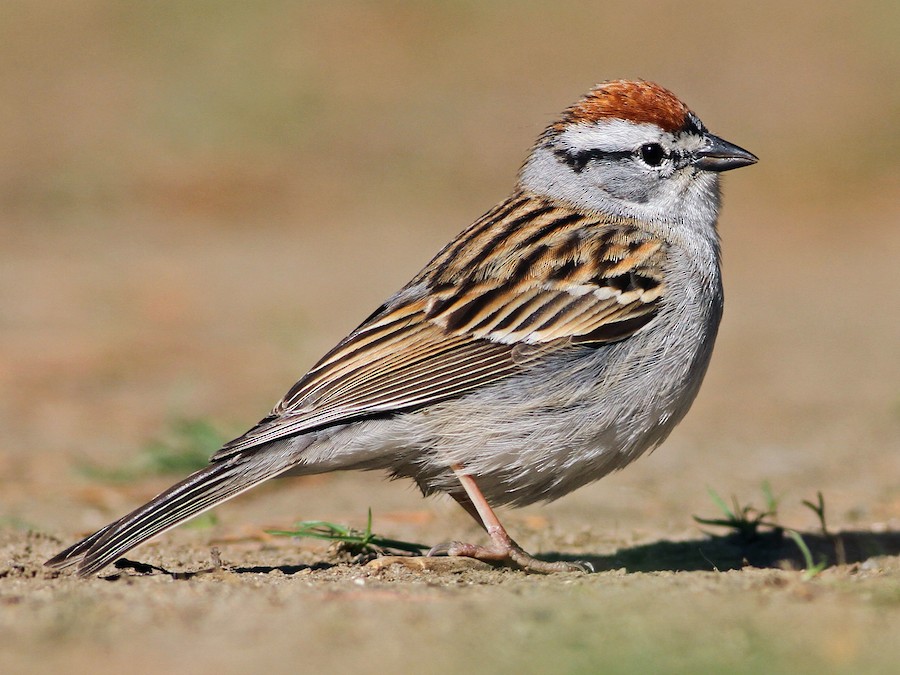
The Chipping Sparrow is a small, widespread North American sparrow known for its distinctive rusty cap and trilling song. It is a common sight in suburban areas, parks, and open woodlands, often foraging on the ground or in low vegetation.
Size & lifespan
- Length
- 12-14 cm (4.7-5.5 in)
- Wingspan
- 20-24 cm (7.9-9.4 in)
- Weight
- 11-15 g (0.4-0.5 oz)
- Lifespan
- Typically 2-5 years in the wild, with records up to 9 years.
- Diet
- Omnivore, primarily granivorous and insectivorous. Diet shifts seasonally, with a higher proportion of insects during breeding season.
Physical characteristics
- Plumage
- Adult breeding plumage features a bright rusty (rufous) cap, a prominent white supercilium (eyebrow stripe), and a black eye-line extending from the lores through the eye. The back is streaked brown and black, and the underparts are clean gray to whitish. The rump is unstreaked gray. Non-breeding adults have a duller rusty cap, often streaked with dusky, and a less distinct facial pattern. Juveniles are heavily streaked on the breast and flanks, lack the rusty cap, and have a buffy wash.
- Beak shape
- Small, conical, and pointed bill, typically dark gray to black in breeding adults, becoming pinkish at the base of the lower mandible in non-breeding birds and juveniles.
- Eye color
- Dark brown.
- Leg color
- Pinkish-brown to dark brown.
- Distinguishing features
- Rusty cap, white supercilium, black eye-line, unstreaked gray breast and rump (in adults), and a relatively small size.
- Juvenile appearance
- Juveniles are heavily streaked on the breast and flanks, lack the rusty cap, and have a buffy wash on the underparts. Their crown is streaked brown and black, and their facial pattern is less defined than adults. They acquire adult-like plumage after their first prebasic molt.
- Seasonal changes
- Breeding adults have a brighter rusty cap and more defined facial markings. Non-breeding adults and first-year birds have a duller, often streaked, rusty cap and a less crisp facial pattern. The bill color also changes, being darker in breeding season.
- Sexual dimorphism
- Males and females are outwardly similar in plumage. Males may be slightly larger on average, but this is not a reliable field mark.
How to identify
- 1
Rusty Cap
Look for the bright rufous (rusty) crown, especially prominent in breeding adults. This is the most reliable field mark.
- 2
Facial Pattern
Note the clean white supercilium (eyebrow stripe) contrasting with a distinct black eye-line that passes through the eye. This creates a 'clean-faced' appearance.
- 3
Underparts
Observe the plain, unstreaked gray to whitish underparts. Juveniles will have streaking, but adults do not.
- 4
Rump
The rump is unstreaked gray, which can be a useful distinguishing feature from some other sparrows.
- 5
Size and Shape
They are relatively small and slender sparrows with a small, conical bill.
- 6
Song
Listen for the distinctive, dry, mechanical trill, often likened to a sewing machine or a rapidly vibrating insect. This is a key auditory identification cue.
Habitat & range
- Biomes
- Temperate forests, grasslands, shrublands, urban/suburban areas.
- Geographic range
- Widespread across North America. Breeds from Alaska and Canada south through the United States and into Mexico. Winters primarily in the southern United States and Mexico.
- Elevation range
- Sea level up to 3,000 meters (10,000 feet) in some parts of its range, particularly in western mountains.
- Preferred environments
- Open woodlands, forest edges, parks, suburban gardens, orchards, cemeteries, clearings, and areas with scattered trees and grassy undergrowth. They prefer areas with short grass for foraging and shrubs or small trees for nesting.
Behavior
- Activity time
- Diurnal.
- Feeding habits
- Primarily ground foragers, hopping and scratching through leaf litter or short grass to find seeds and insects. They also glean insects from foliage and occasionally catch flying insects. During the breeding season, insects (caterpillars, grasshoppers, beetles) form a significant part of their diet, especially for feeding young. In winter, seeds of grasses and weeds are dominant.
- Social behavior
- During the breeding season, they are territorial and typically found in pairs. Outside of the breeding season, they form loose flocks, often mixing with other sparrow species, especially during migration and in wintering grounds.
- Flight pattern
- Flight is typically short, undulating, and low to the ground. When flushed, they often fly to a nearby tree or shrub.
- Migration pattern
- Most populations are migratory, moving south for the winter. Northern and interior populations undertake long-distance migrations. Some southern populations in the United States and Mexico may be resident or undertake short-distance movements. They migrate in flocks, often at night.
- Territoriality
- Males establish and defend breeding territories through song and displays. They are less territorial outside the breeding season.
Song & calls
- Song
- A distinctive, dry, mechanical trill, often described as a rapid series of 'chip' notes: 'chip-chip-chip-chip-chip-chip-chip'. The trill is on a single pitch and can last for several seconds. It is often compared to the sound of a sewing machine or a rapidly vibrating insect.
- Call
- A sharp, high-pitched 'chip' or 'tsip' note, used as an alarm call or contact call. Also a softer 'seet' call.
- When they vocalize
- Males sing frequently from prominent perches during the breeding season, from early spring through mid-summer. Calls are given year-round.
Breeding & reproduction
- Breeding season
- Typically April to August, with peak activity from May to July. May raise 1-3 broods per season.
- Nesting habits
- Nests are typically built low in shrubs, small trees, or dense vegetation, usually within 1-3 meters (3-10 feet) off the ground, but can be higher. The nest is a neat, cup-shaped structure made of fine grasses, rootlets, and plant fibers, often lined with fine hair (horsehair is a common lining material, giving it the nickname 'hair bird'). Both sexes participate in nest building, though the female does most of the work.
- Clutch size
- 3-5 eggs, most commonly 4.
- Egg description
- 3-5 eggs, pale blue or bluish-green, often speckled or spotted with reddish-brown or black, particularly at the larger end. Eggs are approximately 18 x 13 mm.
- Incubation period
- 10-13 days, primarily by the female.
- Fledging period
- 8-12 days after hatching. Young leave the nest before they can fly well.
- Parental care
- Both parents feed the nestlings and fledglings. The male may continue to feed the first brood while the female begins a second clutch.
Where to find
Suburban Gardens and Parks
Common in areas with lawns, scattered trees, and shrubs, often seen foraging on the ground or perched on low branches.
Open Woodlands and Forest Edges
Favors deciduous or mixed woodlands with an open understory, clearings, and woodland borders.
Orchards and Cemeteries
These managed landscapes often provide the ideal mix of short grass for foraging and small trees/shrubs for nesting.
Shrublands and Old Fields
Can be found in areas with dense shrubby growth and grassy patches.
Field tips
- Listen for the Song. Their distinctive trilling song is often the first indication of their presence. Once you hear it, scan nearby trees or shrubs for the singer.
- Check Low Vegetation and Ground. Chipping Sparrows frequently forage on the ground or in low shrubs. Look for small birds hopping and scratching in leaf litter or short grass.
- Look for Movement. They are often active and can be seen flitting between low branches or darting across open ground.
- Visit Suitable Habitats. Focus your search in parks, gardens, and open woodlands, especially during the breeding season.
Similar species
American Tree Sparrow
Spizelloides arborea
The American Tree Sparrow has a bicolored bill (dark upper, yellow lower mandible), a single dark spot on its unstreaked breast, and a gray head with a rusty eye-line (no white supercilium). It also has rusty wing bars. Chipping Sparrows have a dark bill (in breeding season), no breast spot, a white supercilium, and a black eye-line.
Field Sparrow
Spizella pusilla
The Field Sparrow has a pink bill, a plain gray face with a rusty crown (but no distinct black eye-line or white supercilium), and a plain gray breast. Its song is a slurred series of whistles that accelerate into a trill, distinct from the Chipping Sparrow's dry trill.
Clay-colored Sparrow
Spizella pallida
The Clay-colored Sparrow is paler overall, with a buffy-brown face, a distinct dark malar stripe, and a pale median crown stripe. It lacks the bright rusty cap and prominent white supercilium of the Chipping Sparrow. Its song is a series of buzzy 'bzzzt' notes.
House Sparrow
Passer domesticus
House Sparrows are stockier, with a much thicker bill. Males have a gray crown, chestnut nape, black bib, and white cheeks. Females are duller brown with a plain buffy supercilium. Chipping Sparrows are more slender, have a rusty cap, and a distinct white supercilium and black eye-line.
Quick facts
- Primary Diet:
- Seeds and Insects
- Distinctive Feature:
- Rusty Cap
- Song Type:
- Dry, mechanical trill
- Nest Lining:
- Often uses animal hair (e.g., horsehair)
- Migration Status:
- Mostly migratory
Fun facts
- The Chipping Sparrow's common name comes from its distinctive 'chip' call and its trilling song, which sounds like a series of chips.
- They are sometimes called 'hair birds' due to their habit of lining their nests with fine animal hair, often horsehair.
- Chipping Sparrows are one of the most widespread and familiar sparrows in North America, often found in close proximity to human habitation.
- Their diet shifts significantly with the seasons; they are much more insectivorous during the breeding season to provide protein for their young.
- Despite their small size, they can be quite aggressive in defending their nests from predators or competitors.
Scientific classification
- Kingdom
- Animalia
- Phylum
- Chordata
- Class
- Aves
- Order
- Passeriformes
- Family
- Passerellidae
- Genus
- Spizella
- Species
- Spizella passerina
Explore the Chipping Sparrow
Identify birds anywhere
Free on iOS, Android, and Web. Photo & sound identification, full species database, and your personal life list.