
Spotted a bird? Identify it instantly with the Birdby app
Open the appAbout
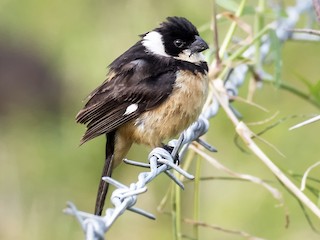
The White-collared Seedeater is a small, sexually dimorphic passerine bird found in Central America. Males are striking with their contrasting black and white plumage, while females are duller, exhibiting a more uniform olive-brown coloration. They are typically found in open grassy areas, agricultural fields, and shrubby habitats. Known for their melodious songs, they are often detected by their vocalizations.
Size & lifespan
- Length
- 10-11 cm
- Wingspan
- 14-16 cm
- Weight
- 8.5-12 g
- Lifespan
- 3-5 years (estimated in the wild)
- Diet
- Primarily seeds of grasses and weeds; occasionally insects, especially during breeding season.
Physical characteristics
- Plumage
- Adult males display a striking pattern: black head, back, wings, and tail, with a prominent white collar extending from the nape around the sides of the neck, and a white chin and throat patch. The underparts are mostly white, sometimes with a buff or yellowish wash, especially on the flanks. A small white alar speculum is visible on the wings. Females are uniformly dull olive-brown above, paler and buffier below, with no distinct markings. Some females might show faint streaking on the breast or a slight buffy wash on the throat. Juveniles resemble females closely, but young males may show hints of black in their plumage as they mature.
- Beak shape
- Conical and stout, adapted for crushing seeds. Color varies from black in breeding males to horn-colored or yellowish in females and non-breeding males.
- Eye color
- Dark brown.
- Leg color
- Dark gray to blackish.
- Distinguishing features
- Males are unmistakable due to the prominent white collar. Females are much harder to identify and require careful observation, often distinguished by shape, size, and association with males or by their unique calls.
- Juvenile appearance
- Juveniles are similar to adult females, overall olive-brown with paler underparts. Young males gradually acquire adult male plumage through molts, showing patchy black and white areas.
- Seasonal changes
- Males exhibit slightly duller plumage outside the breeding season, with some variation in bill color. Their black areas may appear less intensely black and the white less pristine. However, the overall pattern remains distinctive. Females show minimal seasonal variation.
- Sexual dimorphism
- Strong; males are black and white, females are olive-brown.
How to identify
- 1
Male Plumage
Look for the distinct white collar separating the black head from the black back, and the prominent white chin and throat. This pattern is unique among seedeaters in its range.
- 2
Female/Juvenile Plumage
Identifying females and juveniles is challenging. Look for a small, dull olive-brown bird with a conical bill in appropriate habitat. Association with a known male White-collared Seedeater can be a strong clue. Pay attention to soft calls and overall behavior.
- 3
Song
Learn the male's melodious and warbling song. It is often the first way to detect this species, especially in dense grassy habitats where they can be hard to spot.
- 4
Habitat Preference
They prefer open, grassy areas with seeding plants. Searching in these specific habitats increases the chances of encountering them.
- 5
Behavior
Watch for small birds foraging on grass seeds, typically low to the ground or clinging to grass stalks. Their active, flitting movements can be characteristic.
Habitat & range
- Biomes
- Tropical and subtropical grasslands, shrublands, and agricultural areas.
- Geographic range
- Southern Mexico south through Central America to western Panama, with an isolated population in parts of northern South America (Colombia and Venezuela).
- Elevation range
- Sea level up to 1,800 meters, occasionally higher in parts of its range.
- Preferred environments
- Open grassy fields, pastures, savannas, roadsides, agricultural lands (especially those with seeded crops), and shrubby clearings. They often prefer areas with tall seeding grasses interspersed with low shrubs for perching and cover.
Behavior
- Activity time
- Diurnal, most active during early mornings and late afternoons.
- Feeding habits
- Forages predominantly on the ground or low in vegetation, gleaning seeds directly from grass heads or fallen seeds. Occasionally takes small insects, especially when feeding young. They are active and agile while foraging, often hopping or flitting between grass stalks.
- Social behavior
- Typically seen singly or in pairs, especially during the breeding season. Outside of breeding, they may form small flocks, sometimes mixed with other seedeater species, particularly at abundant food sources.
- Flight pattern
- Undulating, often low to the ground with rapid wing beats, especially during short flights. Long-distance flights are more direct.
- Migration pattern
- Generally resident throughout its range, though some local or altitudinal movements may occur in response to food availability or weather conditions. There is no large-scale migratory pattern.
- Territoriality
- Males are territorial during the breeding season, defending a nesting territory with song and occasional aggression towards rivals.
Song & calls
- Song
- A varied and musical series of phrases, typically consisting of clear, slurred whistles and rapid warbling notes. The song is often described as sweet and melodious, with some variations between individuals and subspecies. It can be quite complex and prolonged.
- Call
- Common calls include a soft 'chip' or 'tseep', and a sharper 'tic' or 'tink' often given when alarmed or in flight. Contact calls are generally subtle.
- When they vocalize
- Males sing frequently from prominent perches during the breeding season to attract mates and defend territory. Calls are given year-round for communication, alarm, and contact.
Breeding & reproduction
- Breeding season
- Varies geographically, generally coinciding with the rainy season when food resources (seeds) are abundant. Typically May to August in Mexico and Central America, but can extend longer in some regions.
- Nesting habits
- Nests are small, cup-shaped structures, typically built low in dense shrubs, grass clumps, or small trees. Constructed by the female using fine grasses, rootlets, and plant fibers, often lined with softer materials.
- Clutch size
- 2-3 eggs per clutch.
- Egg description
- Usually 2-3 eggs, whitish or pale bluish-white, speckled and blotched with reddish-brown or purple, particularly at the larger end.
- Incubation period
- Approximately 11-13 days, primarily by the female.
- Fledging period
- Nestlings fledge around 10-13 days after hatching. Both parents feed the young.
- Parental care
- Both parents are involved in feeding the nestlings and fledglings, though the female does most of the incubation. Males are known to sing near the nest site and contribute to defending the territory.
Where to find
Agricultural Fields
Look in corn, rice, or other crop fields, especially along their edges or in weedy patches within them.
Pastures/Grazing Lands
Areas with cattle or horses often have grazed-down grass and weeds, which provide food sources for seedeaters.
Roadsides and Verges
Weedy roadsides with ample seeding grasses are common spots for them to forage and perch.
Open Shrubland Edge
Where grasslands meet low, scrubby vegetation, they can be found using the shrubs for cover and perching posts.
Field tips
- Listen for their song. Their distinctive, musical song is often the best indicator of their presence before you see them. Learn to recognize it.
- Scan grassy areas. Use binoculars to carefully scan tall grasses and weed patches for movement. They can be quite camouflaged, especially females.
- Morning and late afternoon. These birds are most active during the cooler parts of the day, making these the best times for observation.
- Look for movements in grass. Rather than looking for the bird itself, look for characteristic rustling movements in seeding grass heads.
- Observe patiently. They can be shy and cryptic. Settle in one spot and observe quietly; they may eventually emerge or become more visible.
Similar species
Morelet's Seedeater
Sporophila morelleti
Historically considered the same species, Morelet's Seedeater (Sporophila morelleti) is now often recognized as a distinct species. Males of S. morelleti typically have a more extensive white cheek patch that often connects to a white collar, and usually lack the broad white chin patch of S. torqueola. The underparts might also show more extensive buffy or yellowish tones, and the wing speculum might be smaller or absent. Female identification is extremely challenging and often relies on geographic location.
Variable Seedeater
Sporophila corvina
Male Variable Seedeaters are entirely glossy black with entirely white underparts (or black overall with a white patch on the wing), lacking the white collar distinctive of S. torqueola. Females are also uniformly olive-brown but can be slightly larger and often have a more robust bill.
Yellow-bellied Seedeater
Sporophila nigricollis
Males have a black head and upperparts, but distinct yellow underparts and a white throat patch without a full white collar. Females are similar to S. torqueola females but often have a stronger yellowish wash on the belly.
Quick facts
- Taxonomic Note:
- The species 'Sporophila torqueola' has undergone significant taxonomic revision, with several former subspecies now recognized as distinct species, most notably Morelet's Seedeater (Sporophila morelleti).
- Diet Specialization:
- Highly adapted to feeding on grass seeds, exhibiting a strong conical bill ideal for crushing them.
- Vocal Performer:
- Males are renowned for their complex and melodious songs, which are a key part of their breeding behavior.
- Habitat Indicator:
- Presence often indicates areas with abundant seeding grasses, reflecting its ecological niche as a granivore.
Fun facts
- The name 'Seedeater' (Sporophila) literally means 'seed-lover' in Greek, perfectly describing their primary diet.
- Despite their small size, male White-collared Seedeaters can be quite assertive in defending their breeding territories from rivals.
- Their strong, conical bills are highly specialized for efficiently cracking open tough seeds, a key adaptation for their diet.
Scientific classification
- Kingdom
- Animalia
- Phylum
- Chordata
- Class
- Aves
- Order
- Passeriformes
- Family
- Thraupidae
- Genus
- Sporophila
- Species
- S. torqueola
Explore the White-collared Seedeater
Identify birds anywhere
Free on iOS, Android, and Web. Photo & sound identification, full species database, and your personal life list.