
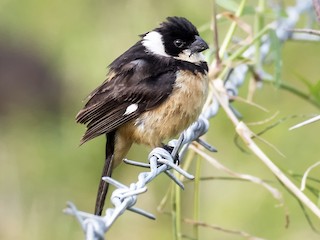
How to identify the White-collared Seedeater
Sporophila torqueola
Spotted a bird? Identify it instantly with the Birdby app
Open the appTo correctly identify the White-collared Seedeater (Sporophila torqueola), check each of these features. Birds can be tricky: habit, habitat, and call often confirm a sighting that a single photo cannot.
Size at a glance
- Length
- 10-11 cm
- Wingspan
- 14-16 cm
- Weight
- 8.5-12 g
Physical features to check
- 1
Plumage
Overall feather coloration and pattern.
Adult males display a striking pattern: black head, back, wings, and tail, with a prominent white collar extending from the nape around the sides of the neck, and a white chin and throat patch. The underparts are mostly white, sometimes with a buff or yellowish wash, especially on the flanks. A small white alar speculum is visible on the wings. Females are uniformly dull olive-brown above, paler and buffier below, with no distinct markings. Some females might show faint streaking on the breast or a slight buffy wash on the throat. Juveniles resemble females closely, but young males may show hints of black in their plumage as they mature.
- 2
Beak shape
Shape and color of the bill: a key field mark.
Conical and stout, adapted for crushing seeds. Color varies from black in breeding males to horn-colored or yellowish in females and non-breeding males.
- 3
Eye color
Iris color and any distinctive eye markings.
Dark brown.
- 4
Leg color
Leg and foot color.
Dark gray to blackish.
- 5
Distinguishing features
Standout features that separate this species.
Males are unmistakable due to the prominent white collar. Females are much harder to identify and require careful observation, often distinguished by shape, size, and association with males or by their unique calls.
- 6
Juvenile appearance
How young birds differ from adults.
Juveniles are similar to adult females, overall olive-brown with paler underparts. Young males gradually acquire adult male plumage through molts, showing patchy black and white areas.
- 7
Seasonal changes
Plumage variation between breeding and non-breeding seasons.
Males exhibit slightly duller plumage outside the breeding season, with some variation in bill color. Their black areas may appear less intensely black and the white less pristine. However, the overall pattern remains distinctive. Females show minimal seasonal variation.
- 8
Sexual dimorphism
How males and females differ.
Strong; males are black and white, females are olive-brown.
Key field marks
- Male Plumage. Look for the distinct white collar separating the black head from the black back, and the prominent white chin and throat. This pattern is unique among seedeaters in its range.
- Female/Juvenile Plumage. Identifying females and juveniles is challenging. Look for a small, dull olive-brown bird with a conical bill in appropriate habitat. Association with a known male White-collared Seedeater can be a strong clue. Pay attention to soft calls and overall behavior.
- Song. Learn the male's melodious and warbling song. It is often the first way to detect this species, especially in dense grassy habitats where they can be hard to spot.
- Habitat Preference. They prefer open, grassy areas with seeding plants. Searching in these specific habitats increases the chances of encountering them.
- Behavior. Watch for small birds foraging on grass seeds, typically low to the ground or clinging to grass stalks. Their active, flitting movements can be characteristic.
Explore the White-collared Seedeater
Identify birds anywhere
Free on iOS, Android, and Web. Photo & sound identification, full species database, and your personal life list.