
Spotted a bird? Identify it instantly with the Birdby app
Open the appAbout
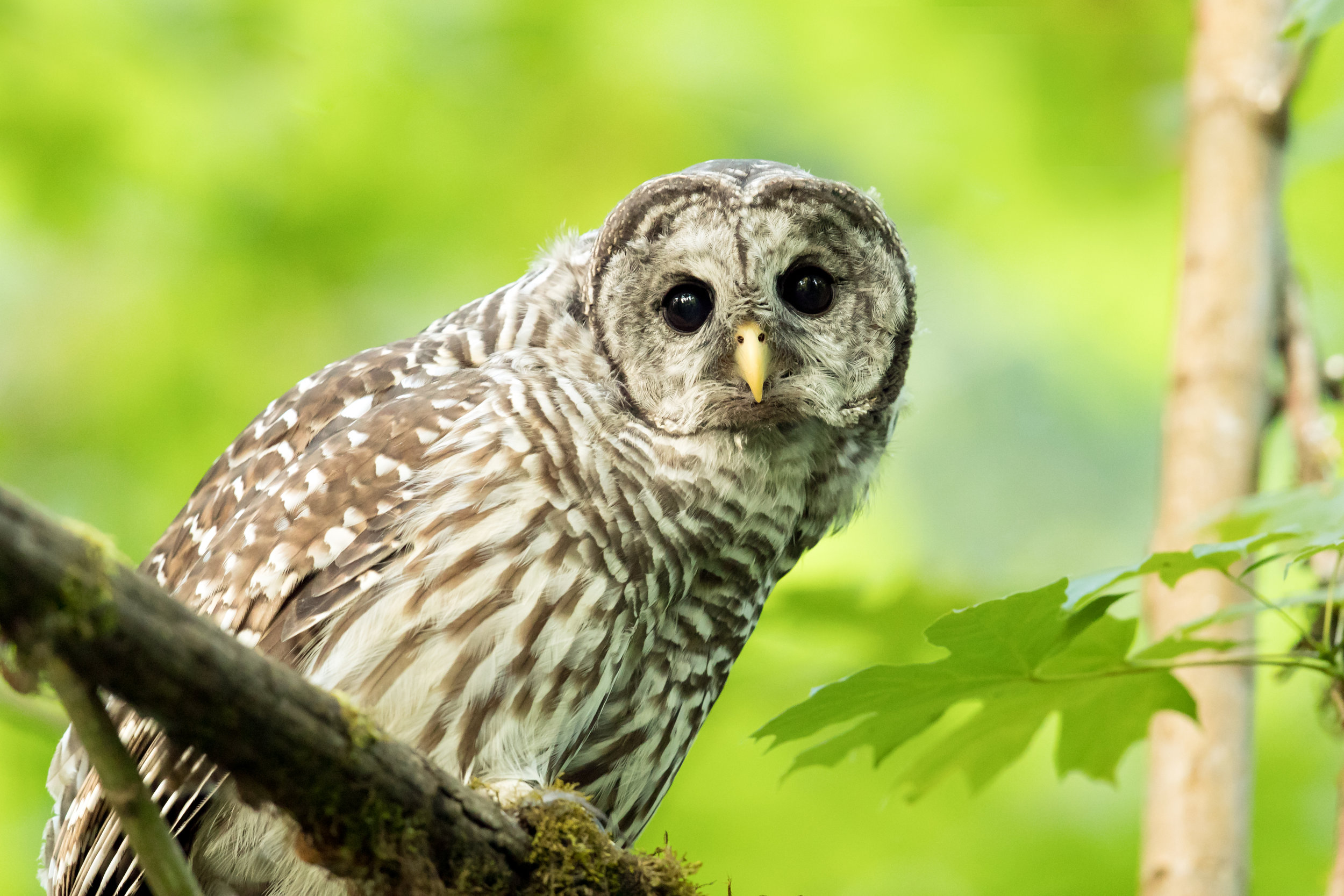
The Barred Owl is a large, stocky owl native to eastern North America, known for its distinctive 'who cooks for you?' call. It is characterized by its round head, dark eyes, and barred plumage, lacking ear tufts. This species is primarily nocturnal but often active during the day, especially at dawn and dusk.
Size & lifespan
- Length
- 40-63 cm (16-25 in)
- Wingspan
- 99-125 cm (39-49 in)
- Weight
- 500-1070 g (1.1-2.4 lbs)
- Lifespan
- Up to 10 years in the wild, over 20 years in captivity.
- Diet
- Carnivore
Physical characteristics
- Plumage
- Adults have mottled brown and white plumage. The underparts are vertically streaked (barred) with brown on a white background, while the upperparts are horizontally barred. The breast is horizontally barred, giving the species its common name. The back and wings are mottled brown and white. There is no significant seasonal change in plumage.
- Beak shape
- Short, strongly hooked, and dark yellowish to greenish-yellow.
- Eye color
- Dark brown to black, giving a gentle, soulful appearance, a key distinguishing feature from most other North American owls which have yellow eyes.
- Leg color
- Feathered to the talons, which are dark.
- Distinguishing features
- Large, round head without ear tufts; dark brown eyes; distinctive horizontal barring on the breast and vertical streaking on the belly; yellowish beak. The facial disc is prominent and pale with concentric brown rings.
- Juvenile appearance
- Juveniles resemble adults but may have softer, fluffier plumage and less distinct barring. They acquire adult plumage within their first year.
- Seasonal changes
- No significant seasonal changes in plumage.
- Sexual dimorphism
- Females are typically larger and heavier than males, but plumage is identical.
How to identify
- 1
Eyes
Look for large, dark brown to black eyes. This is the most reliable field mark to distinguish it from most other North American owls with yellow eyes.
- 2
Head Shape
Observe the large, round head with no visible ear tufts.
- 3
Plumage Pattern
Note the horizontal barring on the breast and the vertical streaking on the belly. The back and wings are mottled brown and white.
- 4
Vocalization
Listen for the distinctive 'Who cooks for you? Who cooks for you all?' hooting call. This is often the easiest way to detect their presence.
- 5
Habitat
They are typically found in dense, mature forests, especially near water. If you're in such an environment, keep an eye out.
Habitat & range
- Biomes
- Temperate forests, boreal forests, swamps, riparian woodlands.
- Geographic range
- Primarily eastern North America, extending from southeastern Canada south through the eastern United States to Florida and west to Texas. In recent decades, its range has expanded westward into the Pacific Northwest, often displacing Spotted Owls (Strix occidentalis).
- Elevation range
- Sea level up to approximately 2,500 meters (8,200 feet), though most common in lower to mid-elevations.
- Preferred environments
- Mature, dense forests with a mix of deciduous and coniferous trees, often near water sources such as rivers, swamps, or lakes. They require large trees for nesting and roosting, and an open understory for hunting.
Behavior
- Activity time
- Primarily nocturnal and crepuscular (active at dawn and dusk), but frequently seen and heard during daylight hours.
- Feeding habits
- Primarily a nocturnal hunter, but often hunts during the day, especially at dawn and dusk, or on cloudy days. They are opportunistic predators, preying on small mammals (voles, mice, squirrels, rabbits), birds (including other owls), amphibians, reptiles, and invertebrates. They hunt from a perch, swooping down silently to capture prey with their powerful talons.
- Social behavior
- Generally solitary or found in pairs, especially during the breeding season. They are territorial.
- Flight pattern
- Silent, buoyant flight with deep, powerful wing beats. They often glide through the forest canopy.
- Migration pattern
- Mostly resident throughout their range, though some northern populations may make short-distance movements in harsh winters or in response to prey scarcity (irruptions).
- Territoriality
- Highly territorial, especially around nesting and roosting sites. They defend their territory through vocalizations and occasional aggressive displays.
Song & calls
- Song
- The most characteristic call is a series of eight to nine hooted notes, often described mnemonically as 'Who cooks for you? Who cooks for you all?' The call is resonant and often ends with a downward inflection.
- Call
- In addition to the primary hooting call, Barred Owls produce a variety of other vocalizations, including barks, gurgles, cackles, and a loud, piercing 'scream' or 'monkey call,' particularly during courtship or when agitated. Pairs often engage in duets.
- When they vocalize
- Most vocal during the breeding season (late winter to early spring) and at night, but can be heard at any time of day, especially at dawn and dusk.
Breeding & reproduction
- Breeding season
- Typically late winter to early spring (February to April), with eggs laid in March or April.
- Nesting habits
- They do not build their own nests. They prefer to nest in large tree cavities, broken-off snags, or sometimes in abandoned stick nests of other large birds (e.g., hawks, crows). They often reuse nest sites year after year.
- Clutch size
- 2-4 eggs.
- Egg description
- 2-4 (occasionally 1-5) dull white, rounded eggs, typically laid at intervals of 2-4 days.
- Incubation period
- 28-33 days, primarily by the female.
- Fledging period
- Young owls fledge (leave the nest) at about 4-5 weeks of age, but remain dependent on their parents for several more weeks, often up to 4 months.
- Parental care
- Both parents care for the young. The female incubates and broods, while the male provides food. After hatching, both parents hunt and feed the owlets.
Where to find
Mature Forests
Look in old-growth or mature deciduous and mixed forests with large trees for nesting and roosting.
Riparian Areas
Areas along rivers, streams, and swamps are prime habitats due to abundant prey and suitable nesting sites.
Wooded Parks and Suburbs
In some areas, they have adapted to suburban environments with large, mature trees and sufficient green space.
Field tips
- Listen for Calls. The Barred Owl's distinctive call is often heard at dawn, dusk, or throughout the night. Learning this call is crucial for identification.
- Look for Roosting Sites. During the day, they often roost quietly in dense foliage close to the trunk of a large tree. Look for whitewash (droppings) or pellets on the ground beneath potential roosts.
- Scan for Movement. Despite being nocturnal, they are often active during the day. Look for movement in the canopy or listen for alarm calls from smaller birds, which might indicate an owl's presence.
- Use Playback Sparingly. While playing their call can elicit a response, use it very sparingly and ethically, as it can stress the birds.
Similar species
Spotted Owl
Strix occidentalis
The Barred Owl's range has expanded into that of the Spotted Owl. Key differences: Barred Owls have dark eyes and vertical streaking on the belly, while Spotted Owls have yellow eyes and horizontal barring on the belly. Barred Owls are generally larger and more aggressive. Their calls are also distinct.
Great Horned Owl
Bubo virginianus
Great Horned Owls have prominent ear tufts and yellow eyes, whereas Barred Owls lack ear tufts and have dark eyes. Great Horned Owls have a more robust build and a deeper, more rhythmic hooting call ('hoo-hoo-hoo-hooo-hoo').
Quick facts
- Call:
- 'Who cooks for you? Who cooks for you all?'
- Eyes:
- Dark brown/black
- Ear Tufts:
- Absent
- Diet:
- Small mammals, birds, amphibians, reptiles
- Habitat:
- Dense, mature forests near water
Fun facts
- Barred Owls are one of the few owl species in North America with dark eyes, giving them a 'gentle' appearance compared to the fierce yellow-eyed owls.
- Their westward range expansion is a significant ecological event, leading to competition and hybridization with the federally threatened Spotted Owl.
- They are known to be quite curious and sometimes approach humans, especially if they are mimicking their calls.
- Despite their nocturnal reputation, Barred Owls are frequently seen hunting during daylight hours, particularly on overcast days or in dense, shaded forests.
Scientific classification
- Kingdom
- Animalia
- Phylum
- Chordata
- Class
- Aves
- Order
- Strigiformes
- Family
- Strigidae
- Genus
- Strix
- Species
- Strix varia
Explore the Barred Owl
Identify birds anywhere
Free on iOS, Android, and Web. Photo & sound identification, full species database, and your personal life list.